If you run a bowling center, FEC, axe throwing venue, or any multi-activity entertainment concept, you've probably seen both Rex and ROLLER on your shortlist. They're the two names that keep coming up when operators search for venue booking software.
But they're built for different operators, at different price points, with fundamentally different philosophies about what venue software should do. This guide breaks down exactly where each platform wins, where it falls short, and which one fits your business.
The 30-Second Version
Rex is a venue booking and reservation platform built for activity-based entertainment. It focuses on online reservations, party packages, memberships, add-on upsells, and venue scheduling. Flat-rate pricing per location with no transaction fees. Built for venues of any size — from single locations to multi-location brands like Triple Shift Entertainment (26 locations) and Punch Bowl Social (14 venues) — that want deep booking flexibility without paying enterprise prices.
ROLLER is a full-stack venue management platform covering POS, ticketing, online booking, memberships, waivers, F&B ordering, cashless cards, and analytics. Backed by $50M in funding with 3,000+ venues. Best for larger venues or chains that want an all-in-one system and are willing to pay for it.
The core difference: Rex gives you best-in-class booking with strategic integrations. ROLLER gives you everything in one box. Which approach works depends on your venue's size, complexity, and budget.
Who Each Platform Is Built For
Rex's Sweet Spot
- Multi-activity entertainment venues — bowling + golf sims + axe throwing + karaoke under one roof
- Multi-location operators — single locations to large multi-location brands that need booking flexibility without enterprise overhead
- Venues that already have a POS — Rex integrates with GoTab, Tripleseat, and Stripe rather than replacing your existing stack
- Operators who iterate fast — change packages, pricing, and promotions instantly without support tickets
ROLLER's Sweet Spot
- Large-scale attractions — trampoline parks, water parks, FECs with 50,000+ visitors annually
- Venues wanting a single vendor — POS, booking, waivers, F&B, and payments all in one system
- Multi-location brands — both platforms support multiple locations, but Rex includes multi-location management out of the box on every plan. ROLLER charges extra for an "HQ" feature to get centralized control.
- Venues with heavy walk-in traffic — ROLLER's POS and ticketing focus handles high-throughput gate admission
Feature Comparison
Online Booking and Checkout
Both platforms offer online booking, but the approach differs significantly.
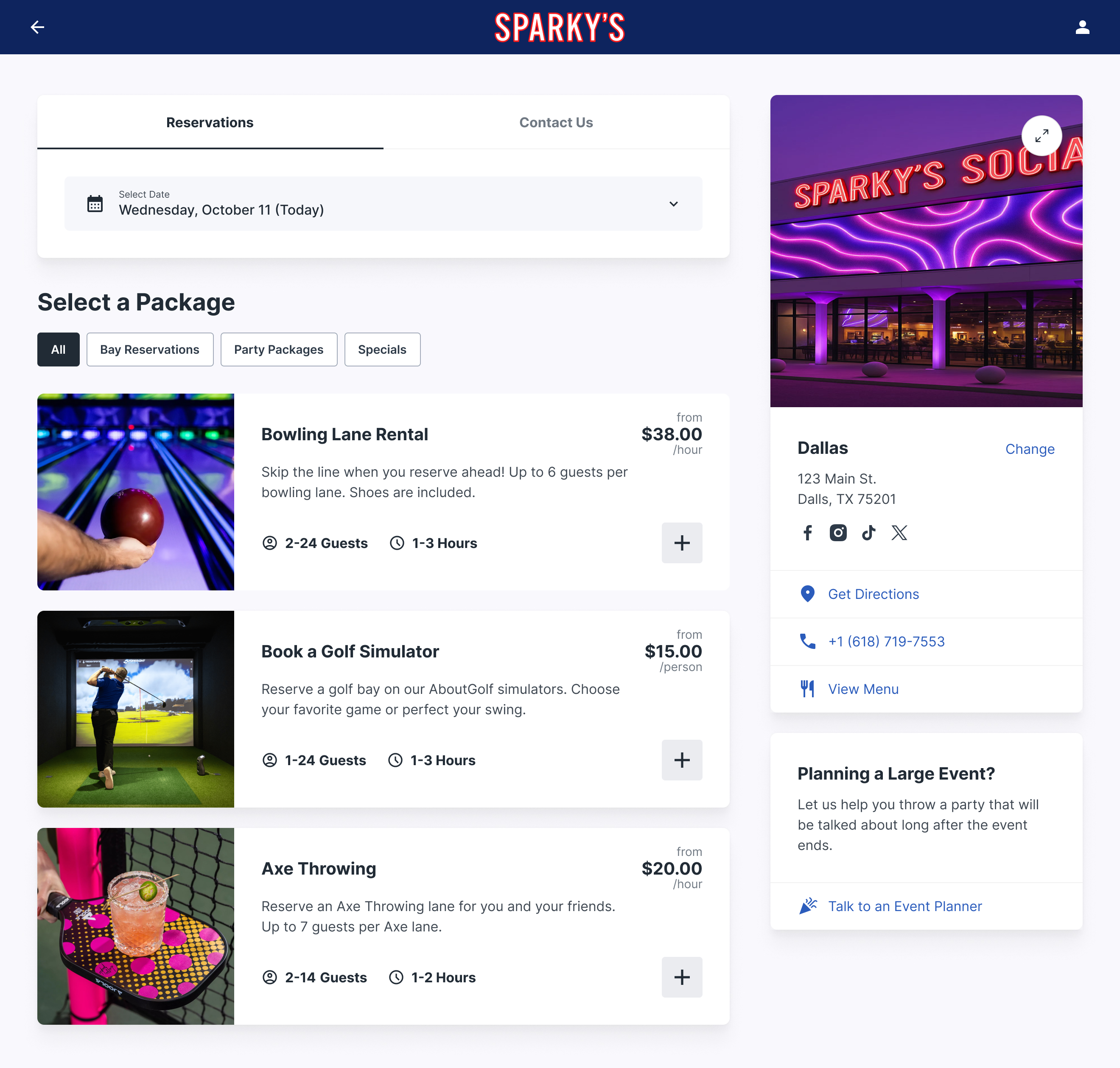
Rex's checkout is designed specifically for activity-based bookings — lanes, bays, courts, and rooms. Operators can build complex multi-activity packages (bowling + food + arcade credits), set dynamic pricing by time slot, and offer add-on upsells during the booking flow. The guest-facing checkout is branded and embeds directly into your website. Atomic Golf tested 9 different package configurations, narrowed to 3, and went from $2,000/day to $30,000/day in online bookings — that kind of rapid experimentation is where Rex shines.
ROLLER's online checkout covers a broader scope — general admission tickets, timed sessions, party packages, memberships, and gift cards. It includes capacity management for gate-controlled attractions (think: trampoline parks with session limits). The checkout is polished but more standardized, with less granular control over activity-specific configurations.
Winner: Rex for activity-specific booking flexibility. ROLLER for high-volume ticketed attractions.
Party and Event Booking
Party packages are a major revenue driver for entertainment venues, and both platforms handle them — but Rex takes a different approach. Rex lets operators build tiered party packages with granular add-ons, custom pricing per guest count, and automated upsells. The Tripleseat integration syncs party inventory between your booking system and event CRM, so double-bookings don't happen.
ROLLER handles party bookings as part of its broader package system. It works well for standard party flows but has historically been less flexible for complex, multi-activity party configurations.
Winner: Rex, especially for venues that use Tripleseat for event management.
Point of Sale (POS)
This is ROLLER's biggest structural advantage. ROLLER includes a full POS system — terminals, kitchen display integration, cash drawers, tab management, tipping, and till reconciliation. If you're opening a new venue and want one vendor for everything, ROLLER's POS eliminates the need for Toast, Square, or any standalone system.
Rex deliberately does not build a POS. Instead, it integrates with best-in-class POS partners like GoTab. The philosophy: let venues keep the POS that works for their F&B operation, and Rex handles the booking and revenue layer on top. This means less vendor lock-in, but it requires managing two systems.
Winner: ROLLER if you want a single system. Rex if you already have a POS you like.
Memberships
Both platforms offer membership management with recurring billing, member perks, and usage tracking. ROLLER adds membership agreements and advanced dunning (payment recovery) on higher tiers. Rex's membership module is newer but covers the core needs — flexible cycles, automatic billing, and member-specific pricing.
Winner: Tie. ROLLER has more mature membership features. Rex covers what most venues need.
Analytics and Reporting
ROLLER includes built-in analytics, detailed reports, scheduled reports, and accrual accounting on higher tiers. It also supports Meta/TikTok Pixel and Google Tag Manager natively.
Rex provides revenue attribution and reporting within its dashboard, plus Stripe integration for payment analytics. For marketing attribution, Rex works with standard UTM tracking and Google Analytics.
Winner: ROLLER for built-in reporting depth. Rex is adequate for most operators, especially when combined with Stripe's dashboard.
Integrations
Rex's integration strategy is a key differentiator. The Tripleseat integration for party/event CRM, GoTab for POS/F&B, Stripe for payments, and scoring system integrations (Steltronic, aboutGOLF) mean Rex plays well with your existing tech stack.
ROLLER also offers integrations and APIs/webhooks, but its model leans more toward replacing your existing tools than connecting with them. Advanced integrations (workforce management, gate access control, advanced inventory) are reserved for higher pricing tiers.
Winner: Rex for integration flexibility. ROLLER if you prefer fewer vendors.
Pricing
This is where the decision gets real for most operators.
Rex Pricing
- Core — $195/location/mo — Unlimited reservations, activities, add-ons, Stripe payments
- Pro — $295/location/mo — Multi-activity bookings, custom checkout, revenue attribution, digital waivers
- Growth — $395/location/mo — POS integrations, premium integrations, custom domain, discovery network
- Enterprise — Contact us — Custom pricing for large or complex venues
No transaction fees. No per-booking charges. Flat rate.
ROLLER Pricing
ROLLER doesn't publish exact pricing on their website. They offer four tiers — Lite, Pro, Premium, and Enterprise. Based on industry data, ROLLER's pricing starts around $900/month for roughly the same feature set that comes in Rex's $295/month Pro plan. Add-ons and per-device POS licensing push the total higher for most venues.
Key pricing differences:
- Transaction fees — ROLLER charges per-booking fees on certain plans. Rex charges zero.
- Feature gating — ROLLER locks features like mobile F&B ordering, custom checkout domains, and advanced integrations behind higher tiers. Rex includes more features at lower tiers.
- POS licensing — ROLLER includes POS device licenses (2 on Lite, 6 on Pro, 10 on Premium, unlimited on Enterprise). This is a real cost savings if you'd otherwise buy a standalone POS.
For a 3-location bowling and entertainment venue on Rex Pro, you're looking at roughly $885/month. The equivalent ROLLER tier with similar functionality is likely $1,500–$2,500+/month — though it includes POS, which you'd need to source separately with Rex.
Winner: Rex on pricing, full stop. At $295/month for Pro, you get the same core features ROLLER charges around $900/month for — plus Rex includes multi-location management without an extra "HQ" fee. ROLLER's all-in-one POS can offset some costs if it replaces your existing system, but for most venues the math isn't close.


Where Rex Wins
- Booking flexibility — More configuration options for packages, pricing, and multi-activity setups than any competitor
- Speed of changes — Operators adjust packages, pricing, and promotions instantly from the admin dashboard. No support tickets, no waiting.
- No transaction fees — Flat-rate pricing means your costs don't increase as your bookings grow
- Integration-first approach — Works with your existing POS, CRM, and payment systems rather than forcing you to rip and replace
- Shipping speed — Small team that ships features fast. Customers like FatCats and Punch Bowl Social cite Rex's responsiveness as a key reason they stay.
Where ROLLER Wins
- All-in-one platform — POS, booking, waivers, payments, F&B, analytics in one system. Fewer vendors, fewer integrations to manage.
- All-in-one breadth on the Enterprise tier — HQ management for large chains, unlimited POS licenses on Enterprise, dedicated CSM
- Walk-in and ticketed attractions — Capacity management, gate access control, and cashless cards are built for high-throughput venues
- Market presence — 3,000+ venues and $50M in funding means a larger support team and more resources
The Real Question to Ask Yourself
The Rex vs ROLLER decision usually comes down to two questions:
Do you want an all-in-one platform or best-of-breed tools?
If you want one vendor for everything — POS, booking, waivers, F&B — ROLLER is the play. If you already have a POS you like (or prefer choosing best-in-class tools for each function), Rex gives you a stronger booking layer that integrates with your stack.
What’s your budget reality?
For a venue doing $500K–$3M in annual revenue, Rex at $295/month delivers comparable or better functionality to ROLLER's ~$900/month tier. That's a $600+/month difference before accounting for ROLLER's add-on fees for features like HQ multi-location management that Rex includes standard. At larger revenue levels, Rex's Enterprise tier scales to support chains like Triple Shift Entertainment (26 locations) and Punch Bowl Social (14 venues) without the per-transaction drag.
Frequently Asked Questions
Can I switch from ROLLER to Rex (or vice versa) without losing data?
Yes, but plan for a transition period. Both platforms can import customer and booking data, though the process isn't instant. Most venues run both systems in parallel for 2–4 weeks during migration. Rex's onboarding team handles the setup and data transfer.
Does Rex work for venues with no food and beverage operation?
Absolutely. Rex is booking-first, so venues without F&B (pure axe throwing, golf sim studios, pickleball courts) work perfectly. You won't pay for POS features you don't need.
Is ROLLER overkill for a single-location venue?
It depends on the venue's complexity. A single-location trampoline park doing 100,000+ visitors per year might benefit from ROLLER's ticketing and capacity tools. A single-location bowling center with 12 lanes probably doesn't need — or want to pay for — ROLLER's full platform.
Does Rex charge transaction fees?
No. Rex charges a flat monthly rate per location. No per-booking fees, no percentage of sales, no hidden charges. Standard Stripe payment processing fees still apply (those are Stripe's fees, not Rex's).
Can Rex handle 10+ locations?
Yes. FatCats runs 10 locations on Rex, and Punch Bowl Social manages multi-activity reservations across their portfolio. Rex's Enterprise tier is built for this.
Which platform has better customer support?
Rex is consistently praised for fast, responsive support from a team that actually builds the product. ROLLER has a larger support org with tiered access — phone support and dedicated CSMs are only available on higher plans. For most venues, Rex's support responsiveness is a meaningful differentiator.
Ready to See Rex in Action?
The best way to compare is to see both platforms with your own venue data. Book a demo with Rex to see how multi-activity booking, party packages, and integrations work for your specific setup. The demo is free, takes 15 minutes, and there's no commitment.
Related Articles
• Rex vs SevenRooms: Which Reservation Platform Fits Your Venue?
• Best Bowling Booking Systems in 2026
• How FatCats Scaled to 10 Locations on Rex
• How Atomic Golf 10x'd Their Bookings with Fewer Choices
• How to Increase Revenue Per Guest Without Raising Prices