Every week, thousands of people open Google and type "axe throwing near me," "bowling alley near me," or "things to do near me this weekend." These are high-intent, ready-to-book searches — and whoever shows up first wins the reservation. The question isn't whether local SEO matters for your entertainment venue. The question is whether you've done enough to show up when it counts.
Local SEO is the practice of optimizing your online presence so that your venue ranks prominently in location-based searches — both in Google Maps (the local pack) and in traditional organic results. Unlike national SEO, which is a slow, years-long game, local SEO has a tighter feedback loop. Changes you make this week can show up in search results within days. For activity-based entertainment venues that depend on guests within a 15–25 mile radius, local SEO is one of the highest-ROI marketing investments you can make.
This guide covers the five core levers of local SEO for entertainment venues: your Google Business Profile, your review strategy, local citations, on-page website optimization, and local backlinks. Get all five working together and your venue becomes nearly impossible to miss when someone nearby is searching for something fun to do.
What Local SEO Actually Means for Entertainment Venues
When someone searches "bowling alley near me," Google returns two types of results: the local pack (a map with three venue listings at the top of the page) and traditional blue-link organic results below it. The local pack captures the most clicks for local business searches — research consistently shows that the top three local pack results absorb 40–60% of total clicks for "near me" queries.
Your goal with local SEO is to appear in the local pack for the keywords your ICP actually searches. That means ranking for your specific activity type ("axe throwing," "mini golf," "go-kart track") combined with your city, neighborhood, or "near me" modifiers. For multi-activity venues, it means ranking across multiple activity keywords in the same geographic area — which compounds your visibility dramatically.
- Local pack ranking factors — Google uses three primary signals to determine local pack rankings: relevance (does your profile match the search?), proximity (how close is the venue to the searcher?), and prominence (how well-known and reviewed is your venue?). You can't control proximity, but you can control relevance and prominence significantly.
- Organic vs. local pack — the local pack and organic results are separate ranking systems. A venue can rank in the local pack without ranking organically, and vice versa. Optimizing for both gives you the most total surface area in search results.
- "Near me" is location-aware — Google doesn't show the same results to everyone. A user in downtown Miami searching "escape room near me" sees different results than a user in Coral Gables. Your local SEO work compounds in your actual geographic service area, not globally.
- Booking intent is high — people searching local entertainment keywords are usually ready to book. They've already decided they want to do something — they're choosing where. Your local SEO gets you into the consideration set at the highest-intent moment in the funnel.
Step 1: Claim and Fully Optimize Your Google Business Profile
Your Google Business Profile (GBP) is the single most important local SEO asset you control. It's what appears in Google Maps, in the local pack, and in the knowledge panel on the right side of Google Search when someone searches your venue name. Most entertainment venues have claimed their GBP but left 40–60% of the profile incomplete — and that incompleteness directly suppresses rankings.
The Fields That Actually Move Rankings
Google uses GBP completeness as a relevance signal. An incomplete profile tells Google you're less authoritative and less relevant than a competitor with a fully built-out listing.
- Business name — use your exact legal/operating name. No keyword stuffing ("Best Bowling Alley in Chicago - Pinz"). Google penalizes this and it erodes trust with guests.
- Primary and secondary categories — your primary category is the most important relevance signal in your profile. Choose the most specific category that fits (e.g., "Bowling Alley," "Laser Tag Center," "Escape Room Center"). Add secondary categories for every activity you offer — this expands the keyword surface area your profile matches.
- Business description — 200–750 characters. Include your primary keyword naturally in the first sentence. Describe your venue, activities, and who it's for. Don't keyword stuff — write for the guest, not the algorithm.
- Service area — if guests come to you, set your location precisely. Don't set a broad service area — it dilutes your proximity signal for your actual location.
- Hours — keep hours current, especially for holidays and special events. Google penalizes profiles with outdated hours by surfacing them less frequently.
- Attributes — GBP offers attributes like "family-friendly," "good for groups," "wheelchair accessible," "LGBTQ+ friendly." Select every applicable attribute. These match your profile to filtered searches.
- Photos and videos — profiles with 100+ photos get significantly more views and direction requests than profiles with fewer. Upload high-quality action shots, event photos, venue walk-throughs, food and drink if applicable. Aim for at least 30 photos to start, then add monthly.
- Products and services — list every activity, package, and event type as a service or product. Include pricing where possible. This feeds directly into Google's ability to match your profile to specific search queries.
- Q&A section — Google allows anyone to ask questions and anyone to answer. Proactively add your own questions and answers covering common queries: "Do you accept walk-ins?", "What's the minimum age?", "Can you host a birthday party?" This both answers guest questions and seeds your profile with more relevant text.
Google Posts: The Underused Feature That Drives Bookings
Google Posts are short updates (150–300 words) that appear directly on your GBP listing. Most venues don't use them. The ones that do consistently report higher click-through rates and more direct conversions from their GBP.
Post types to use regularly:
- Offer posts — limited-time promotions, early-bird pricing, birthday month discounts. Include a photo and a direct link to your booking page. These show up prominently in the local pack and give searchers a reason to click.
- Event posts — upcoming league nights, themed events, corporate packages, holiday specials. Events can appear in Google's event discovery results in addition to your GBP.
- Update posts — new activities, seasonal hours, new menu items, renovations. Signals to Google (and guests) that your venue is active and current.
Cadence: at least one post per week keeps your profile active. Google weighs recency — a profile with weekly posts ranks better than a dormant one.
Step 2: Build Your Review Velocity and Respond to Every Review
Reviews are both a ranking signal and a conversion driver. Google uses your review count, average rating, and recency to determine local pack rankings. Guests use the same data to decide whether to book. Building review velocity — a steady stream of new reviews — is one of the highest-impact things you can do for local SEO.
The basics on review generation: ask at the right moment (30–60 minutes after the visit, not at the door), use direct links that skip the friction of finding your profile, and build the ask into automated post-visit email or SMS flows so it happens without manual effort.
For a deeper breakdown of review generation strategy — including timing, channel-by-channel tactics, and how to handle negative reviews — read our full guide on
For a complete review generation strategy — including timing, channel-by-channel tactics, and how to handle negative reviews — see our guide on how to get more Google reviews for your entertainment venue.
The local SEO piece specific to reviews:
- Review velocity matters as much as total count — a venue with 200 reviews and 10 new reviews per month ranks better than a venue with 400 reviews and no new reviews in six months. Recency signals an active, quality business to Google.
- Review text influences keyword ranking — when guests write reviews mentioning "birthday party," "corporate event," "date night," or specific activities, Google reads that text and uses it as a relevance signal. The more keyword-rich your review corpus, the broader the keyword surface area your GBP matches.
- Responding to reviews is a ranking signal — Google explicitly factors in whether business owners respond to reviews. Respond to every review — positive and negative — within 48 hours. Thank guests by name, mention the specific activity when relevant, and address concerns professionally and specifically in negative reviews.
- Never buy or incentivize reviews — Google penalizes this aggressively and can suspend your GBP entirely. The only ethical path is making it easy for genuinely happy guests to leave reviews. Volume comes from systems, not incentives.
Step 3: Keep Your NAP Consistent Across Every Directory
NAP stands for Name, Address, Phone Number — the three data points Google uses to verify that your venue exists at a specific location. When your NAP is inconsistent across directories and review sites, Google's confidence in your business data decreases, which suppresses local rankings.
Inconsistencies are more common than most operators realize. Your business may be listed as "Pinz Bowling" on your website, "Pinz Bowling Center" on Yelp, and "Pinz" on TripAdvisor. Your phone number might be formatted differently across listings. These small inconsistencies add up to a weaker local authority signal.
The directories that matter most for entertainment venues:
- Google Business Profile — the source of truth — match everything else to this.
- Yelp — still significant for entertainment venues, especially for discovery by guests who filter by category.
- TripAdvisor — critical for venues that attract tourists, out-of-town visitors, or event groups.
- Apple Maps — iPhone users access Apple Maps by default. Claim your listing at mapsconnect.apple.com.
- Facebook Business Page — used by Google as a cross-reference signal for business data validation.
- Foursquare — feeds data to dozens of downstream apps and directories. Keeping it accurate has a multiplier effect.
- Industry-specific directories — for entertainment venues: FunCity, Groupon (if you use it), ClassPass (if applicable), local chamber of commerce directory, and any regional "things to do" directories in your market.
Action: audit your top five directories against your GBP. Make sure name, address, phone, website URL, and hours match exactly. Then set a quarterly reminder to check for drift — directories sometimes update listings automatically with incorrect data.
Step 4: Optimize Your Website for Local Search
Your Google Business Profile is the front door for local search, but your website is what drives organic rankings and conversion. Optimizing your site for local search signals reinforces and amplifies your GBP — and captures guests who scroll past the local pack to organic results.
Location Pages and Homepage Optimization
If you operate a single location, your homepage should include your full NAP, a Google Maps embed, and your city/neighborhood in your title tag, H1, and first paragraph. Don't bury your location — it should be immediately clear where you are.
- Title tag — include your primary keyword and city: "Axe Throwing in Austin, TX | Hatchet House." Keep under 60 characters.
- Meta description — include city and primary keyword. Write for clicks: "Austin's top-rated axe throwing venue. Walk-ins welcome, parties our specialty. Book online in 2 minutes."
- H1 — your main page heading should include the primary keyword and location naturally: "Austin's Premier Axe Throwing Experience"
- First 100 words — mention your city and activity type in the opening paragraph. This is a strong on-page signal for local relevance.
- NAP in footer — your full name, address, and phone number in the footer of every page — formatted consistently with your GBP.
- Embedded Google Map — embed your Google Maps location directly on your contact or about page. This creates a hard link between your website and your GBP that Google values.
If you operate multiple locations, create a dedicated landing page for each one with unique, location-specific content. Don't duplicate the same page with just the city name swapped — Google penalizes thin duplicate content, and each market deserves specific content about what makes that location distinct.
Local Business Schema Markup
Schema markup is structured data you add to your website's HTML that tells Google explicitly what type of business you are, where you're located, and what you offer. It's invisible to guests but machine-readable by Google — and it's one of the clearest local relevance signals you can provide.
For entertainment venues, implement:
- LocalBusiness schema — or a more specific subtype like "EntertainmentBusiness," "SportsActivityLocation," or "AmusementCenter." Include name, address, phone, URL, opening hours, and geo coordinates.
- Event schema — for upcoming events, leagues, parties, or special programming. Events with schema markup can appear in Google's event discovery results — a free additional placement.
- FAQ schema — for pages with Q&A sections. FAQ schema generates rich results in Google Search (the expandable question/answer format), increasing your clickable surface area without a ranking improvement required.
- AggregateRating schema — if your site collects reviews or shows ratings, schema markup makes that rating visible in search results as stars — a major CTR booster.
Test your schema implementation with Google's Rich Results Test (search.google.com/test/rich-results) before deploying. Broken schema is worse than no schema.
Step 5: Build Local Backlinks and Community Presence
Backlinks from other websites are a general SEO ranking signal, but for local SEO, the geographic relevance of the linking site matters as much as its authority. A link from your city's local newspaper, a regional tourism board, or a popular neighborhood blog carries significant local authority weight — sometimes more than a link from a nationally known site that has no geographic connection to your market.
- Local press and media — pitch your venue opening, new activities, milestones, and events to local journalists. Local news sites almost always include a link when they cover a business story.
- Chamber of commerce and business associations — most chambers include member directories with links. If you're not a member, the link-building value alone often justifies the cost for a local business.
- Regional tourism and "things to do" sites — sites like Visit[CityName].com, your state's tourism board, and regional event aggregators often accept venue listings with backlinks. Many are free.
- Local bloggers and influencers — invite local lifestyle bloggers, family activity accounts, and "things to do in [city]" content creators for a complimentary visit in exchange for honest coverage. Not every post will link to you, but many will — and local influencer mentions also drive direct discovery.
- Sponsor local events and organizations — sponsoring local sports leagues, community events, or school fundraisers often includes a website mention or link. The link value compounds with the brand-building value.
- Partner with complementary local businesses — restaurants near your venue, hotels that host guests looking for activities, corporate event planners in your market — cross-linking partnerships with complementary businesses create mutual local authority benefits.
Local link building is slower than local citation work or GBP optimization, but it has an outsized long-term impact on both local pack rankings and organic rankings. Prioritize outreach consistently over several months rather than doing a burst and stopping.
How Rex Supports Your Local Marketing
Rex's booking platform helps your local SEO in ways that most operators don't think about. Every booking completed through Rex captures guest email and contact data — which becomes the audience for post-visit review requests. Rex's guest database lets you build the automated post-visit email flows that drive review velocity without manual effort. Guest data segmented by activity type also lets you send targeted promotions that fill slow nights — the same content you'd promote via Google Posts.
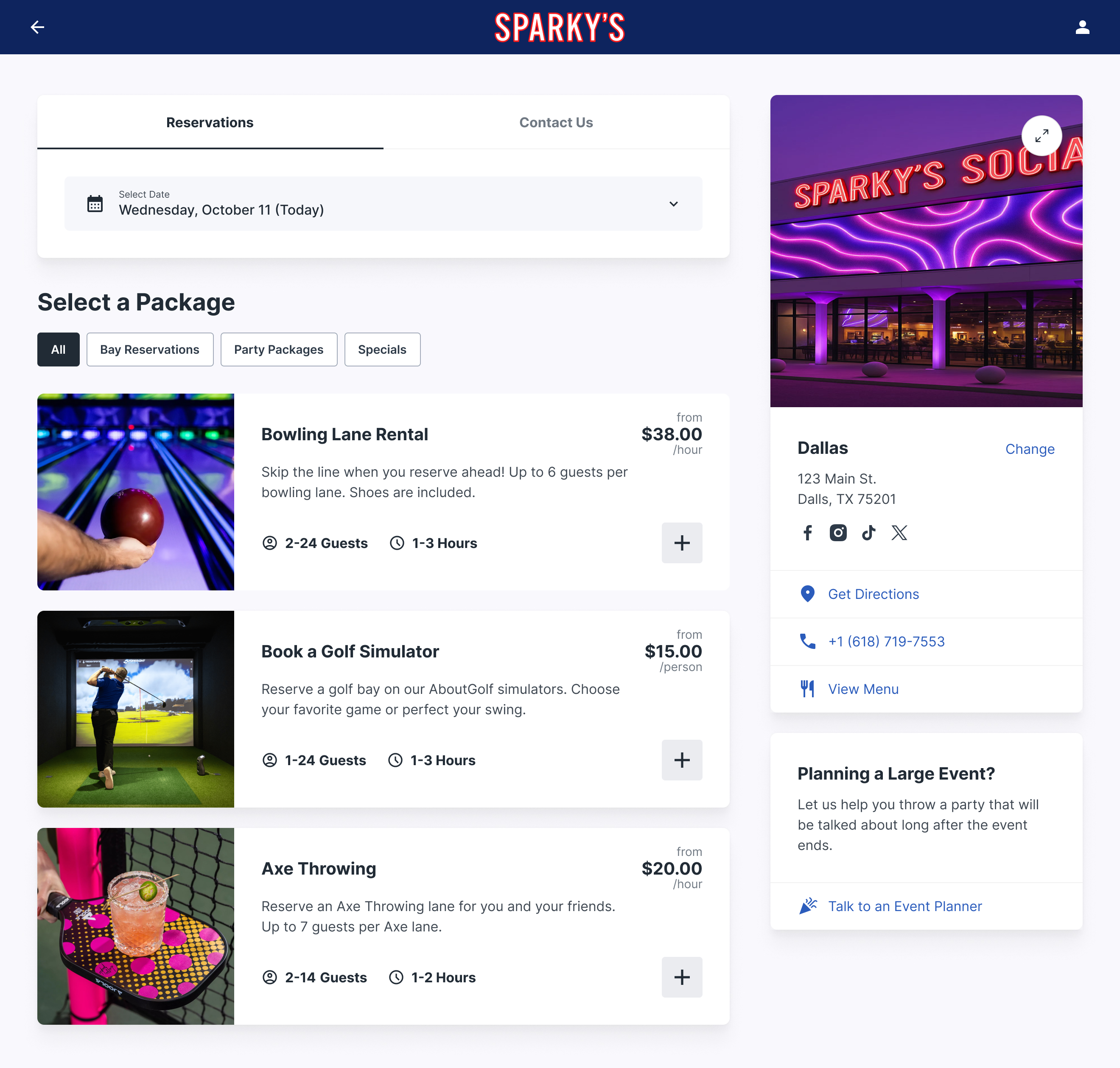
Rex also supports the online booking experience that converts your GBP clicks into actual reservations. When a guest taps "Book" on your Google Business Profile, they need a fast, mobile-optimized booking flow that gets them from intent to confirmation in under two minutes. A clunky booking experience is the single biggest gap between local search visibility and actual revenue. Rex's online reservation system is built specifically for entertainment venues — no generic tour-booking UX, no awkward workarounds for multi-activity venues.
For a broader look at the tech stack required to run a modern entertainment venue, see our guide: The New Venue Tech Stack: Every System You Need Before Opening Day.
Frequently Asked Questions
How long does local SEO take to show results for an entertainment venue?
Google Business Profile optimizations (categories, photos, posts) can show ranking improvements within 2–4 weeks. Review velocity improvements start showing up in rankings within 4–8 weeks as Google recalculates prominence. Website on-page changes take 4–8 weeks to be fully indexed and reflected. Full local SEO compounding — where all five levers are working together — typically produces significant ranking changes within 3–4 months.
What's the most important local SEO factor for entertainment venues?
Your Google Business Profile categories and review count/recency are the two highest-impact factors you can control. Getting your primary and secondary categories right determines which searches your profile is eligible to appear in. Review velocity and rating determine your prominence score, which determines how often you rank in the top three local pack positions. Fix categories first, then build review velocity.
Should I have a Google Business Profile for each activity or one for the whole venue?
One GBP per physical location, not per activity. If your venue offers bowling, axe throwing, and laser tag under one roof, that's one GBP — with all three activities listed as secondary categories. Creating multiple GBPs for the same address violates Google's guidelines and can result in all profiles being suspended. Exception: if you genuinely operate separate businesses at separate addresses, those get separate profiles.
Does social media affect my local SEO rankings?
Social media doesn't directly influence Google local pack rankings — Google has confirmed that social signals are not a ranking factor. However, social media affects local SEO indirectly in a few ways: your Facebook Business Page is a citation source that Google cross-references for business data validation, and viral social content sometimes generates local press coverage and backlinks that do carry ranking weight. Focus on GBP, reviews, and on-page optimization before investing heavily in social for SEO purposes.
What should I do if a competitor has more reviews than me?
Build systematic review velocity rather than trying to match their total count overnight. Implement a post-visit email and SMS sequence that asks every guest for a review within 30–60 minutes of departure. If you convert even 10–15% of your daily guests into reviewers, you'll close the gap within months and then sustain a velocity advantage. Focus on consistent improvement rather than the raw gap — Google values recent reviews, so a venue adding 50 new reviews per month will eventually outrank a venue with 500 total reviews and no recent additions.
How do I track whether my local SEO efforts are working?
Use Google Business Profile Insights (in your GBP dashboard) to track: searches (how many people found your profile), views (impressions in the local pack and search), and actions (clicks to website, calls, direction requests). Track each metric weekly and look for month-over-month growth. In Google Search Console, filter by location-based queries to see which keywords are driving impressions and clicks. Set a baseline now, before you start optimizing, so you have a clear before/after comparison.
Turn Local Search Visibility Into Bookings
Showing up in local search is only half the equation. The other half is converting that visibility into actual reservations. You need a booking experience that's fast, mobile-optimized, and built for the way entertainment venues actually sell — sessions, lanes, bays, parties, and events, not generic time slots.
Rex is the online reservation system built specifically for entertainment venues. Axe throwing, bowling, golf simulators, escape rooms, go-karts, pickleball — Rex handles multi-activity booking complexity that generic tour software can't. See how Rex works or book a 20-minute demo to see how venues like yours use Rex to capture local search demand and convert it into revenue.