When you're evaluating booking and management software for an entertainment or activity venue, Mindbody often shows up in the research phase. It's everywhere in the fitness world — yoga studios, gyms, personal training businesses — and it has made moves into activity booking for wellness-adjacent experiences. But fitness management software and entertainment venue software are solving fundamentally different problems.
Mindbody was built for class-based fitness businesses: scheduling instructors, managing memberships by attendance credit, running front-desk check-ins, and processing retail sales. Rex was built for activity venues where the inventory isn't a class seat but a bowling lane, golf simulator bay, escape room, or axe throwing lane that needs to be managed in real time, tied to F&B, and scaled across multiple locations.
This comparison breaks down where Mindbody wins, where Rex wins, and which type of venue operator should choose which platform.
Platform Overview: How Rex and Mindbody Approach Booking
What Is Mindbody?
Mindbody is a business management platform originally built for fitness, wellness, and beauty businesses. It launched in 2001 and became the dominant software in the yoga studio, gym, and personal training space. In recent years, Mindbody has expanded into "experience" and "activity" booking through its Mindbody Business product and the acquisition of Booker (for salons and spas).
Mindbody's core architecture is class-based: a schedule with slots, an instructor or staff member attached to each slot, and a client who reserves a spot. Memberships are credit-based or visit-based. Revenue flows through class packages and monthly membership billing. The platform is excellent at what it was built for — but that foundation doesn't map well to venue-type businesses with physical inventory like lanes, bays, or rooms.
Pricing is per-location with multiple tiers. Mindbody charges a monthly fee plus a percentage on bookings made through the Mindbody marketplace app, which creates an additional cost layer for any booking that flows through their consumer discovery platform.
What Is Rex?
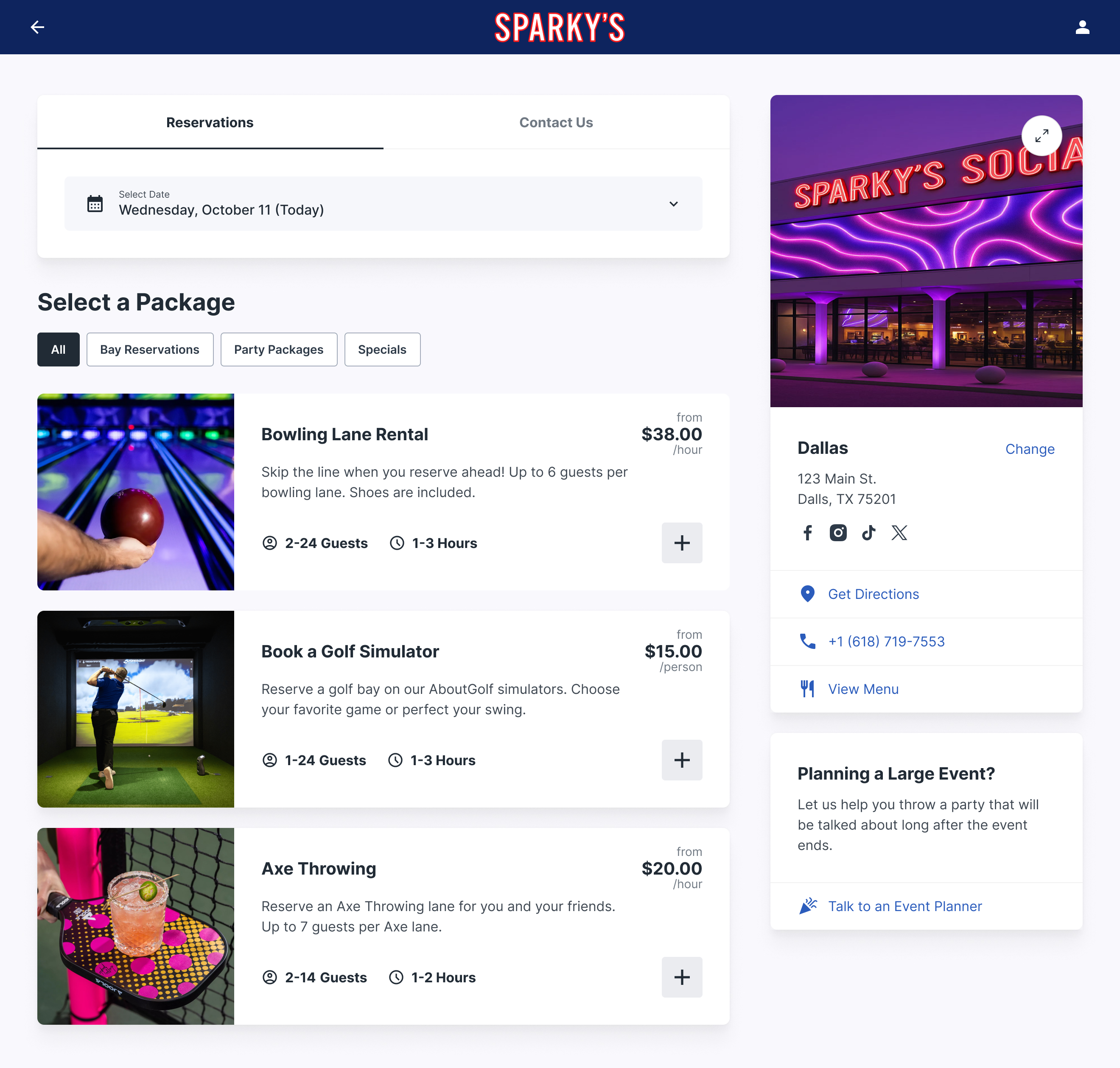
Rex is a venue management and reservation platform built specifically for multi-activity entertainment businesses. Bowling centers, golf simulators, escape rooms, axe throwing venues, trampoline parks, go-kart facilities, and eatertainment concepts all use Rex to manage lane or bay inventory, handle party and corporate bookings, run memberships, and integrate with F&B and event sales systems.
Rex's architecture is resource-first: physical inventory (lanes, bays, courts, rooms) is the primary object being managed. Reservations are tied to a specific resource, availability is tracked in real time across all inventory, and the system prevents double-booking at the resource level. That's architecturally different from class management software where the constraint is seat count in a room, not individual physical assets.
Rex is used by enterprise-scale entertainment groups — FatCats, Punch Bowl Social, Lucky Strike, Splitsville — as well as independent venues. Pricing is flat-rate per location, with no percentage taken on booking volume.
Feature Comparison: Rex vs Mindbody

Where Mindbody Wins
Fitness and Wellness Businesses
Mindbody is genuinely excellent for yoga studios, gyms, Pilates studios, climbing gyms with a heavy class program, and personal training businesses. The class scheduling interface, instructor management, and attendance tracking are purpose-built for this use case. If your primary revenue model is selling class packages or memberships to recurring fitness customers, Mindbody has 20+ years of refinement in this workflow.
Consumer Marketplace Discovery
The Mindbody app has tens of millions of downloads and is how a large portion of fitness consumers discover new studios. Rex matches this with its ClassPass integration — surfacing your venue's bookable activities to ClassPass's large consumer base and giving you a comparable discovery platform for reaching new guests. Combined with how entertainment guests already find you — searching Google, visiting your site directly, and word-of-mouth referrals — consumer discovery is no longer a Mindbody-only advantage.
Credit and Visit-Based Memberships
Mindbody's membership model is purpose-built for the fitness industry's "class credits" concept: a member buys a 10-class pack or an unlimited monthly pass, and each check-in draws down their credit balance. This model is standard in yoga and fitness but unusual in entertainment venues, where memberships typically give recurring access or discounts rather than credits. If your venue runs a fitness-style credit membership, Mindbody handles this natively.
Salon and Spa Add-Ons (via Booker)
For hybrid concepts that include a spa, salon, or beauty component alongside an activity offering, Mindbody's acquisition of Booker gives it staff scheduling and treatment booking capabilities. A wellness center that also offers yoga, infrared sauna, and massage therapy has a legitimate Mindbody use case.
Where Rex Wins
Lane and Bay Inventory Management
Managing 16 bowling lanes, 12 golf simulator bays, or 6 escape rooms is architecturally different from scheduling fitness classes. Every resource is a distinct physical asset that can only be in one booking at a time, needs real-time availability tracking, and requires the system to prevent double-booking across concurrent reservations. Rex was built for this. Mindbody was not — its constraint model is room capacity and class size, not individual physical resource inventory.
Party and Group Bookings
Private parties and group events are among the highest-revenue bookings at entertainment venues. Rex has built-in party booking flows — custom packages, deposit requirements, add-ons, and private area reservations all in one checkout. Mindbody can create bookings for groups, but the party workflow, package customization, and event-day management tools aren't built for the entertainment venue use case.
F&B Integration via GoTab
Rex integrates natively with GoTab, which means F&B ordering is tied directly to your reservation. A guest books four bowling lanes, and their GoTab tab opens automatically on check-in — all revenue flows against the same booking record. Mindbody has no equivalent F&B integration. For any venue where food and beverage is a meaningful revenue stream alongside activities, this is a meaningful gap.
Corporate Event Revenue via Tripleseat
Corporate team-building events and holiday party buyouts are among the highest-revenue single transactions entertainment venues close. Rex integrates with Tripleseat for corporate event sales — the sales pipeline, contract management, and venue calendar stay in sync. Mindbody has no comparable corporate event sales workflow.
Hardware Integrations
Rex's integration layer is built specifically for the entertainment venue tech stack:
Steltronic — automatic bowling scoring integrated with lane reservations
aboutGOLF — golf simulator hardware activated directly from the booking system
Tripleseat — corporate event CRM connected to venue calendar and booking
GoTab — F&B ordering linked directly to booking tab
Gift cards — supported natively and via integrations, tracked against bookings
Mindbody integrates with fitness-oriented hardware (wearables, heart rate monitors, attendance check-in kiosks) but has no equivalent entertainment venue hardware integrations.
Enterprise Multi-Location Scaling
Rex was built to manage dozens of locations under a single enterprise account — consistent pricing controls, centralized reporting, and multi-location staff management. FatCats (10+ locations), Punch Bowl Social, and Lucky Strike all operate at enterprise scale on Rex. Mindbody supports multi-location businesses as well, but its enterprise architecture is optimized for fitness chains, not multi-activity entertainment groups.
Rex vs Mindbody: Which Platform Fits Your Business?
Choose Mindbody if:
- You operate a fitness, yoga, Pilates, or wellness studio — Mindbody's class scheduling, instructor management, and attendance tracking are purpose-built for this model
- Consumer discovery via the Mindbody app is a real acquisition channel for your business
- Credit-based or visit-based memberships are your primary revenue model — Mindbody's credit system is built for this
- You run a hybrid wellness-fitness concept with massage, spa, or beauty services — Booker covers this alongside Mindbody's fitness tooling
- Activities are a minor add-on to a fitness-primary business — a gym that added a climbing wall or fitness classes to an existing studio
Choose Rex if:
- You run an entertainment venue with physical inventory to manage — bowling lanes, golf simulator bays, escape rooms, axe throwing lanes, go-kart tracks, or any activity with dedicated physical resources
- Party and group bookings are a significant revenue stream — Rex has built-in party packages, deposit management, and event-day operations
- F&B revenue sits alongside your activity revenue — GoTab integration ties food and drink directly to reservations
- Corporate events and buyouts are part of your business model — Tripleseat integration handles the sales-to-operations handoff
- You're scaling to multiple locations — Rex was built for enterprise entertainment group management
You're evaluating multiple platforms — Rex has dedicated comparison guides for ROLLER, Peek Pro, CenterEdge, and Checkfront to help you work through the comparison
Pricing: Rex vs Mindbody
Mindbody charges a monthly base fee that varies by tier, plus a percentage on bookings made through the Mindbody consumer marketplace app. The marketplace percentage creates a variable cost layer on top of your monthly fee — the more bookings flow through the Mindbody app, the higher your effective platform cost. For entertainment venues, this marketplace cost is largely irrelevant (most bookings come from direct traffic), but for a fitness studio where Mindbody app discovery drives a meaningful portion of new client acquisition, it's an important cost to model.
Rex charges a flat rate per location with no percentage taken on booking volume. Your platform cost is predictable regardless of how much revenue you process. For high-revenue entertainment venues, the flat-rate model becomes increasingly advantageous as booking volume grows — you're not paying a cut of every transaction.
When comparing total cost of ownership, factor in whether you'd need additional platforms alongside Mindbody to handle party booking management, corporate event sales, or F&B integration — Rex consolidates these in one platform.
Switching from Mindbody to Rex: What to Expect
The most common reason Mindbody customers move to Rex is opening or expanding into a venue format that Mindbody wasn't built for — adding a bowling lane to an existing fitness concept, launching an escape room, or building a multi-activity eatertainment venue where lane and bay inventory management is core.
Mindbody provides data export for client and booking history. Rex's onboarding team handles venue configuration — building out your resource inventory, configuring booking flows, and connecting integrations. The more complex your activity setup, the more value the structured onboarding process provides.
If you're launching a new venue rather than migrating an existing business, you skip the migration entirely — Rex is built to configure a new venue from scratch. For operators starting a rock climbing gym, VR entertainment center, or indoor activity venue, the configuration process typically takes two to four weeks depending on complexity.
See our guide on building a venue tech stack for a complete breakdown of every system you need before opening day.
Frequently Asked Questions
Can Mindbody handle bowling lanes or activity bay inventory?
Mindbody can create time-slot bookings, but its architecture is built around class capacity — not individual physical resource inventory. Managing 12 bowling lanes or 8 escape rooms requires a system that tracks each resource as a distinct bookable unit, prevents double-booking at the resource level, and updates availability in real time across concurrent reservations. Rex handles this as core infrastructure. Mindbody requires significant workarounds that don't scale as activity complexity grows.
Is Mindbody a good fit for a climbing gym or rock climbing facility?
It depends on whether your climbing gym is primarily class-based or open-climb-based. If you run structured climbing classes with instructors and a class-credit membership model, Mindbody works well. If your primary revenue is open climb sessions, day passes, and route-based bookings — or if you're adding party packages and corporate events — Rex handles that use case more cleanly. Many climbing gyms that are growing toward the eatertainment model (adding F&B, event spaces, corporate programs) find Rex a better fit as the operation matures.
How does Mindbody's pricing model compare to Rex?
Mindbody charges a monthly subscription fee plus a percentage on bookings made through the Mindbody consumer marketplace. Rex charges a flat rate per location with no percentage taken on booking volume. For entertainment venues where most bookings come directly from your website rather than a consumer discovery platform, Rex's flat-rate model typically produces a lower total cost as your booking volume grows. The right comparison is your projected monthly booking volume multiplied out against both cost structures.
Does Rex work for wellness or fitness businesses?
Rex is built for activity and entertainment venues — bowling, golf simulators, escape rooms, axe throwing, go-karts, trampoline parks, and similar physical inventory-based businesses. It handles memberships and recurring billing, but its membership model is access-based and discount-based, not class-credit based. Fitness studios, yoga centers, and wellness businesses with a class-schedule model should evaluate Mindbody. Rex is the stronger fit when activities, physical resources, and F&B are the revenue drivers.
What integrations does Rex have that Mindbody doesn't offer for entertainment venues?
Rex has purpose-built integrations for the entertainment venue tech stack: GoTab for F&B ordering tied to reservations, Tripleseat for corporate event sales pipeline management, Steltronic for automatic bowling scoring linked to lane assignments, aboutGOLF for golf simulator hardware activation from the booking system, and gift card support natively and via integrations. Mindbody's integrations are oriented toward fitness and wellness hardware and software. If your venue runs on any of the Rex-integrated systems, that's often the deciding factor.
Can Rex handle memberships the way Mindbody does?
Rex handles recurring membership billing — monthly fees, tiered access levels, member pricing, and access controls tied to membership status. What Rex doesn't have is Mindbody's specific class-credit and visit-based membership model where a member purchases a pack of classes or sessions and each visit draws down the balance. For entertainment venues where memberships give recurring access or discounts rather than class credits, Rex's membership system is more than sufficient. For fitness businesses where credit-based memberships are the core revenue model, Mindbody's system is more purpose-built.
Ready to See Rex in Action?
If you're building or running a multi-activity entertainment venue — and you've been evaluating Mindbody alongside purpose-built options — Rex handles the lane and bay inventory management, party booking, corporate events, and F&B integration that Mindbody wasn't designed for.
Book a demo with the Rex team to see how it handles your specific venue type and revenue model. No pressure — just a look at whether it fits.
Related Articles
Rex vs ROLLER: Which Venue Booking Platform Fits Your Business?
Rex vs Peek Pro: Which Venue Booking Platform Fits Your Business?
Rex vs CenterEdge: Which Venue Management Platform Fits Your Business?
Rex vs Checkfront: Which Booking Platform Fits Your Venue?
Rex vs Tock: Which Reservation Platform Fits Your Entertainment Venue?
How to Build a Membership Program for Your Entertainment Venue (2026 Guide)
The New Venue Tech Stack Guide: Every System You Need Before Opening Day