When you're evaluating reservation software for an upscale entertainment venue, eatertainment concept, or dining-activity hybrid, Tock often comes up alongside Rex. Both handle online reservations, deposits, and guest management. But they were designed for fundamentally different businesses — and that distinction determines which one will actually fit your operation.
Tock, acquired by Squarespace in 2021, was built for the restaurant and fine dining industry. It excels at timed-seating reservations, waitlists, and the ticketed dining experience model. Rex was built for multi-activity entertainment venues: bowling centers, indoor golf simulators, axe throwing facilities, escape rooms, trampoline parks, and competitive socializing concepts where guests book experiences — not just tables.
This comparison breaks down exactly where each platform wins, where each falls short, and which venue types belong on which system. If you're running a venue where guests book activities, manage bay or lane inventory, and return for memberships and events, this comparison will save you weeks of demo calls.
Platform Overview: How Rex and Tock Approach Reservations
What Is Tock?
Tock is a reservation and ticketing platform that originated in the restaurant industry. Founded in 2014 and acquired by Squarespace in 2021, Tock pioneered the "ticketed dining" model — prepaid reservations that reduce no-shows by charging guests upfront rather than taking a credit card hold. The platform now serves restaurants, wineries, breweries, and some dining-activity concepts that are closer to hospitality than entertainment.
Tock's strengths are in the dining experience: seating layout management, pacing controls to smooth kitchen output, integration with hospitality POS systems, and waitlist management. For restaurant groups adding an activity component — a wine bar adding a tasting room, or a steakhouse adding private experiences — Tock can handle the hybrid model. But as the activity complexity increases (multiple bay types, lane inventory, technical hardware integrations), Tock's hospitality-first architecture starts to show its limits.
Tock charges a percentage of revenue on bookings. Because it's owned by Squarespace, there are Squarespace website builder integrations available, but Tock's core product remains the reservation and ticketing engine.
What Is Rex?
Rex is a venue management and reservation platform purpose-built for multi-activity entertainment businesses. It was built to solve the booking complexity that off-the-shelf tools couldn't handle — managing 20 bowling lanes, 15 golf simulator bays, or an escape room complex with six themed rooms simultaneously. Rex's data model is built around resource-level inventory: individual lanes, bays, rooms, and courts — not just time slots.
The platform handles memberships natively, integrates directly with GoTab for F&B, Tripleseat for corporate event sales, Steltronic for bowling scoring, and aboutGOLF for golf simulator hardware. Rex powers some of the largest entertainment venue groups in North America — FatCats (multi-location FEC chain), Punch Bowl Social (multi-activity competitive socializing), and Lucky Strike Entertainment (bowling and entertainment).
Feature Comparison: Rex vs Tock

Where Tock Wins
Restaurant and Fine Dining Operations
Tock is genuinely excellent at the restaurant reservation workflow. Seating pacing, kitchen-output controls, prepaid ticket management, and the waitlist experience are all built for the hospitality cadence. If your venue's primary operation is a restaurant or bar where activity is secondary to the dining experience, Tock fits the model.
Ticketed Dining and Premium Experiences
The prepaid/ticketed model Tock pioneered is a real no-show reducer. Charging guests upfront — or requiring a deposit — dramatically cuts the empty-table problem that plagues hospitality. For high-demand dining experiences, tasting menus, and ticketed events, this model works well. Rex supports deposits and prepayment too, but Tock's entire architecture is built around it.
Squarespace Integration
If your venue website is built on Squarespace, Tock's native integration is a legitimate convenience. Booking widgets embed cleanly, and the Squarespace-Tock connection removes some integration friction. Rex integrates with most website platforms but doesn't have the same native Squarespace relationship.
Winery and Brewery Experiences
Tock has deep traction in the winery and brewery space — tasting room reservations, winemaker dinners, and private cellar experiences. If your business is in this vertical, Tock's user base and feature set are well-matched. Rex doesn't specifically target this market.
Where Rex Wins
Multi-Activity Entertainment Venues
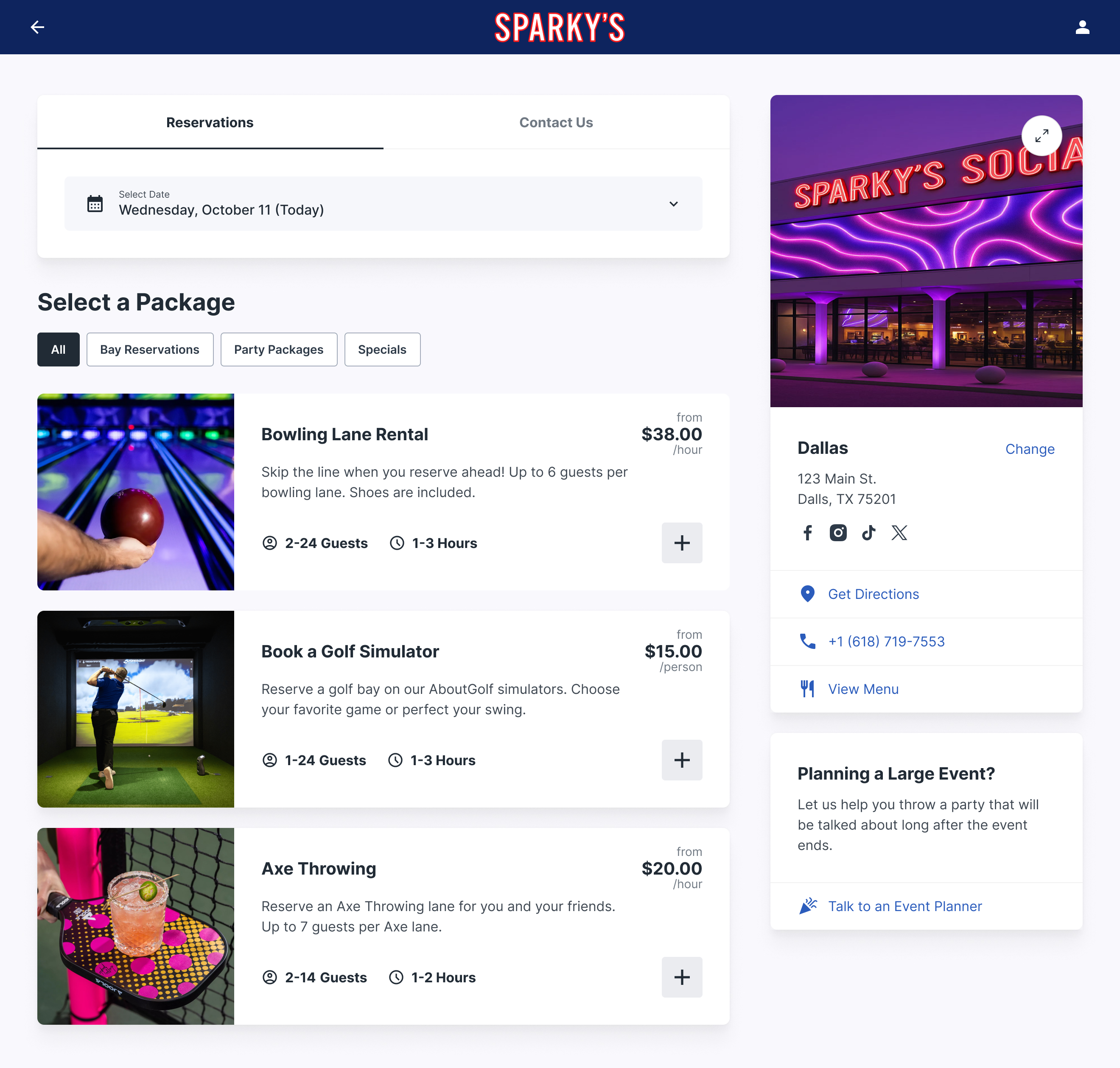
Rex was designed from the ground up for venues where guests book activities, not just seats. Bowling centers, indoor golf facilities, escape rooms with multiple rooms, axe throwing venues with multiple bays, trampoline parks, and FECs all need resource-level inventory management that Tock's table-based architecture doesn't provide.
If you run a competitive socializing venue with darts, shuffleboard, private event spaces, and a full bar, Rex handles the complexity in a single system. Tock can handle the bar and dining component but will require workarounds or separate systems for the activity inventory.
Lane and Bay Inventory Management
Managing 20 bowling lanes or 15 golf simulator bays is architecturally different from managing restaurant tables. Rex tracks inventory at the resource level — individual lanes, bays, or rooms — and manages availability across all of them in real time. A guest booking lane 7 at 7 PM takes that specific resource off the inventory, triggers the Steltronic scoring system, and connects to the F&B tab. That closed loop doesn't exist in Tock.
Native Memberships and Recurring Revenue
Memberships are the highest-margin revenue stream for most entertainment venues. Rex supports recurring membership billing, member-exclusive pricing, access controls, and renewal automation out of the box. Tock has limited membership functionality — operators who want to build a membership program as a core revenue stream will find Rex far more capable.
Deep Hardware and Software Integrations
Rex's integration layer is purpose-built for the entertainment venue tech stack:
- GoTab — F&B ordering linked directly to your booking tab — no separate POS juggling
- Tripleseat — Corporate event sales pipeline connected to your venue calendar for group and buyout bookings
- Steltronic — Automatic bowling scoring integrated with lane reservations — lane assignment triggers the scoring system
- aboutGOLF — Golf simulator hardware linked directly to the booking system — bay assignment activates the sim
- Gift cards — Natively supported and via integrations, fully tracked against bookings
Tock has strong integrations with hospitality POS systems (Revel, Toast, Square) but doesn't have equivalents for entertainment hardware. If your venue runs on any of the Rex-integrated systems, that's a decisive factor.
Corporate Event Revenue
Corporate team-building buyouts and holiday parties are often the highest-revenue single transactions for entertainment venues — $5,000 to $25,000 per event. Rex's Tripleseat integration connects your sales pipeline to your availability calendar, so corporate inquiries flow directly into bookings. Tock offers group booking via "Tock Experiences" but doesn't have the same enterprise event sales infrastructure.
Scale: Multi-Location Enterprise Operations
Rex was purpose-built for multi-location venue management at scale. FatCats, Punch Bowl Social, and Lucky Strike manage dozens of locations on Rex. If growing beyond one location is in your plan, Rex's architecture handles it without requiring a platform migration when you hit five or ten venues. Tock supports multiple locations but is primarily optimized for independent venue operations.
Rex vs Tock: Which Platform Fits Your Business?
Choose Tock if:
- You operate a restaurant, fine dining concept, or hospitality-primary business — Tock's seating management, kitchen pacing, and prepaid dining tools are genuinely strong
- No-show reduction via prepaid ticketing is a top priority — Tock's core model was built for this
- Your website runs on Squarespace — native integration removes friction
- You run a winery, brewery, or tasting room — Tock has deep traction and purpose-built features in this vertical
- Activity is secondary to dining — a restaurant that added a bowling lane or private event room with simple inventory needs
Choose Rex if:
- You're a multi-activity entertainment venue — bowling centers, golf simulators, escape rooms, axe throwing venues, trampoline parks, FECs, competitive socializing concepts
- Lane or bay inventory management is core to your operation — Rex tracks and manages individual resource availability; Tock doesn't
- Memberships are a revenue focus — Rex handles recurring billing, member pricing, and access controls natively
- You need F&B, event sales, or hardware integrations — GoTab, Tripleseat, Steltronic, aboutGOLF — Rex connects your full tech stack
- Corporate events are a significant revenue stream — Tripleseat integration manages the sales-to-operations pipeline
- You're scaling to multiple locations — Rex was built for enterprise multi-location management
Pricing: Rex vs Tock
Rex and Tock have fundamentally different pricing models — and this difference matters enormously for high-volume venues. Tock charges $199–$699/month for its platform subscription PLUS takes a percentage of ticket sales and booking revenue on top. Rex charges flat monthly plans with no percentage of revenue taken. Your booking volume doesn't affect your Rex bill.
To put the Tock model in context: a venue generating $50,000/month in bookings on a plan with a 2% revenue share would pay $1,000+/month in revenue fees alone — on top of the $199–$699 base subscription. At $100,000/month in bookings, that's $2,000+/month in revenue share fees plus the subscription cost. Rex's flat-rate model means your software cost stays predictable regardless of how busy your venue gets — and as your bookings grow, Rex becomes dramatically more cost-effective.
Total cost of ownership across your full tech stack is the right frame. If Rex replaces separate booking software, a membership platform, and eliminates the need for middleware between your POS and reservation system, the effective cost per dollar of revenue managed often compares even more favorably to Tock's combined subscription-plus-revenue-share model.
Switching from Tock to Rex: What to Expect
The most common reason Tock customers move to Rex is opening or acquiring a venue with activity complexity that Tock wasn't built to handle — adding bowling lanes to an existing eatertainment concept, expanding from a tasting room to a multi-room experience center, or launching a competitive socializing venue from scratch.
Tock provides data export for customer and booking history. Rex's onboarding team handles the configuration — building out your resource inventory, connecting integrations, and setting up pricing rules — and typically targets a two-to-four-week timeline for venue migrations. The main operational task is updating your booking links across your website, Google Business Profile, and any other channels where you take reservations.
Communicating the change to your guest list is good practice. Most venues send a simple email announcing the new booking experience before cutover. If you have a Tock waitlist, export that data before switching.
Frequently Asked Questions
Can Tock handle bowling lanes or activity bay inventory?
Tock can create time-slot bookings for activity spaces, but its architecture is built around table management — not lane or bay inventory. If you need to manage 10 or more lanes or bays simultaneously, prevent double-booking at the resource level, and track availability in real time across multiple activity types, Rex handles this as core infrastructure. Tock requires workarounds that don't scale well as activity complexity grows.
Does Rex work for restaurants or dining-focused businesses?
Rex is primarily built for multi-activity entertainment venues. It handles F&B through the GoTab integration, but its core architecture — resource-level inventory management, activity booking flows, memberships — is optimized for entertainment rather than dining. If your primary operation is a restaurant, Tock or SevenRooms will be a better fit. If you run a competitive socializing venue where F&B is a significant revenue stream alongside activities, Rex with the GoTab integration is purpose-built for that hybrid.
How does Tock's pricing compare to Rex?
Tock charges a percentage of booking revenue plus a per-cover fee. Rex charges a percentage of booking revenue without the per-cover component. Exact rates for both platforms depend on your volume and contract terms — neither publishes a complete rate card publicly. For high-volume venues, the per-cover fee model adds up faster than a percentage-only model. Model both against your actual monthly cover or booking count to compare accurately.
What integrations does Rex have that Tock doesn't?
Rex has native integrations specifically for entertainment venue operations: GoTab (F&B), Tripleseat (corporate event sales), Steltronic (bowling scoring), aboutGOLF (golf simulator hardware), and gift card support natively and via integrations. Tock has strong integrations with hospitality POS systems (Toast, Revel, Square) but doesn't have equivalents for entertainment hardware. If your venue runs on any of the Rex-integrated systems, that's often the deciding factor.
Can Rex handle prepaid or ticketed reservations like Tock?
Yes — Rex supports prepayment, deposits, and full payment at booking. The mechanics of requiring payment upfront to reduce no-shows are available on Rex. What Rex doesn't have is Tock's specific fine-dining ticketing model and the "timed dining experience" workflow that Tock pioneered. For entertainment venues, the deposit and prepayment approach Rex provides is typically sufficient — the Tock-style ticketed dining experience isn't a relevant model for most activity-based venues.
Which platform is better for a competitive socializing or eatertainment concept?
Rex is the stronger fit for competitive socializing and eatertainment venues. These concepts — darts bars, bowling-and-dining, golf-and-food, escape room complexes with event spaces — have the exact profile Rex was built for: multiple activity types, lane or bay inventory, F&B revenue, corporate event bookings, and memberships. Tock can handle the dining component but requires additional systems for the activity side. Rex handles both in one platform through native integrations.
Ready to See Rex in Action?
If you're running a multi-activity entertainment venue — or building one — Rex is purpose-built for the complexity Tock wasn't designed to handle. From lane and bay inventory to memberships, corporate event pipelines, and native integrations with the tools your venue already runs on, Rex closes the gaps that restaurant-focused platforms leave open.
Book a demo with the Rex team to see how it handles your specific venue type and revenue model. No pressure — just a look at whether it fits.