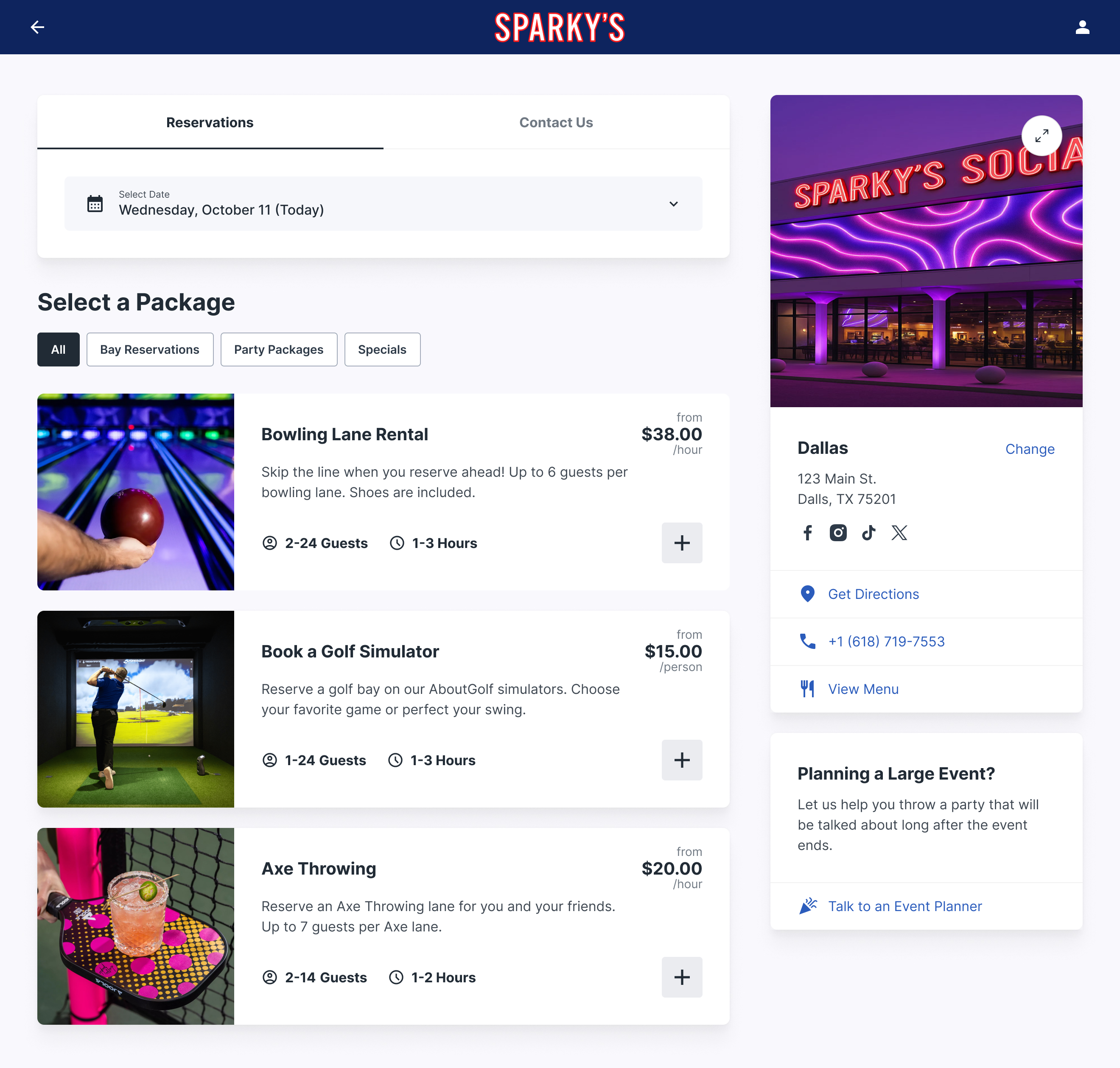
When you're evaluating booking software for your entertainment venue, Rex and Xola both appear in the search results — and for good reason. Both platforms handle online reservations, waivers, and payments. But they were built for fundamentally different types of businesses, and choosing the wrong one will cost you in workflow complexity, missing features, and customer experience.
Xola was built for tour operators and single time-slot attraction businesses: zip lines, kayak rentals, cooking classes, ghost tours, water sports, and guided experiences. Rex was built for entertainment venues with multiple resources: axe throwing lanes, bowling lanes, karaoke rooms, golf simulator bays, laser tag arenas, and family entertainment centers. Rex works for single-activity venues too — but Rex is not optimized for the OTA distribution networks that Xola specializes in. That distinction matters more than any feature checklist.
This comparison breaks down where each platform excels, where each falls short, and which operators belong on which system. If you run a venue where guests can book multiple activities, manage bay or lane inventory, and drive repeat visits through memberships, this comparison will save you weeks of demo calls.
Platform Overview: How Rex and Xola Approach Venue Booking
What Is Xola?
Xola is a booking and business management platform designed primarily for tour operators and single time-slot attraction businesses. It launched in 2012 targeting the tours-and-activities market and has built strong features for managing guide availability, affiliate distribution, and single-slot experience bookings. Xola's marketplace and reseller network is a genuine strength — operators can connect to OTAs and affiliate partners like Viator and GetYourGuide to fill capacity. Xola works best for businesses where every booking follows the same simple pattern: a group books a time slot, shows up, and does one activity.
The platform works well for businesses where every booking is essentially the same: a group books a time slot, shows up, and does the activity. Escape rooms, axe throwing lanes, and outdoor adventures fit this model when operated at a basic level. Where Xola starts to strain is when a venue has complex bay or lane inventory, multiple simultaneous activity types, or revenue streams beyond the base booking — memberships, F&B integration, corporate event management. Rex works for single-activity venues too, but if OTA distribution and tour operator features are your primary need, Xola has a deeper partner network there.
What Is Rex?
Rex is a venue management and reservation platform purpose-built for multi-activity entertainment businesses. Founded to solve the booking complexity that off-the-shelf tools couldn't handle — managing 20 bowling lanes, 12 golf simulator bays, or an escape room complex with six themed rooms simultaneously — Rex is architected around inventory management at the resource level.
The platform handles memberships natively, integrates directly with GoTab for F&B, Tripleseat for corporate event sales, Steltronic for bowling scoring, and aboutGOLF for golf simulator hardware. These are not third-party add-ons — they're native integrations that close the loop between booking, operations, and revenue.
Feature Comparison: Rex vs Xola

Where Xola Wins
Tour Operator and OTA Distribution
If filling capacity through Viator, GetYourGuide, and affiliate networks matters to your business, Xola has the stronger marketplace infrastructure. Tour operators who depend on OTA distribution to fill off-peak slots will find Xola's reseller network genuinely useful — Rex doesn't have an equivalent.
Guide and Staff Scheduling
Xola handles guide assignment and staff scheduling as a first-class feature. For tour operators who need to match staff to specific bookings based on certifications or availability, Xola's staffing tools are more mature. Rex is built around inventory (lanes, bays, rooms) rather than guide assignment.
Single-Experience Simplicity
If your venue does one thing — one type of experience, one booking flow, no recurring revenue complexity — Xola's setup is faster to configure and easier to manage. The onboarding curve is lower for straightforward operations.
Where Rex Wins
Multi-Activity Venue Management
Rex was designed from day one for venues where guests might book bowling lanes, a private event space, and food and beverage in a single transaction. Xola's data model treats each booking as a single experience — building multi-activity packages requires workarounds that don't scale.
If you run a FEC with go-karts, arcade, laser tag, and birthday party rooms, or a competitive socializing venue with darts, shuffleboard, and private event buyouts, Rex handles the complexity Xola can't.
Lane and Bay Inventory Control
Managing 20 bowling lanes or 15 golf simulator bays is a fundamentally different problem than managing time slots for a single activity. Rex tracks inventory at the resource level — individual lanes, bays, or rooms — and manages capacity across all of them simultaneously. This is core infrastructure in Rex; it doesn't exist in Xola.
Native Memberships
Memberships are the highest-margin revenue stream for most entertainment venues. Rex supports recurring membership billing, member-exclusive pricing, access controls, and renewal flows out of the box. Xola offers limited membership functionality — for venues where memberships are a growth lever, Rex is the clear choice.
Deep Integration with Venue Hardware and Software
Rex's integration layer is built for the entertainment venue stack:
- GoTab — F&B ordering linked to your booking, not a separate system
- Tripleseat — corporate event sales pipeline connected to your venue calendar
- Steltronic — automatic bowling scoring integrated with lane reservations
- aboutGOLF — golf simulator hardware linked directly to the booking system
- Gift cards — natively supported and via integrations, no third-party juggling
Xola doesn't have equivalents for most of these. If your venue runs on any of these systems, Rex is the only option that connects them.
Corporate Event Revenue
Corporate events — team-building buyouts, holiday parties, offsite meetings — are often the highest-revenue single transactions for entertainment venues ($5,000–$25,000 per event). Rex's Tripleseat integration connects your sales pipeline to your availability calendar. Xola handles group bookings but doesn't have the same depth for enterprise-level event sales.
Rex vs Xola: Which Platform Is Right for You?
Choose Xola if:
Choose Rex if:
Pricing: Rex vs Xola
Rex and Xola have fundamentally different pricing models. Xola charges a percentage of booking revenue — a tiered model starting around 6% for smaller operators and scaling down for high-volume businesses. Rex charges flat monthly plans with no percentage of revenue taken. This means as your venue grows and booking volume increases, Rex becomes dramatically more cost-effective.
For a venue generating $30,000/month in bookings, Xola's 6% model would cost $1,800/month in platform fees alone — and that's before any base subscription costs. Rex's flat-rate model means your software cost stays the same whether you process 100 bookings or 10,000 in a month. Rex pricing is not published publicly — contact Rex for a quote based on your venue type and projected volume.
The right way to evaluate cost is total cost of ownership across your full tech stack. If Rex replaces three separate tools (booking software, membership platform, F&B integration), the effective cost per dollar of revenue managed is often lower than the headline rate suggests.
Switching from Xola to Rex: What to Expect
The most common reason Xola customers move to Rex is outgrowing the platform. When a venue adds activities, starts selling memberships, or needs hardware integrations that Xola doesn't support, Rex becomes the path forward.
The migration process involves exporting customer and booking history from Xola (Xola provides data export), reconfiguring your booking flows in Rex, and relaunching your booking links. Rex's onboarding team handles the configuration and typically targets a 2–4 week setup timeline for venue migrations.
Guest communication during the transition is the main operational consideration. Most venues send a simple email to their list announcing the new booking system before cutover. Rex's team can advise on the timing and messaging.
Frequently Asked Questions
Can Xola handle bowling lanes or golf simulator bays?
Xola can create time-slot bookings for activity spaces, but it doesn't have native lane or bay inventory management. If you need to manage 10+ lanes or bays simultaneously, track individual resource availability, or prevent double-booking at the resource level, Rex handles this as core infrastructure. Xola requires workarounds that become harder to manage as your venue grows.
Does Rex work for tour operators or single-experience businesses?
Rex is primarily built for multi-activity entertainment venues — bowling centers, golf simulators, escape rooms, FECs, and similar. If you're a tour operator who relies on OTA distribution (Viator, GetYourGuide, affiliate networks), Xola or Peek Pro will be a better fit. Rex doesn't have an equivalent marketplace distribution network.
How does pricing compare between Rex and Xola?
Both platforms charge a percentage of booking revenue. Xola's rates start around 6% for smaller volumes and decrease at scale. Rex doesn't publish pricing publicly — request a quote based on your venue type and volume. For venues with multiple revenue streams (bookings + memberships + F&B), Rex's all-in-one model often delivers better effective cost than piecing together multiple tools.
What happens to my data if I switch from Xola to Rex?
Xola provides data export functionality for customer records and booking history. Rex's onboarding team will help you configure your new system and migrate the data you need. Most venue migrations take 2–4 weeks from kick-off to launch. The main operational task during the transition is updating your booking links and communicating the change to your guest list.
Does Rex support escape rooms and axe throwing venues?
Yes — escape rooms and axe throwing venues are among Rex's core venue types. Rex manages room or bay inventory, handles timed session bookings, supports walk-in and pre-booked capacity, and connects to waiver systems. The Tripleseat integration is particularly valuable for escape room operators selling corporate team-building experiences.
Which platform is better for growing to multiple locations?
Rex was purpose-built for multi-location enterprise venue management — it powers some of the largest entertainment venue groups in North America. Xola supports multiple locations but is primarily optimized for single-location tour operators. If scaling to 5+ locations is on your roadmap, Rex's architecture will handle it without requiring platform migration later.
Ready to See Rex in Action?
If you're running a multi-activity entertainment venue — or planning one — Rex is purpose-built for your operation. From lane and bay inventory management to memberships, corporate event sales, and native integrations with the tools your venue already runs on, Rex closes the gaps that tour-focused platforms leave open.
Book a demo with the Rex team to see how it handles your specific venue type and revenue model. No pressure — just a look at whether it fits.