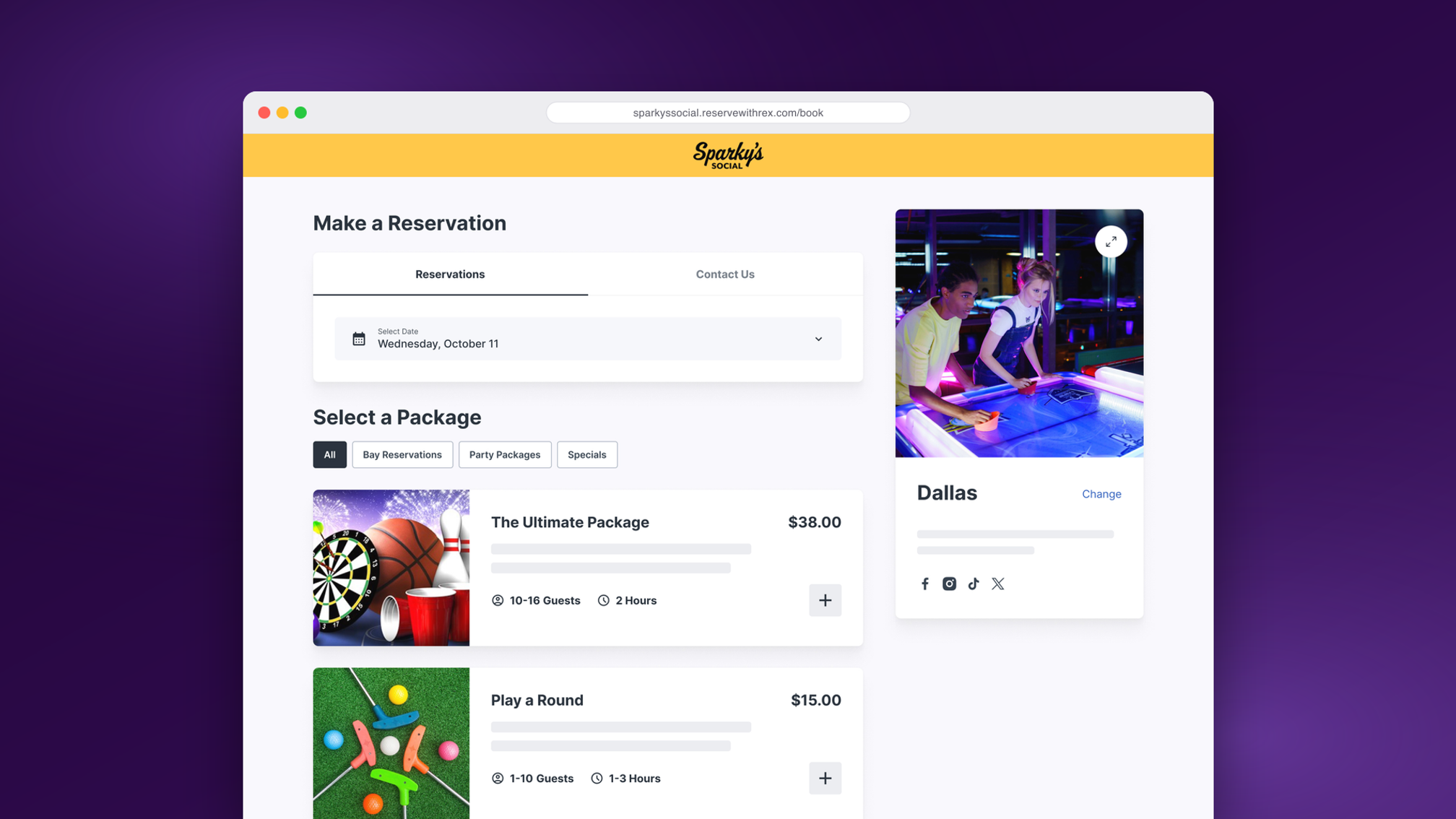
Atomic Golf tested 9 package structures and landed on 3. That simplification took them from $2,000/day to $30,000/day in online bookings. Read the full Atomic Golf case study for the details. This guide shows you the framework they used — and how to apply it to your venue.
Why Most Venue Pricing Underperforms
Entertainment venue pricing usually gets set once — when the venue opens or when a new activity launches — and then rarely changes. The owner picks a few price points based on competitor research and gut feel, puts them on the website, and moves on.
The problem: your first guess is almost never your best pricing.
Guests don't tell you they almost booked but the packages were confusing. They don't tell you they would've paid more for a premium option. They just book somewhere else. Or book your cheapest option when they would've upgraded if the tiers made sense.
The 5 Principles of High-Converting Venue Packages
Principle 1: Fewer Options Convert Better
The paradox of choice is real. When guests see 7–9 package options, they freeze. Decision fatigue kicks in. They either pick the cheapest option (leaving money on the table) or abandon the booking entirely.
The sweet spot: 3 tiers per activity type.
- Good — entry point that gets them in the door. Anchors the value.
- Better — the one you want most people to pick. Highlighted as "Most Popular" or "Best Value." Priced to feel like an obvious upgrade from Good.
- Best — premium experience. Makes the Better tier feel reasonable by comparison.
The Better tier should be your highest-volume seller. If most guests are choosing Good, the gap between Good and Better is too wide. If most are choosing Best, Better isn't compelling enough.
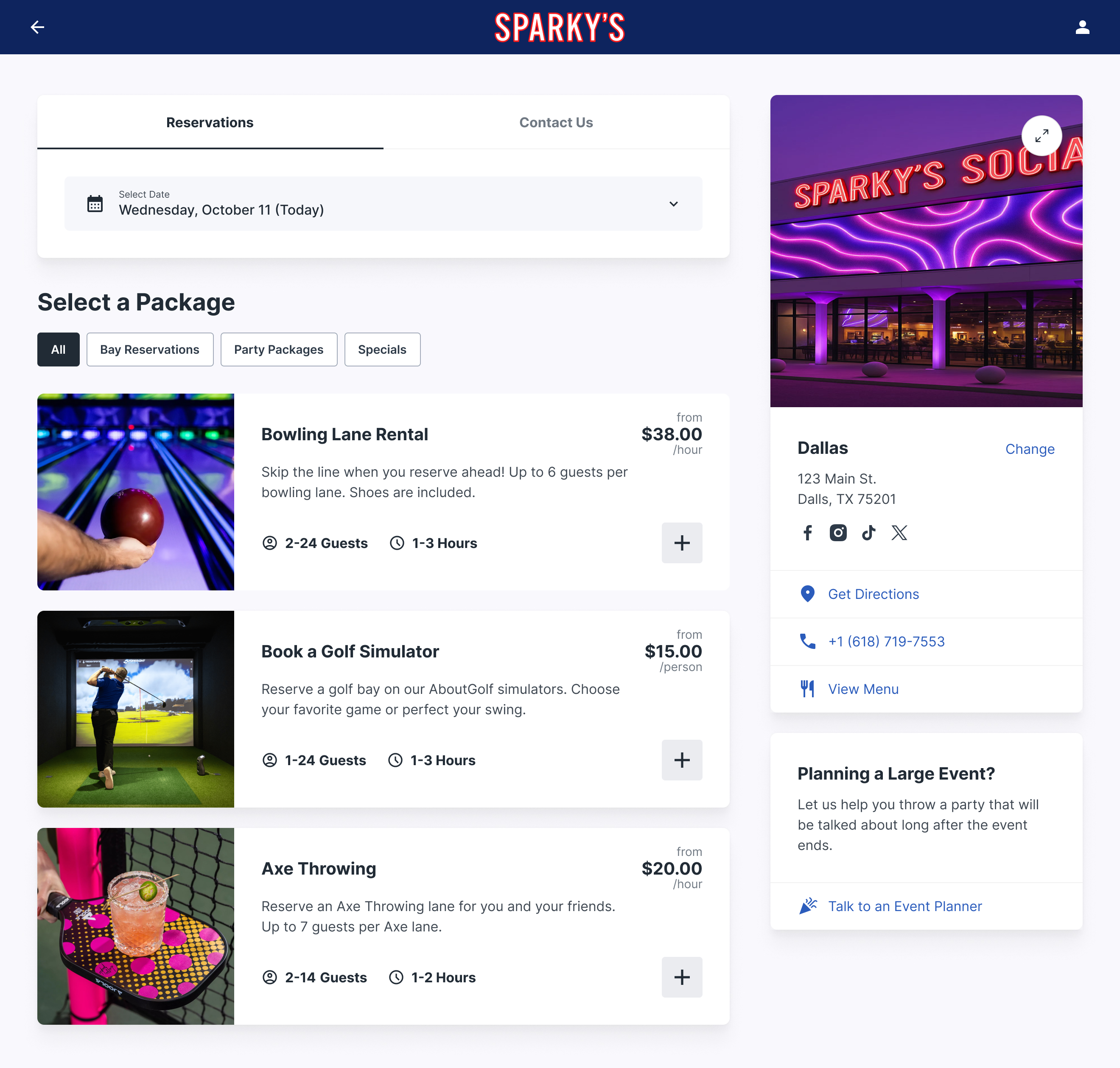
A bowling venue offered 5 packages. They consolidated to 3: Weekend Fun ($35/person — 2 games, shoes), Party Package ($55/person — 2 games, shoes, food, drinks), and VIP Experience ($85/person — unlimited games, premium lanes, food, drinks, dedicated host). Bookings increased 40% and average booking value went up 25% — because the decision was easy.
Principle 2: Bundle Experiences, Don't Just Add Time
The most common venue pricing mistake: charging by the hour and nothing else. "1 hour of bowling: $40. 2 hours: $75." This commoditizes your experience. Guests comparison-shop on price per hour. You compete on being cheapest.
Instead, bundle the experience:
- Instead of "1 hour of bowling: $40" — try "Game Night" — 2 games + shoes + appetizer platter: $55/person
- Instead of "Golf sim rental: $60/hour" — try "The Full Swing" — 1 hour sim time + 2 drinks + nachos: $85/person
- Instead of "Axe throwing: $30/person" — try "Lumberjack Package" — 1 hour throwing + group photo + beer flight: $50/person
Why this works:
- Guests perceive more value — they're getting an "experience," not renting equipment
- Average ticket goes up — food and drink are high-margin additions
- Price comparison becomes harder — you're not selling "bowling," you're selling a night out
- You control the experience quality — guests who eat and drink have more fun and leave better reviews
Principle 3: Make Add-Ons Visible and Easy
Add-ons are the easiest revenue you'll ever generate — if guests see them at the right moment. The right moment is during checkout, not at the front desk.
When add-ons appear in the online booking flow, guests are already committed, they're in buying mode, and there's no social pressure or rush (unlike a busy front desk).
High-performing add-on categories for entertainment venues:
- Food and Beverage — pizza package, appetizer platter, drink package, bottle service. Typical 30–50% attach rate.
- Upgrades — premium lanes, VIP area, extended time, private room. Typical 15–30% attach rate.
- Party Extras — decorations, cake, party host, custom invitations. Typical 40–60% attach rate for party bookings.
- Extras — socks, merchandise, photos, locker rental. Typical 10–25% attach rate.
Pricing add-ons: keep individual add-ons under 40% of the base package price. A $20 appetizer platter on a $55 booking feels like a no-brainer. A $45 food package on a $55 booking makes guests reconsider the whole thing. For more strategies, read our guide on increasing revenue per guest without raising prices.
Principle 4: Use Time-Based Pricing (But Keep It Simple)
Your venue has peak and off-peak hours. Your pricing should reflect that — but not to the point of confusion.
- Off-peak (weekday daytime) — base price or slight discount. Drive volume during slow hours.
- Standard (weekday evening) — base price. Normal demand.
- Peak (Friday/Saturday evening) — 20–40% premium. High demand, limited capacity. Guests expect to pay more.
- Special (holidays, events) — custom pricing. Black Friday bowling, NYE packages, Valentine's date night.
Only 2–3 pricing tiers based on time. Not a different price for every hour. Guests should be able to understand your pricing in 10 seconds.
Pro tip: frame off-peak as a deal, not peak as expensive. "Weekday Happy Hour Bowling: $25/person (save $15!)" works better than "Weekend bowling: $40/person."
Principle 5: Test One Variable at a Time
This is where most venues fail. They redesign all their packages at once, change prices, add new activities, and launch it all on the same day. When revenue changes, they don't know why.
The testing framework:
- Pick one thing to test. One package structure change, one price point, one new add-on.
- Run it for 2–4 weeks. Long enough to get real data, short enough to iterate fast.
- Measure what matters: booking volume, average booking value, total revenue, add-on attach rate.
- Decide: keep, modify, or kill.
- Move to the next test.
Package Templates by Venue Type
Bowling Center
- Good: Open Bowl — 2 games + shoe rental. $25–35/person
- Better: Bowl & Bite — 2 games + shoes + appetizer platter + 1 drink. $45–55/person
- Best: VIP Lanes — unlimited games + premium lane + food & drink package + dedicated server. $75–95/person
Key add-ons: extra games, pitcher of beer, dessert, bowling socks, party decorations. For more revenue ideas, see our guide on how to increase bowling alley revenue.
Golf Simulator Venue
- Good: Sim Session — 1 hour sim time (up to 6 players). $50–70/hour
- Better: The Full Swing — 1.5 hours + appetizers + 2 drinks/person. $40–55/person
- Best: Tournament Package — 2 hours + full food spread + unlimited drinks + scorecard + prizes. $75–100/person
Axe Throwing
- Good: Throw Session — 1 hour + coach + safety intro. $25–35/person
- Better: Axe & Apps — 1 hour + coach + appetizer platter + 1 drink. $45–55/person
- Best: Lumberjack Experience — 1.5 hours + coach + full food + drinks + group photo + winner trophy. $65–80/person
Family Entertainment Center (Multi-Activity)
- Good: Pick One — 1 activity (bowling OR sims OR arcade card) + 1 hour. $20–30/person
- Better: Combo Pass — 2 activities + 2 hours + food voucher. $45–60/person
- Best: All-Access — unlimited activities + 3 hours + food & drink package + arcade card loaded. $75–100/person
The 30-Day Package Optimization Sprint
Week 1: Audit
- List every package and price point you currently offer
- Pull last 90 days of booking data: volume per package, revenue per package, average booking value
- Identify which packages sell most, which sell least, and where revenue is concentrated
Week 2: Simplify
- Consolidate to 3 tiers per activity (Good/Better/Best)
- Name them clearly — no internal jargon
- Set the Better tier as "Most Popular" with visual emphasis
- Go live with the new structure
Week 3: Add-Ons
- Create 3–5 relevant add-ons per activity type
- Make sure they appear in the online booking checkout flow
- Track attach rate daily
Week 4: Measure and Plan
- Compare Week 2–3 revenue to prior 2 weeks
- What moved? What didn't?
- Plan your next test based on the data
Common Mistakes to Avoid
- Too many options — 7+ packages = decision paralysis. Simplify ruthlessly.
- Pricing only by time — you're not renting equipment, you're selling experiences. Bundle.
- Hiding add-ons — if guests have to ask, most won't. Surface them in the booking flow.
- Never changing — if your packages haven't changed in 6 months, you're not optimizing — you're hoping.
- Changing everything at once — test one variable at a time so you know what's actually working.
- Ignoring the data — "it felt busy" isn't a metric. Track booking volume, average value, and total revenue.
- Pricing too low — entertainment is emotional, not rational. Guests will pay for a great experience. Don't leave money on the table.
Frequently Asked Questions
How often should I change my packages?
Test something new every 2–4 weeks. You're not overhauling everything — just changing one variable at a time. Most venues that iterate monthly on pricing see measurable revenue gains within 90 days.
Won't guests be confused if I keep changing prices?
Guests don't memorize your pricing. They compare options at the moment of booking. As long as your packages are clear and easy to understand, changes are invisible to them.
What if my booking system makes it hard to change packages?
That's a red flag. If updating a package requires a support ticket and a two-week wait, you'll never iterate fast enough. Your booking system should let you change packages, pricing, and add-ons in minutes — not weeks.
Should I offer discounts or stick to value-based pricing?
Use discounts strategically for off-peak times and specific promotions, not as your default pricing strategy. Leading with discounts trains guests to wait for deals. Leading with value (better packages, more included) trains them to spend more.
How do I know if my Better tier is priced right?
Look at tier distribution. If 50–60% of bookings land on the Better tier, you've nailed it. If most go Good, the jump to Better is too steep. If most go Best, Better needs more value or Best needs a higher price.
Start Testing Packages That Convert
The hardest part of package optimization isn't knowing what to test — it's being able to test it quickly. If changing a package in your current system takes a support ticket and two weeks, you'll never iterate fast enough. For party-specific tips, see our guide on building the ultimate party package for competitive socializing venues.
Rex lets you update packages, pricing, and add-ons in minutes — and go live the same day. That's how Atomic Golf tested 9 structures and found the 3 that 10x'd their bookings. See how it works — book a 30-minute demo →