If you're evaluating booking software for your entertainment venue, Checkfront has probably landed on your radar. It's a well-known name in the tours and activities space, with a flexible platform and transparent pricing. But is it the right fit for a bowling center, FEC, golf simulator studio, or multi-activity entertainment concept?
This guide breaks down Rex and Checkfront side by side — features, pricing, integrations, and where each platform genuinely wins. No sales spin, just an honest comparison to help you pick the right tool for your venue.
The Quick Version
Rex is a venue booking and reservation platform purpose-built for activity-based entertainment. It handles online reservations, party packages, memberships, dynamic add-on upsells, and venue scheduling. Flat-rate pricing per location with zero transaction fees. Built for venues from single locations to multi-location brands like Triple Shift Entertainment (26 locations) and Punch Bowl Social (14 venues).
Checkfront is an online booking platform built primarily for tours, activities, rentals, and accommodations. It offers real-time availability, resource management, OTA (Online Travel Agent) channel distribution, and flexible booking widgets. Pricing is $99/month plus a 3% fee on online bookings. Used by thousands of experience-based businesses worldwide.
The core difference: Rex is built from the ground up for entertainment venues — bowling, axe throwing, golf sims, FECs. Checkfront is a general-purpose booking tool designed for tours and activities that some venues try to adapt. Which approach works depends on whether your venue needs entertainment-specific features or a more generic booking solution.
Who Each Platform Is Built For
Rex's Sweet Spot
- Multi-activity entertainment venues — bowling + golf sims + axe throwing + karaoke under one roof
- Multi-location operators — from single venues to 26+ location brands that need consistent booking across every site
- Venues that already have a POS — Rex integrates with GoTab, Tripleseat, and Stripe rather than replacing your existing stack
- Operators who iterate fast — change packages, pricing, and promotions instantly without support tickets
- Party-heavy venues — self-serve online party booking with granular add-ons, deposits, and automated confirmation flows
Checkfront's Sweet Spot
- Tour and activity operators — kayak rentals, ATV tours, boat charters, zipline experiences
- Single-activity businesses — one experience type with simple timeslot-based booking
- Businesses selling through OTAs — Viator, GetYourGuide, Google Things to Do channel distribution
- Accommodation + experience combos — lodges, resorts, or campgrounds that bundle stays with activities
- International operators — multi-language and multi-currency booking pages out of the box
Feature-by-Feature Breakdown
Online Booking and Checkout
Both platforms handle online booking, but they approach it differently.
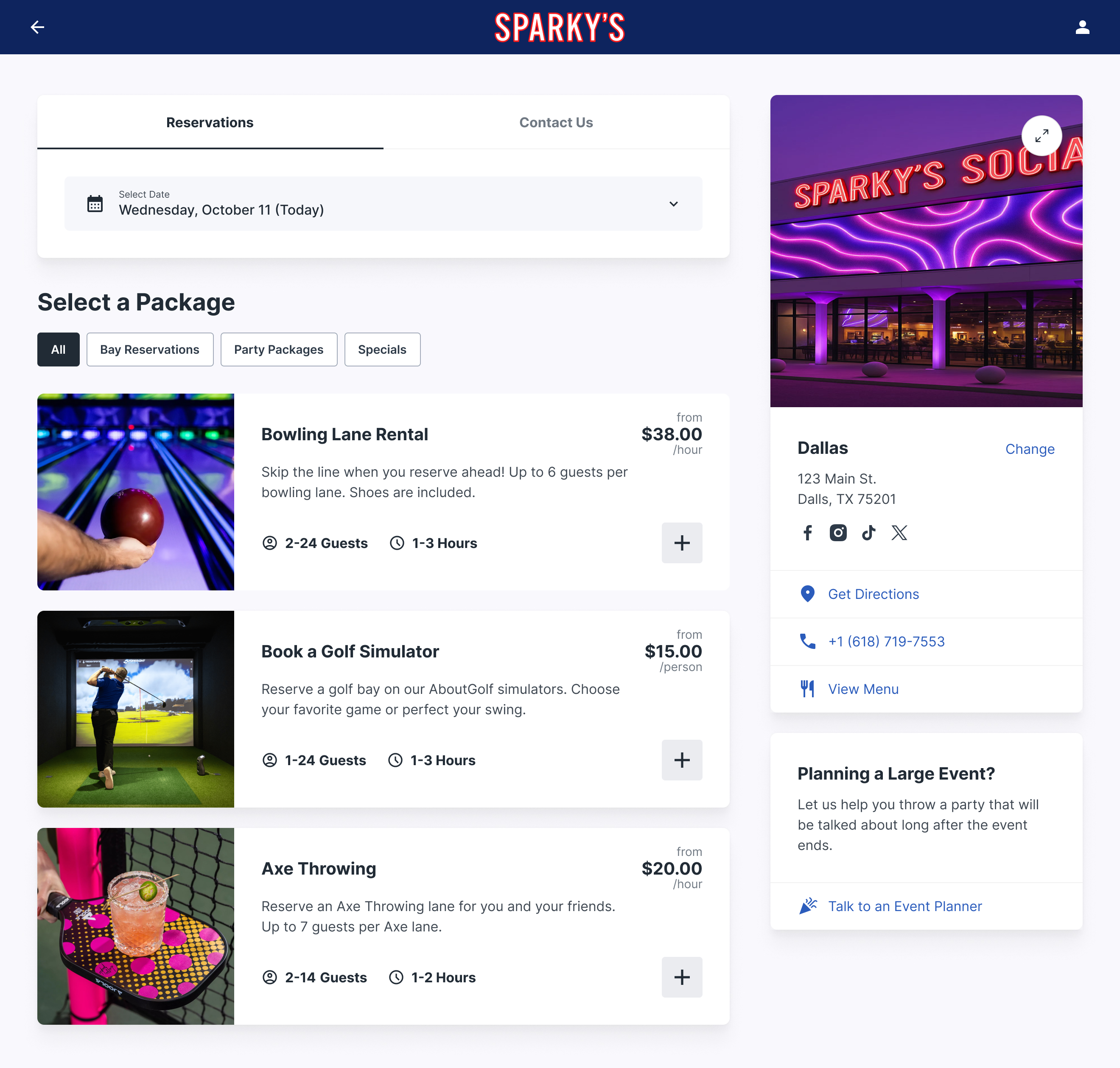
Rex is built for multi-activity venues where a single guest might book bowling lanes, a golf simulator session, and a party room in one transaction. The checkout flow handles complex combinations — time-based resources, capacity-limited activities, and package bundles — all in a single cart. Guests can add food and beverage packages, select specific lanes or bays, and customize their experience without calling the venue.
Checkfront's booking system is designed around individual experiences. You create products (a kayak rental, a guided tour, an axe throwing session), set availability, and guests book specific timeslots. It handles this well for single-activity businesses. But when you need guests to book multiple different activities in one session — the way entertainment venues actually operate — the workflow gets clunky. Checkfront treats each product as a separate booking, which means more friction for guests and more complexity for staff.
Party and Group Booking
This is where the gap widens significantly.
Rex's party booking system lets guests build custom packages online: pick activities, choose time slots, add food and beverage options, select add-ons (decorations, extra time, premium lanes), and pay deposits — all self-serve. For venues where party bookings represent 30–50% of weekend revenue, this is a major differentiator. No phone tag, no back-and-forth emails, no manual invoicing.
Checkfront doesn't have a dedicated party booking module. You can create a "party package" as a bookable product with add-ons, but it lacks the depth entertainment venues need: granular per-activity customization, automated deposit collection with balance-due reminders, party-specific capacity management, and the kind of upsell flows that drive $50+ in incremental revenue per booking.
Resource and Capacity Management
Checkfront's resource management is legitimately strong for its use case. It handles shared resources across experiences (one boat used by three different tour products), prevents double-booking, and manages complex availability rules. If you're running a rental operation with 15 kayaks shared across four tour types, Checkfront handles that cleanly.
Rex approaches resource management from a venue perspective: lanes, bays, courts, rooms, simulators. Each resource has its own availability, pricing tiers (peak vs. off-peak), minimum booking times, and capacity rules. Rex also handles the entertainment-specific complexity that Checkfront doesn't — like ensuring lane 7 isn't booked for open play when it's reserved for a party at 3 PM, or managing bumper-lane availability separately from regular lanes.
Memberships and Recurring Revenue
Rex includes built-in membership management: recurring plans, member-only pricing, automatic billing, and member check-in tracking. For entertainment venues building a loyalty base, this turns one-time visitors into predictable monthly revenue. Memberships are fully integrated with the booking system — members see their pricing automatically when they book.
Checkfront doesn't offer a native membership system. If you want recurring memberships, you'll need to bolt on a third-party subscription tool and manage the integration yourself. For tour operators, this usually isn't a gap. For entertainment venues where memberships can represent 15–25% of revenue, it's a significant missing piece.
Integrations
Rex integrates with the tools entertainment venues actually use: GoTab for food and beverage, Tripleseat for event management, Steltronic for bowling scoring, aboutGOLF for simulator systems, Pixelcom for race timing, and gift cards natively and via integrations. These aren't generic API connections — they're purpose-built integrations that share data bidirectionally.
Checkfront's integration strength is in the distribution channel: Viator, GetYourGuide, Google Things to Do, and a network of 20,000+ resellers. It also connects with Zapier, Mailchimp, Google Analytics, and popular payment gateways. For venues that rely on OTA distribution (tourist-area attractions, for example), this is a legitimate advantage. But for entertainment venues that drive most bookings direct, the OTA channel matters less.
Multi-Location Management
Rex includes multi-location support on every plan. A 10-location bowling chain manages all venues from one dashboard with location-specific pricing, availability, and staff permissions. No add-on fees, no tier gates.
Checkfront can handle multiple locations, but the platform wasn't designed around multi-location entertainment brands. Each location is essentially a separate Checkfront account. If you're running three kayak rental shops, that's manageable. If you're running a 15-location entertainment brand that needs consistent booking flows, unified reporting, and centralized package management, the workarounds add up.

Where Rex Wins
- Entertainment-specific booking logic — Rex understands lanes, bays, courts, and simulators. It handles the scheduling complexity that entertainment venues deal with daily: overlapping party and open-play bookings, activity-specific capacity, time-block management.
- Party booking revenue — Self-serve party packages with granular add-ons turn a phone-heavy process into an automated revenue engine. Venues using Rex report significant increases in party booking volume because guests can book at 10 PM on a Tuesday without calling.
- No transaction fees — At $99/month plus 3% per booking, a venue doing $30,000/month in online bookings through Checkfront pays $900 in transaction fees alone — plus the base subscription. Rex's flat rate means costs stay predictable as revenue grows.
- Memberships built in — Recurring revenue without bolting on third-party subscription tools. Members see their pricing automatically, and the venue tracks usage without spreadsheets.
- Multi-location at scale — One dashboard, consistent booking flows, centralized reporting. No per-location workarounds.
Where Checkfront Wins
- OTA and reseller distribution — If your venue gets significant bookings through Viator, GetYourGuide, or Google Things to Do, Checkfront's channel management is a genuine advantage. This matters most for tourist-area attractions.
- Lower entry price — $99/month is accessible for small, single-activity operations just getting started with online booking. The 3% fee only applies to online bookings, so if most of your volume is walk-in, the effective cost stays low.
- International flexibility — Multi-language booking pages, multi-currency support, and localized payment methods (iDEAL, Alipay) make Checkfront a strong choice for operators outside North America or serving international tourists.
- Resource sharing across products — If you run a rental operation where physical assets are shared across multiple bookable experiences, Checkfront's resource management model handles this cleanly.
Pricing: The Real Math
Checkfront's $99/month looks attractive on paper. But the 3% online booking fee changes the equation fast as your venue grows.
Consider a mid-size entertainment venue doing $50,000/month in online bookings:
- Checkfront: $99 + ($50,000 × 3%) = $1,599/month
- Rex Pro: $295/month flat — no transaction fees
That's a $1,304/month difference — over $15,000 per year. And the gap only widens as online booking volume grows. At $100,000/month in bookings, Checkfront costs $3,099/month vs. Rex's flat $295.
For small tour operators doing $5,000–$10,000/month in online bookings, Checkfront's model works fine. For entertainment venues where online booking is the primary revenue channel, the percentage-based fee becomes a significant cost as you scale.
Which Platform Should You Pick?
Choose Rex if:
- You run an entertainment venue — bowling, golf sims, axe throwing, FEC, karaoke, or any multi-activity concept
- Party bookings are a meaningful part of your revenue
- You want memberships without third-party tools
- You operate (or plan to operate) multiple locations
- You want predictable costs that don't grow with your revenue
Choose Checkfront if:
- You run a tour, rental, or outdoor activity business
- OTA distribution (Viator, GetYourGuide) drives a significant share of your bookings
- You need multi-language and multi-currency support for international guests
- You're a single-activity operation with simple timeslot-based booking needs
- Your monthly online booking volume is under $10,000
Can I use Checkfront for a bowling alley or FEC?
Technically yes, but you'll be working against the platform's design. Checkfront treats each activity as a separate bookable product, which means guests can't easily book bowling + food + arcade credits in one seamless cart. You'll also miss entertainment-specific features like lane management, party package builders, and membership programs.
Does Checkfront charge fees on walk-in bookings?
No. Checkfront's 3% fee only applies to online bookings. Walk-in and phone bookings processed through their staff booking interface don't incur the transaction fee. If most of your revenue comes from walk-ins, the effective cost stays closer to the $99/month base.
Can I switch from Checkfront to Rex without losing my booking data?
Yes. Rex's onboarding team handles data migration, including customer records and upcoming reservations. Most venues run both systems in parallel for 2–4 weeks during the transition to ensure nothing falls through the cracks.
Does Rex integrate with Viator or other OTAs?
Rex is focused on direct booking, which is how most entertainment venues operate. The majority of bowling centers, FECs, and golf sim studios drive bookings through their own website, not through OTAs. If OTA distribution is critical to your business model, Checkfront has a clear advantage here.
Which platform is better for a single-location venue?
It depends on the type of venue. A single-location bowling center or FEC benefits from Rex's entertainment-specific features even at one location. A single-location kayak rental shop is better served by Checkfront's simpler booking model and OTA distribution. The deciding factor isn't location count — it's venue type.
Does Rex charge transaction fees?
No. Rex charges a flat monthly rate per location with zero transaction fees, zero per-booking fees, and no percentage of revenue. Standard Stripe payment processing fees still apply, but those are Stripe's fees, not Rex's.
Related Comparisons
Looking at other platforms? Read our head-to-head breakdowns:
- Rex vs ROLLER
- Rex vs CenterEdge
- Rex vs FareHarbor
- Rex vs Clubspeed
- Rex vs Party Center Software
- Rex vs AlleyTrak
- Rex vs SevenRooms
See Rex in Action
Ready to see how Rex handles booking for entertainment venues? Book a free demo and we'll walk you through how it works for your specific venue type — no commitment, no pressure.