If you run a competitive socializing venue (bowling, indoor golf, axe throwing, pickleball, or any multi-activity entertainment center), your reservation system is one of the most important decisions you'll make. It touches every part of your business: revenue, operations, guest experience, and your team's daily workflow.
Both Rex and SevenRooms are established platforms in the reservation space, but they were built for fundamentally different types of businesses. This breakdown covers what each platform does well, where they fall short, and which one makes more sense depending on your venue type.
The Quick Snapshot
Rex was purpose-built for competitive socializing and eatertainment venues. It manages lanes, bays, courts, simulators, and any assignable resource alongside food and beverage, all in a single booking flow.
SevenRooms was built for restaurants, hotels, and nightlife. It's a hospitality CRM with strong table management, guest profiles, and marketing automation. It has expanded into sports and entertainment, but its core architecture still thinks in terms of tables, covers, and dining reservations.
$195/mo
Rex starting price
$499/mo
SevenRooms starting price
0%
Rex transaction fees
90 days
SevenRooms cancellation notice
Who Each Platform Is Built For
Rex: Activity-First Venues
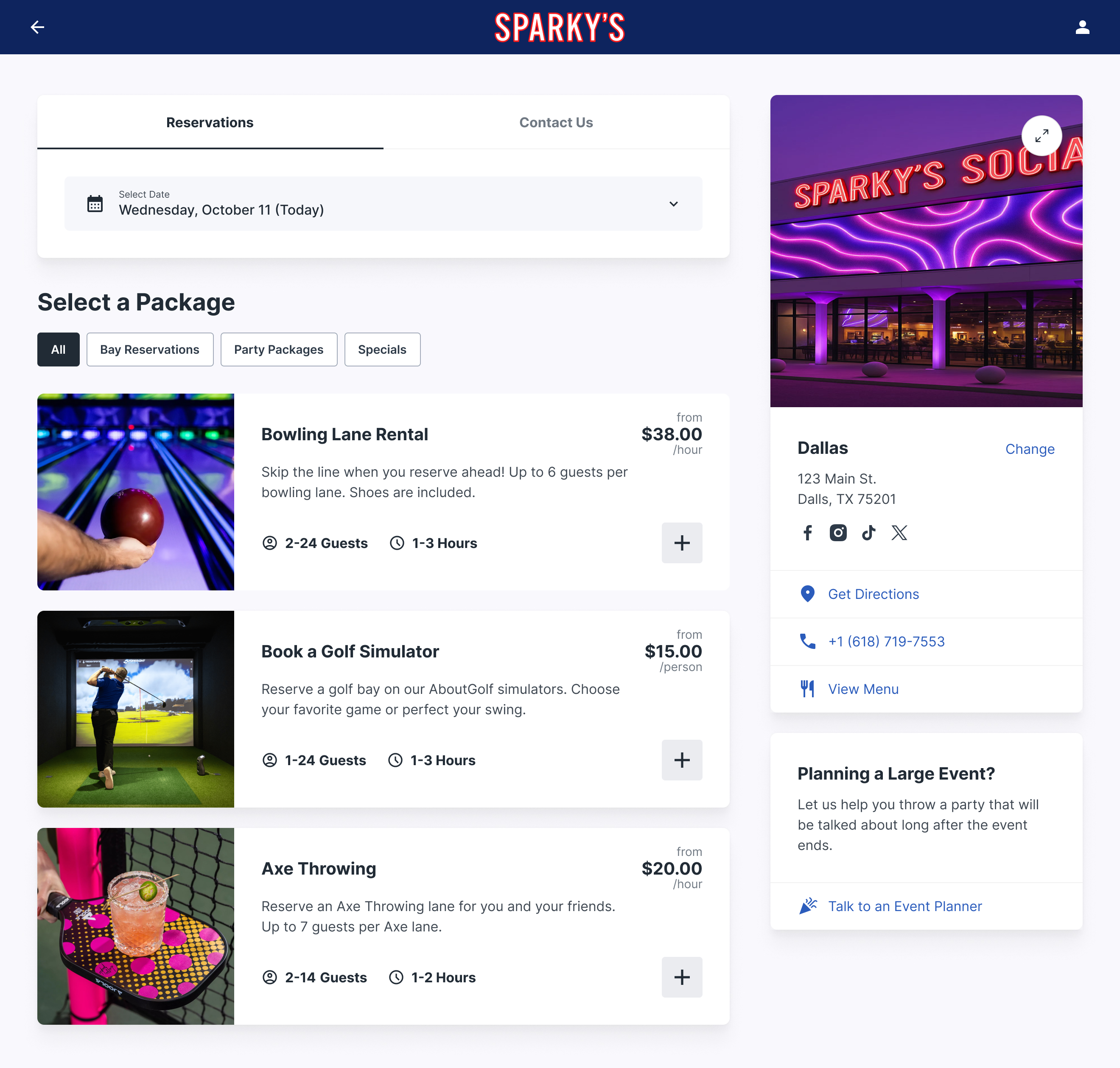
Rex was designed from the ground up for venues where guests book time on a resource, not a table. If your revenue comes from selling hourly lane rentals, bay time, court reservations, or simulator sessions, Rex's data model is built around exactly that.
The platform handles the complexity that's unique to competitive socializing: multi-activity bookings (bowling + food + private room in one cart), resource-level availability (lane 4 is open at 7pm, lane 5 isn't), dynamic pricing (peak vs. off-peak rates per resource), and buffer times between sessions for turnover.
Typical Rex customers include bowling alleys, indoor golf and driving ranges, axe throwing venues, pickleball and padel clubs, family entertainment centers, and multi-activity eatertainment concepts.
SevenRooms: Restaurant & Hospitality Venues
SevenRooms excels at what it was built for: restaurant reservation management. Its table assignment algorithm, waitlist management, and guest CRM are genuinely strong. If you run a restaurant, hotel dining room, or nightclub, SevenRooms has deep, mature features for those use cases.
The platform has added a "Sports & Entertainment" offering, marketing to eatertainment venues. But the underlying system is still oriented around covers and tables, with activity booking layered on top rather than built into the core.
Feature-by-Feature Comparison


Where Rex Stands Out
Resource Management Built for Activities
This is the fundamental difference. Rex doesn't try to adapt a table management system to handle lanes and bays. Its core data model is resource-based: any bookable unit (a bowling lane, a golf simulator bay, a pickleball court, a karaoke room, a go-kart track) is a first-class resource with its own availability, pricing, and capacity rules.
This means your guests see real-time availability for exactly the resource they want, across any time slot, with accurate pricing. No workarounds, no manual availability management, no spreadsheets alongside your reservation system.
Package Builder & Party Bookings
Competitive socializing venues generate significant revenue from parties and group events. Rex's package builder lets you create complex offerings like 2 hours of bowling + shoe rentals + a food package + a private room, and sell them as a single bookable package online.
Guests can book and pay for party packages directly on your website without calling your venue. For operators managing this at scale, Rex also integrates bidirectionally with Tripleseat for event lead management.
Membership Programs
Memberships are increasingly core to competitive socializing. Think unlimited bowling for $49/month, member-only pricing on simulator bays, or tiered access across locations. Rex handles recurring membership plans natively, including member-exclusive packages and automated billing.
SevenRooms does not offer membership management. If memberships are part of your revenue model, you'd need a separate system entirely.
Venue Hardware Integrations
Rex connects directly to the systems that run your activities. Steltronic for automatic bowling lane scoring, AboutGolf and InRange for golf simulators, Pixel Racing for track scoring. These integrations mean your reservation system talks to your activity hardware, reducing manual steps for your staff.
These are the types of integrations that matter most for activity-driven venues, and Rex has invested heavily in building them out.
Transparent Pricing
Rex publishes its pricing: $195/month (Core), $295/month (Pro), and $395/month (Growth) per location, with zero transaction fees. Plans are flexible. You can upgrade, downgrade, or cancel without a long-term commitment or a 90-day notice window.
Where SevenRooms Stands Out
Guest CRM & Profiles
SevenRooms' CRM is its strongest feature. Guest profiles automatically capture visit history, spending patterns, dietary preferences, and special occasions. For restaurants and hotels where repeat guest personalization drives loyalty, this is genuinely valuable.
Rex maintains a first-party guest database, but it's not as deep as SevenRooms' CRM for tracking individual dining preferences across visits.
Marketing Automation
SevenRooms has built-in email and SMS marketing tools with automated campaigns triggered by guest behavior: post-visit follow-ups, birthday offers, loyalty milestones. For restaurants running their own marketing in-house, having this integrated into the reservation system is convenient.
Rex integrates with dedicated marketing platforms like Klaviyo, Mailchimp, and Patch (an entertainment industry-specific CRM), giving you flexibility and power in your marketing stack.
Table Management
If your venue has a significant standalone dining component, not just F&B bundled with activities but a full restaurant operation, SevenRooms' table management is strong. Auto-assign seating, waitlist management, and server section optimization are mature features.
Rex focuses on activity-first F&B integration (like GoTab tab transfer at check-in) rather than traditional table management.
Honest Limitations
Rex's Limitations
- Not built for restaurants. If you're a standalone restaurant without activity components, Rex isn't the right fit. It doesn't have table management, waitlist optimization, or dining-focused CRM features.
- Smaller review footprint. As a specialized platform, Rex has fewer reviews on G2 and Capterra compared to SevenRooms. Its track record is demonstrated through case studies with major brands rather than volume of public reviews.
SevenRooms' Limitations
- Not built for activity management. The platform thinks in tables and covers, not lanes and time slots. Multi-activity booking, resource-level availability, and package building require workarounds or aren't available.
- Higher cost with less transparency. Starting at $499/month with annual price increases up to 5% per renewal. Pricing isn't publicly listed, and contracts auto-renew with a 90-day cancellation notice required.
- Setup complexity. Multiple reviewers on Capterra and Trustpilot note a steep learning curve. Multi-location setup is described as cumbersome, with no straightforward way to copy venue settings to new locations.
- Mixed support experiences. While SevenRooms offers 24/7 support, Trustpilot reviews include complaints about slow response times, system glitches, and billing issues.
Real Results from Rex Customers
After switching to Rex, our online reservations grew from $2,000 to over $30,000 daily. The package builder let us simplify from 9 packages down to 3 while actually increasing conversion.
— Atomic Golf, Las Vegas
145%
Increase in online reservations at Lucky Strike (16 locations)
30%
Increase in party bookings at Splitsville Lanes
$30K+
Daily online reservations at Atomic Golf
Rex also powers reservations for Drive Shack, Puttery, FatCats Entertainment (10 locations), Punch Bowl Social (14 venues), and Sparetime Entertainment, all multi-activity competitive socializing brands that needed resource-based booking at scale.
The Bottom Line
Choose SevenRooms if you run a restaurant, hotel, or nightclub where table management, guest CRM, and dining-focused marketing automation are your primary needs. It's a strong platform for what it was designed to do.
Choose Rex if you run a competitive socializing or eatertainment venue — bowling, indoor golf, axe throwing, pickleball, go-karts, or any multi-activity concept — where you need resource-based booking, package building, party management, and activity hardware integrations. Rex was built specifically for your business model, not adapted from a restaurant platform.
The difference comes down to this: SevenRooms is a restaurant reservation system that has expanded toward entertainment. Rex is an entertainment reservation system built from day one for the way competitive socializing venues actually operate.
Ready to see Rex in action? Book a demo and we'll walk you through how it works for your specific venue type.
Related Articles
• How Punch Bowl Social Manages Multi-Activity Reservations at Scale
• Rex Rebrand: A Fresh New Look
• Meet Rex: The Reservation System Built for Indoor Golf and Driving Ranges
• Why Rex Is the Go-To Bowling Reservation System for Your Center
• How Technology is Transforming Eatertainment Experiences