If you manage a bowling center and you're shopping for reservation software, AlleyTrak has probably come up. It's been around since 2017, it's built specifically for bowling, and the pricing looks attractive. Rex is a newer option — built for multi-activity entertainment venues including bowling, but with a much broader feature set.
So which one actually fits your business? This guide breaks down features, pricing, flexibility, and where each platform wins — so you can make the right call without sitting through two sales demos first.
The 30-Second Version
Rex is a venue booking and reservation platform built for activity-based entertainment — bowling, golf sims, axe throwing, pickleball, karaoke, and more. It handles online reservations, party packages, memberships, add-on upsells, and venue scheduling. Flat-rate pricing per location with no transaction fees. Used by single-location bowling centers and multi-location brands like Triple Shift Entertainment (26 locations) and Punch Bowl Social (14 venues).
AlleyTrak is a bowling lane reservation system that has expanded to cover axe throwing, driving ranges, and other recreation venues. It focuses on online reservations and payment processing with a simple admin panel. Over 39 million lanes reserved through the platform. Pricing starts at $49/month.
The core difference: Rex is a full venue booking platform with multi-activity support, party packages, memberships, integrations, and enterprise-grade tools. AlleyTrak is a straightforward reservation system — simpler, cheaper, but limited in scope. Which one you need depends on where your venue is headed, not just where it is today.
Who Each Platform Is Built For
Rex’s Sweet Spot
- Multi-activity venues — bowling + golf sims + axe throwing + karaoke + pickleball under one roof
- Multi-location operators — from single locations to 26-location brands, with centralized management on every plan
- Venues that need party packages — self-serve online booking with granular add-ons, food, and drink bundling
- Operators who want integrations — Rex connects with GoTab, Tripleseat, Steltronic, aboutGOLF, Stripe, and more
- Brands that care about their look — fully custom branding, colors, typography, and custom domain so the booking page feels native to your site
- Growing venues — if you’re adding activities, locations, or complexity, Rex scales with you
What AlleyTrak Covers
- Lane-only reservations — a no-frills way to take online lane bookings and payments, without the depth of package building, memberships, or integrations
- Simple reservation needs — lanes, time slots, and payments without a lot of configuration
- Budget-conscious operators — $49–$79/month is hard to beat on price alone
- Venues with basic requirements — if the only feature you care about is guests booking lanes online and paying, AlleyTrak handles that, though Rex handles it too on every plan
Feature Comparison
Online Booking and Checkout
Both platforms let guests book lanes online and pay upfront. The difference is in depth and flexibility.
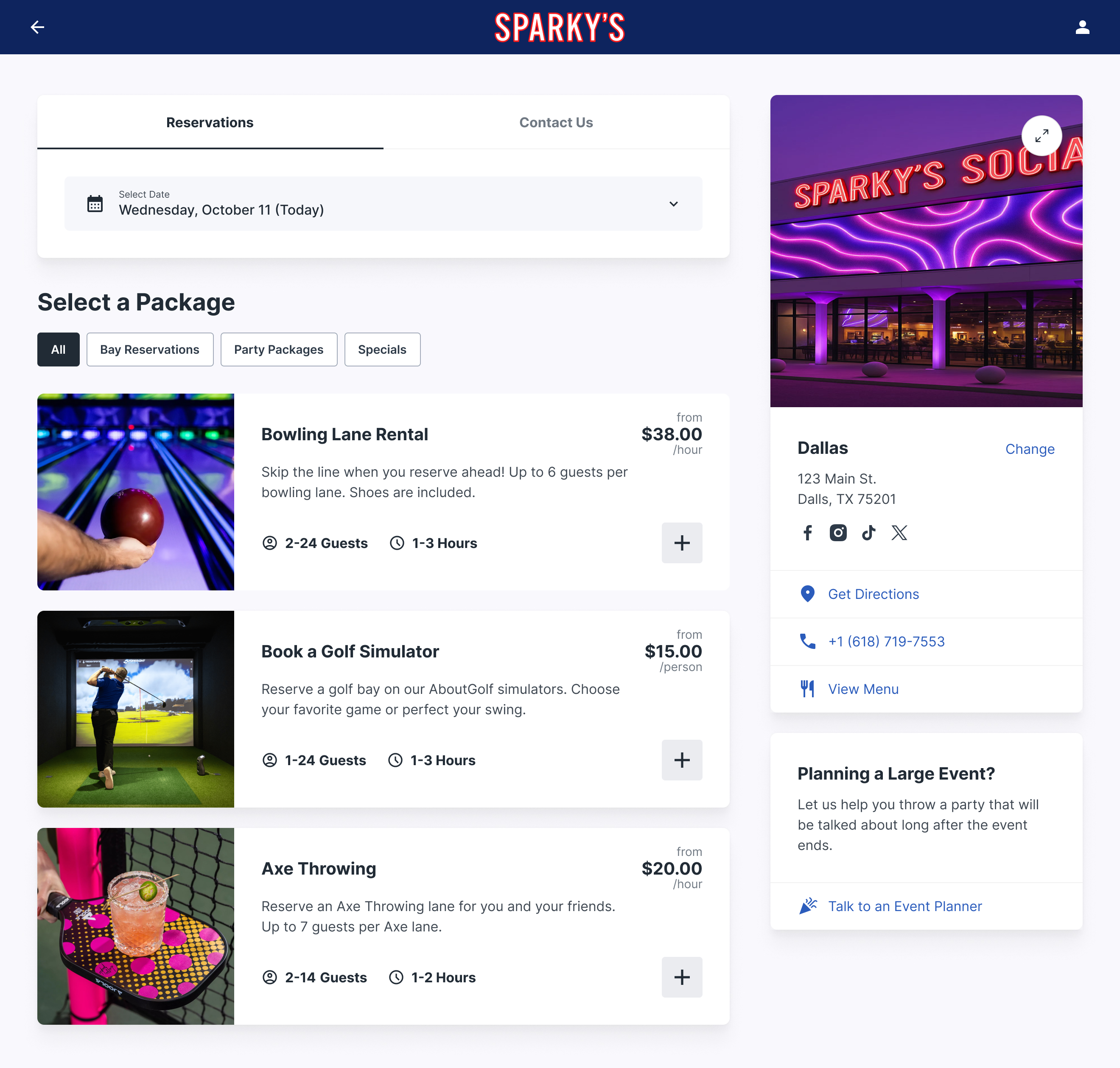
Rex’s checkout is built for complex, multi-activity bookings. Operators can create packages that bundle bowling + food + arcade credits, set dynamic pricing by time slot, offer add-on upsells during checkout, and embed the booking widget directly on their website. Atomic Golf tested 9 package configurations, narrowed to 3, and went from $2,000/day to $30,000/day in online bookings — that kind of rapid experimentation is where Rex excels.
AlleyTrak’s booking flow is simpler — guests select a date, pick available lanes, choose a time slot, and pay. It supports minimum reservation requirements (guest count, duration minimums) and double-booking prevention. The system works, but there’s limited ability to bundle activities, offer add-ons, or customize the checkout experience beyond the basics.
Winner: Rex across the board. Rex handles simple lane-only booking just as easily as complex multi-activity packages — you can stay simple today and turn on more features the week you need them, without switching platforms.
Branding and Guest Experience
Your booking page is part of your brand. Guests shouldn't feel like they've left your website and landed on a generic reservation form — that disconnect hurts conversion and makes your venue feel less professional.
Rex is built to feel like an extension of your brand. You control colors, typography, imagery, and layout; you can embed the booking flow directly on your site or run it on a custom domain (e.g. book.yourvenue.com) so guests never see a third-party URL. Confirmation emails, receipts, and reminders carry your logo and brand voice. Premium branding and custom domain are standard on Rex's Growth plan — they aren't paid add-ons.
AlleyTrak's booking page uses a standard template with limited customization — you can add a logo and basic colors, but the layout, fonts, and structure are fixed. Guests often land on an AlleyTrak-branded checkout, and confirmation emails come from the AlleyTrak system rather than your venue. There's no custom domain option, so the booking URL stays off your own domain.
Winner: Rex. Bookings should feel like a seamless continuation of your website, not a detour through someone else's platform. For venues that care about guest experience and brand consistency, this is a meaningful differentiator.
Party and Event Booking
Party packages are a major revenue driver for bowling centers. Rex treats parties as a first-class booking type — operators build custom packages (bowling + pizza + drinks + shoe rental), set per-guest or flat-rate pricing, and let guests book and pay online without calling the venue. The Tripleseat integration connects Rex’s reservation data directly into event management workflows, which is a big deal for venues doing serious event volume.
AlleyTrak handles event management through its admin panel — you can block off lanes for events and manage reservations — but there’s no self-serve party booking flow for guests. Parties are managed manually by staff rather than booked online by customers. There are no package-building tools or bundled add-on options.
Winner: Rex, decisively. If party revenue matters to your business, this alone may be the deciding factor.
Multi-Activity Support
Rex was designed from the ground up for venues with multiple activity types. Bowling, golf simulators, axe throwing, karaoke rooms, pickleball courts, VR bays — all managed from one dashboard with unified booking, scheduling, and reporting. Guests can book multiple activities in a single cart.
AlleyTrak started as a bowling-only system and has expanded to support axe throwing, driving ranges, and other recreation activities. Each activity type gets its own booking configuration, but the system treats them more as separate instances rather than a unified multi-activity experience. You can manage multiple activities under one account on the Premium ($59/mo) or Ultimate ($79/mo) plans.
Winner: Rex for true multi-activity venues. AlleyTrak can technically handle multiple activities but wasn’t built for that use case.
Multi-Location Management
Rex includes multi-location management on every plan — no add-on fees, no HQ module to purchase. FatCats runs 10 locations on Rex, and Triple Shift Entertainment manages 26. Centralized reporting, consistent branding, location-specific pricing and packages.
AlleyTrak supports multiple locations on its Premium (3 locations, $59/mo) and Ultimate (unlimited, $79+/mo) plans. The Basic plan is limited to one location. Management is handled through a single admin suite, but there’s less depth in centralized reporting and cross-location analytics compared to Rex.
Winner: Rex for multi-location operators who need enterprise-grade management. AlleyTrak works for 2–3 locations with basic needs.
Memberships
Rex includes built-in membership management — recurring billing, member-only pricing tiers, exclusive booking access, and automated renewals. Venues can use memberships to drive predictable recurring revenue and fill off-peak lanes.
AlleyTrak does not offer a membership or recurring billing feature. If you want to run a bowling league membership or loyalty program, you’d need a separate tool.
Winner: Rex. AlleyTrak doesn’t compete here.
Integrations
Rex’s integration ecosystem is a key differentiator. GoTab for F&B ordering, Tripleseat for event management, Steltronic for automatic scoring, aboutGOLF for golf simulators, Stripe for payments, plus API access for custom integrations.
AlleyTrak integrates with six payment processors — Authorize.Net, CardConnect, PayPal, Razorpay, Stripe, and Square. Beyond payment processing, there are no documented integrations with POS systems, event management tools, scoring systems, or other venue software.
Winner: Rex, by a wide margin. If your venue uses any third-party tools, Rex connects them. AlleyTrak is essentially standalone.
Pricing
This is where AlleyTrak’s appeal is obvious — and where you need to think carefully about total value.
Rex Pricing
- Core — $195/location/mo — Unlimited reservations, activities, add-ons, Stripe payments, branded checkout
- Pro — $295/location/mo — Multi-activity bookings, custom checkout, revenue attribution, analytics
- Growth — $395/location/mo — POS integrations, premium integrations, custom domain, priority support
- Enterprise — Contact us — Custom pricing for large or complex venues
No transaction fees. No per-booking charges. Flat rate.
AlleyTrak Pricing
- Basic — $49/mo — 1 location/activity, 1 admin user
- Premium — $59/mo — 3 locations/activities, 5 admin users
- Ultimate — $79+/mo — Unlimited locations/activities, unlimited admin users
AlleyTrak is significantly cheaper on the surface. But consider what’s included: AlleyTrak gives you lane reservations and payment processing. Rex gives you party packages, memberships, multi-activity booking, integrations with your POS and event tools, analytics, and enterprise support. The question isn’t which costs less — it’s which generates more revenue per lane hour.
If your venue does even one extra party booking per month because of Rex’s self-serve party packages, the $195–$295 price difference pays for itself. Atomic Golf’s jump from $2,000/day to $30,000/day didn’t come from cheaper software — it came from better booking tools.


Where Rex Wins
- Party package revenue — Self-serve online party booking is a revenue multiplier that AlleyTrak simply doesn’t offer
- Multi-activity flexibility — If you have (or plan to add) anything beyond bowling, Rex handles it natively
- Integration ecosystem — Connect your POS, event management, scoring systems, and payment tools in one workflow
- Branded guest experience — custom colors, typography, imagery, and a custom domain so your booking page feels like part of your website, not a third-party detour
- Membership revenue — Built-in recurring billing turns occasional bowlers into monthly subscribers
- Scalability — From 1 location to 26, Rex grows with you. Brands like FatCats and Punch Bowl Social prove the platform works at scale
Where AlleyTrak Wins
- Price — At $49–$79/month, AlleyTrak is the most affordable option for basic lane reservations
- Simplicity — AlleyTrak is a narrow, lane-only system with fewer knobs to turn; Rex matches it on simplicity for lane-only use cases but gives you more when you need it
- Quick setup — Simpler system means faster deployment — venues report going live quickly
- Payment processor flexibility — Six processor options give more choice than most competitors
The Real Question to Ask Yourself
The Rex vs AlleyTrak decision comes down to one question:
Are you running a bowling alley, or are you running an entertainment business?
If you operate a straightforward bowling center — lanes, shoes, maybe a snack bar — and your only goal is getting reservations online instead of on the phone, Rex Core and AlleyTrak both do the job at comparable prices. The difference is what happens next: Rex gives you a path to party packages, memberships, and integrations the day you want them, with no platform migration required.
But if you’re thinking bigger — party packages that book themselves, memberships that create recurring revenue, multiple activities under one roof, integrations with your POS and event tools — AlleyTrak will hit a ceiling fast. And switching platforms later costs more in time, disruption, and lost revenue than starting with the right one.
Most bowling centers are adding activities. Most operators want party revenue. Most venues will eventually need integrations. Rex is built for where the industry is going. AlleyTrak is built for where it’s been.
Frequently Asked Questions
Is AlleyTrak really just for bowling?
AlleyTrak started as a bowling lane reservation system and has expanded to support axe throwing, driving ranges, and other recreation venues. However, its core functionality and design are still centered around lane-based reservations. Rex was built from day one for multi-activity venues.
Can I switch from AlleyTrak to Rex without losing reservations?
Yes. Rex’s onboarding team handles data migration and setup. Most venues run both systems briefly during the transition. Future reservations and customer data can be transferred.
Does Rex charge transaction fees?
No. Rex charges a flat monthly rate per location. No per-booking fees, no percentage of sales, no hidden charges. Standard Stripe payment processing fees still apply (those are Stripe’s fees, not Rex’s).
Is AlleyTrak good enough for a small bowling center?
Rex is a strong fit for small and single-location bowling centers — it handles lane-only online reservations just as easily as AlleyTrak, at a comparable price on the Core plan, with all the headroom you need when you decide to add party packages, memberships, or a second activity. AlleyTrak is cheap and narrow; Rex is affordable and gives you somewhere to grow into.
Can AlleyTrak handle party bookings?
AlleyTrak lets staff manage events through the admin panel, but there’s no self-serve party booking flow for guests. Customers can’t build and book a party package online the way they can with Rex.
Which platform has better customer support?
Rex is consistently praised for fast, responsive support from a team that builds the product. AlleyTrak offers email-based support. For venues that need hands-on help with configuration, onboarding, and optimization, Rex’s support is a meaningful advantage.
Ready to See Rex in Action?
The best way to compare is to see Rex with your own venue data. Book a free demo and we’ll show you exactly how Rex handles your lanes, packages, and booking flow — no commitment, no pressure.
Related Articles
• Rex vs ROLLER: Which Venue Booking Platform Fits Your Business?
• Best Bowling Booking Systems in 2026
• How to Increase Bowling Alley Revenue: 8 Strategies That Actually Work
• How FatCats Scaled to 10 Locations on Rex
• How to Build the Ultimate Party Package for Your Competitive Socializing Venue
• How Rex Handles Bowling Reservations: Features, Setup & What to Expect