
If you operate a competitive socializing venue, eatertainment concept, or any entertainment-focused space, your website isn't a brochure. It's your highest-volume salesperson. It works 24/7, handles thousands of visitors simultaneously, and — if it's built right — converts curious browsers into confirmed bookings without a single phone call.
The problem? Most venue websites are built like restaurant sites from 2015. Static photos, buried hours, clunky booking flows, and zero personality. In a category where the entire value proposition is experience, that's a costly disconnect.
This guide covers everything operators need to know about building a venue website that actually performs — from first impressions to page speed to measuring what's working. Whether you're launching a new concept or overhauling an existing site, these are the optimizations that move the needle.
Why Your Website Matters More Than You Think
For most entertainment venues, the guest journey starts online. Someone hears about your spot from a friend, sees a TikTok, or searches "fun things to do near me" on a Friday afternoon. They land on your website. And within about five seconds, they've already decided whether they're booking or bouncing.
That's not an exaggeration. Research consistently shows that users form opinions about a website in under five seconds — and for experience-driven businesses, those snap judgments are even more critical. Your website has to immediately communicate energy, quality, and ease.
If you're not sure whether your site is actually converting visitors, start with a self-audit. We break down exactly how to evaluate your site in Is Your Eatertainment Website Actually Turning Visitors into Paying Guests?
First Impressions: Lead with Video and Real Photography
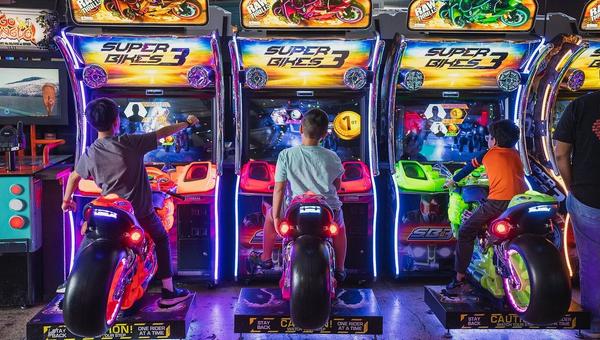
Static hero images don't cut it anymore — especially for venues where the whole point is atmosphere and energy. Your homepage should open with a professional video loop, roughly 10 to 15 seconds, showing real guests having a great time. Think groups laughing over bowling lanes, families cheering at an axe-throwing bullseye, friends clinking drinks at the bar while a shuffleboard game plays out behind them.
The key word is real. Stock footage of generic smiling people in generic spaces kills credibility instantly. Invest in a half-day professional shoot at your venue. Capture actual guests (with permission), real food and drinks, the lighting at its best. This single asset — a well-produced hero video — can transform your entire site's conversion rate.
Pro tip: Keep video files optimized. A beautiful hero video that takes eight seconds to load defeats the purpose. Use compressed formats (WebM or MP4 at 720p) and consider lazy-loading below-the-fold media.
Below the hero, continue the visual story throughout the site. Every section should include high-quality imagery that reinforces what the experience feels like. Activity pages, event spaces, food and drink menus — all of it should be visually rich and authentic.
Visual identity is especially important for venues leaning into the Instagrammable experience trend. Your website should feel like a natural extension of the shareable moments guests create in your space.
Navigation and UX: Make Information Effortless to Find
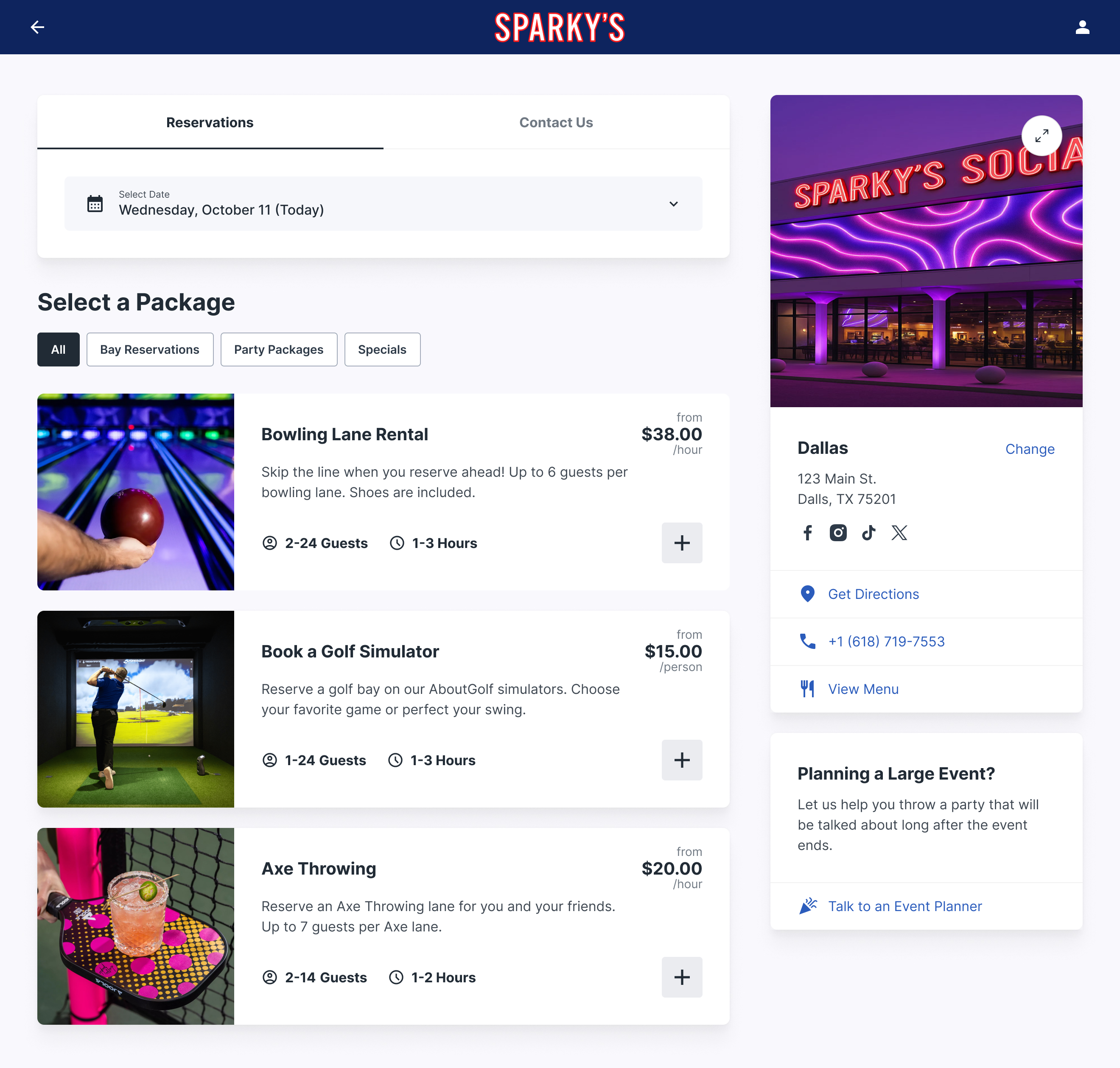
Here's a test: open your website on your phone right now. Can you find your hours, pricing, and booking page within two taps? If not, you're losing guests.
Entertainment venue websites tend to overcomplicate things. They bury hours in the footer, hide pricing behind PDF downloads, and scatter activity information across multiple pages. Every extra click is a chance for someone to leave.
Effective venue website navigation follows a few principles:
- Hours, location, and contact info should be visible on every page — ideally in the header or a persistent banner.
- Activity pages should include pricing, duration, capacity, and age requirements in a scannable format. No PDFs.
- Menus belong in-page with tabs or accordions — not as downloadable files that open in a new window on mobile.
- Your primary navigation should have no more than five to seven items. If you need more, use dropdowns sparingly.
- Use clear, descriptive labels. "Experiences" is vague. "Bowling," "Axe Throwing," "Escape Rooms" is specific.
Think of your site structure like your physical venue: clear signage, logical flow, no dead ends. A guest should never feel lost.
Mobile Optimization Isn't Optional — It's Primary
At least 70% of your website traffic is coming from mobile devices. For many venues, especially those targeting younger demographics, it's closer to 85%. Your mobile experience isn't a scaled-down version of your desktop site. It is the site.
Mobile optimization for entertainment venues means:
- Buttons large enough to tap easily — at least 44x44 pixels — with adequate spacing between them.
- No horizontal scrolling. Ever. If any element extends beyond the screen width, fix it immediately.
- Text that's readable without zooming. Minimum 16px for body copy.
- Forms that use appropriate input types — numeric keyboards for phone numbers, email keyboards for email fields.
- A booking flow that works flawlessly on a phone screen. This is where most venues drop the ball.
Test your site on at least three different phone models and both iOS and Android. What looks fine on your iPhone 16 might break on a guest's older Android device. Test regularly — not just at launch.
Booking Flow: The Make-or-Break Moment
Your entire website exists to get someone to this point: they're ready to book. And this is exactly where most venue websites fumble.
Common booking flow problems include redirecting to a completely different-looking external system, requiring account creation before booking, showing too many options or steps on a single screen, failing to work properly on mobile, and not confirming the booking clearly with a confirmation page and email.
The gold standard is an embedded booking experience that feels native to your website. Same fonts, same colors, same energy. The guest should never feel like they've been handed off to a different company's software.
The booking flow is the single highest-leverage page on your entire site. A 10% improvement in booking completion rate can mean thousands of dollars in additional monthly revenue.
Test your own booking flow from start to finish — on mobile, on desktop, on different browsers. Time how long it takes. Count the number of clicks. If it takes more than 60 seconds or more than four clicks to complete a booking, there's room to improve.
Looking for specific strategies to drive more group bookings? Check out How to Increase Party Bookings at Your Entertainment Center.
Local SEO: Get Found When It Matters
Most guests find entertainment venues through local search — "bowling near me," "fun things to do in [city]," "birthday party venues [neighborhood]." If your website isn't optimized for these searches, you're invisible at the exact moment people are deciding where to go.
Local SEO fundamentals for entertainment venues:
Google Business Profile: This is non-negotiable. Claim it, complete every field, add photos weekly, respond to every review, and post updates regularly. Your GBP listing often gets more visibility than your actual website in local searches.
Location pages: If you operate multiple locations, each needs its own page with unique content — not a copy-paste with the city name swapped out. Include the full address, embedded Google Map, location-specific hours, and unique descriptions.
Schema markup: Add LocalBusiness structured data to your site. This helps Google understand your venue type, hours, location, and pricing — and can earn you rich results in search.
Consistent NAP: Your name, address, and phone number should be identical everywhere — your website, Google Business Profile, Yelp, TripAdvisor, and any directory listings. Inconsistencies hurt your local ranking.
Local content: Blog about local events, partnerships, and community involvement. This builds topical relevance for your area and gives Google more signals about where you operate.
Not sure what competitive socializing actually means in the context of SEO and positioning? Read What Is Competitive Socializing? for a full breakdown of the category.
Social Proof and User-Generated Content
People trust other people more than they trust your marketing. That's just reality. The most effective venue websites lean heavily into social proof — reviews, testimonials, and especially user-generated content.
Here's how to make social proof work on your site:
- Embed a live feed of your best Google or Yelp reviews on your homepage. Real reviews from real guests carry more weight than any copy you write.
- Integrate Instagram or TikTok content throughout the site — not just on a single "social" page. Show real guests in real moments across activity pages, event pages, and the homepage.
- Feature UGC prominently on event and party pages. Parents planning a birthday party want to see what other birthday parties looked like at your venue.
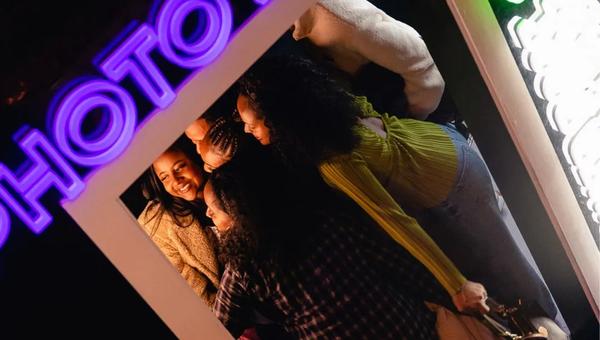
- Create photo-worthy moments in your venue specifically designed to generate UGC — branded walls, neon signs, unique installations. Then feature that content on your site.
The loop is powerful: guests create content at your venue, you feature it on your website, new visitors see it and book, they create content, and the cycle continues. Build for it intentionally.
The eatertainment model thrives on exactly this kind of social energy. The more shareable your venue is, the more your guests become your marketing team.
CTAs That Actually Convert
A call-to-action is only effective if it's specific, visible, and compelling. Yet most venue websites are littered with vague "Learn More" buttons that lead to more reading instead of booking.
Effective CTA strategy for entertainment venues:
- Use action-specific language: "Book Your Lane," "Reserve a Bay," "Plan Your Party" — not "Learn More" or "Click Here."
- Make your primary CTA visually dominant on every page. It should be the most obvious clickable element.
- Place CTAs at natural decision points — after describing an activity, after showing pricing, after social proof sections.
- Use a sticky header or floating button with your primary CTA on mobile. The booking option should always be one tap away.
- Test different CTA copy and placement. What works on your homepage might not work on an activity page.
One primary CTA per page. One clear action you want the visitor to take. When someone finishes reading about your axe-throwing experience, "Book Your Session" should be the only logical next step — and it should be staring them in the face.
Page Speed: The Invisible Conversion Killer
A one-second delay in page load time can reduce conversions by 7%. For a venue doing $50,000 a month in online bookings, that's $3,500 in lost revenue — every month — because your site is a little slow.
Most venue websites have speed issues tied to:
- Uncompressed images. That 5MB hero photo should be a 200KB WebP file. Use modern image formats and serve responsive sizes.
- Unoptimized video. Hero videos should be compressed, served via CDN, and set to lazy-load if below the fold.
- Too many third-party scripts. Every chat widget, analytics tool, and social embed adds load time. Audit and remove what you don't actually use.
- No caching. Proper browser and server caching can dramatically improve repeat visit speeds.
- Slow hosting. If your site is on budget shared hosting, it shows. Invest in quality hosting or a CDN.
Run your site through Google PageSpeed Insights right now. Look at your mobile score specifically. If you're below 70, there's significant room for improvement. Target 90 or above.
Payments, Upselling, and Revenue Optimization
Your website isn't just a booking tool — it's a revenue tool. The best venue websites build upselling directly into the online experience.
During the booking flow, present relevant add-ons: shoe rentals, food and drink packages, VIP upgrades, party decorations. Show them at the right moment — after the core booking is confirmed but before payment — and make them easy to add with a single click.
Accept every payment method your guests expect. Credit cards are baseline. Apple Pay, Google Pay, and buy-now-pay-later options remove friction for different demographics. The easier it is to pay, the more they'll spend.
Display pricing transparently throughout the site. Hidden fees revealed at checkout are the fastest way to lose a booking. If there's a service charge or weekend premium, show it upfront.
Measuring What Works
Optimization without measurement is just guessing. You need data to know what's working, what's not, and where to focus next.
At minimum, track these metrics:
- Bounce rate by page — especially your homepage and activity pages. A high bounce rate signals a disconnect between what visitors expect and what they find.
- Booking funnel conversion rate — what percentage of visitors who click "Book Now" actually complete a booking? Where do they drop off?
- Mobile vs. desktop conversion rates. If desktop converts at 5% and mobile converts at 1%, your mobile experience needs work.
- Page load times by device type. Monitor this monthly, not just once.
- Top landing pages from organic search. These tell you what Google thinks your site is about — and where your SEO is working.
Set up Google Analytics 4 and Google Search Console if you haven't already. Review your data monthly at minimum. Make one optimization per month based on what the data tells you, measure the impact, and iterate.
Start With a Self-Audit
You don't need to overhaul everything at once. Open your website on your phone right now and walk through it as a first-time visitor. Try to find your hours. Try to book an activity. Try to find your menu. Time yourself.
Identify the three biggest friction points and fix those first. Then move to the next three. Every improvement compounds — a faster site with clearer CTAs and a smoother booking flow doesn't just add up, it multiplies.
Your venue's experience is the product. Your website's job is to sell that experience before anyone walks through the door. Make it count.
Related Articles
• Is Your Eatertainment Website Actually Turning Visitors into Paying Guests?
• Capturing Attention: How Activity Centers are Leveraging Instagrammable Experiences
• What Is Competitive Socializing?
• How to Increase Party Bookings at Your Entertainment Center