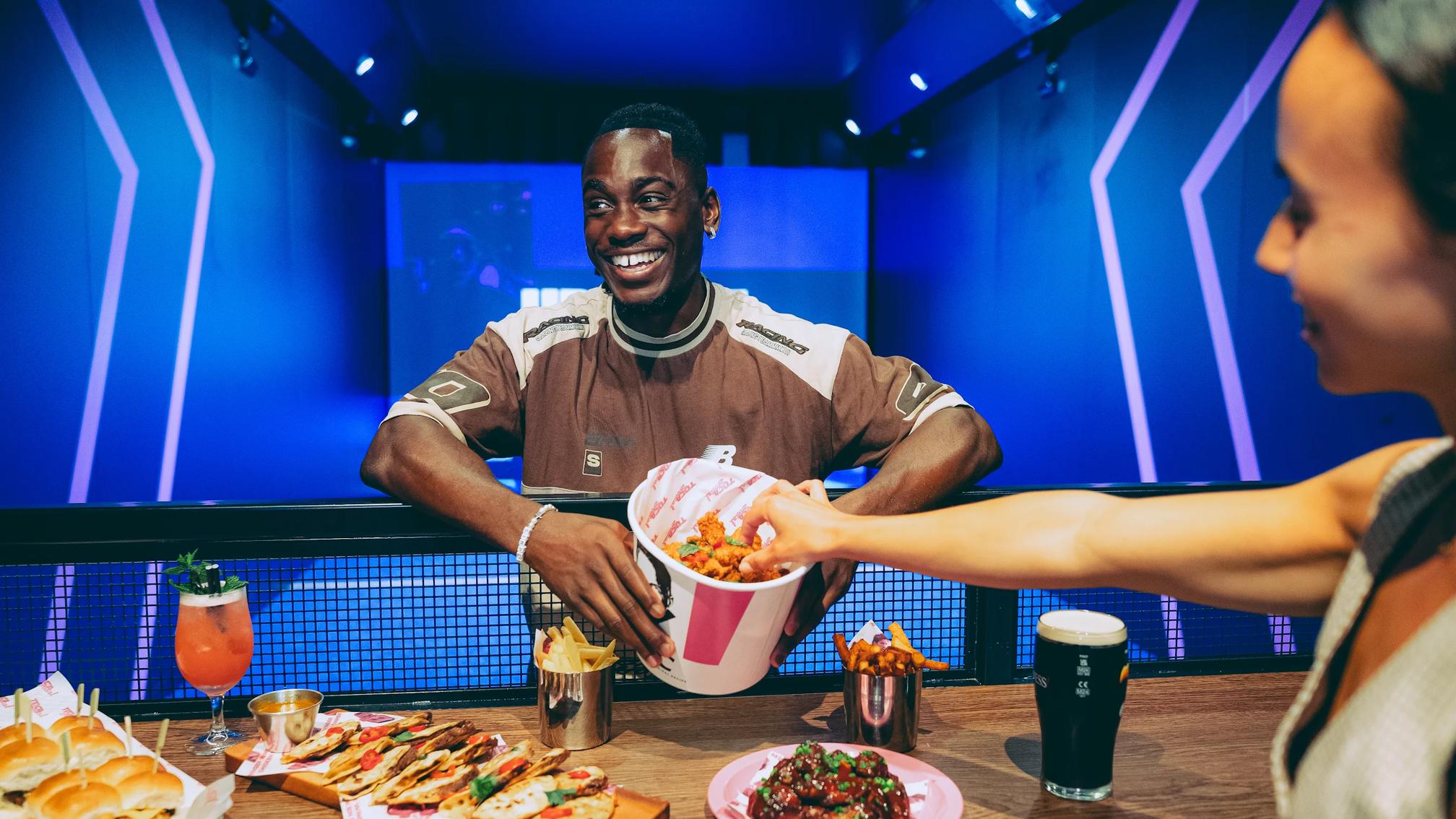
Eatertainment is any venue that pairs a full food-and-beverage operation with interactive activities like bowling, golf simulators, axe throwing, pickleball, or karaoke, so guests come for the experience rather than just the meal. The most popular eatertainment concepts right now are modern bowling centers, golf simulator lounges, competitive socializing venues built around axe throwing, darts, and mini-golf, pickleball clubs with real kitchens, family entertainment centers, and private-room karaoke. If you've visited a Topgolf, bowled at a Punch Bowl Social, or thrown axes at a Chicken N Pickle, you've experienced the model firsthand.
The category has grown from industry buzzword to a $120 billion global market, and in 2026 it is still accelerating. This guide breaks down what eatertainment actually means, the concepts driving the trend, the economics behind it, emerging formats to watch, and how technology is reshaping the operator playbook. Whether you're planning to open a venue or looking to modernize an existing one, this is your complete primer.
What Is Eatertainment?
Eatertainment is a portmanteau of "eating" and "entertainment." It describes any venue that combines a full food-and-beverage operation with one or more interactive activities — bowling, golf simulators, axe throwing, arcade games, karaoke, pickleball, mini-golf, escape rooms, and more. The defining characteristic: guests come for the experience, not just the meal.
Unlike a traditional restaurant that might add a pool table in the corner, eatertainment venues are designed from the ground up around the way dining and activity feed each other. The food is restaurant-quality (not an afterthought), the activities are the main draw (not background noise), and the two are intentionally woven together so guests stay longer and spend more.
The concept isn't brand new — Dave & Buster's has been around since 1982 — but the modern eatertainment wave started accelerating around 2015 with Topgolf's explosive growth, and it hasn't slowed down. By 2026, the category spans everything from boutique 3,000 sq ft karaoke lounges to 65,000 sq ft multi-activity mega-venues.
Why Is Eatertainment Booming in 2026?
The eatertainment trend isn't a fad — it's backed by structural shifts in consumer behavior and real estate economics. Here's what's driving growth:
- The experience economy is mainstream — 78% of millennials and Gen Z prefer spending on experiences over things, according to Eventbrite's 2025 survey. Eatertainment venues are purpose-built for this preference.
- Social media amplifies the model — Instagram-worthy bowling lanes, neon-lit axe throwing bays, and craft cocktails served lane-side generate organic marketing that traditional restaurants can't match. Venues like Puttshack and Puttery design specifically for shareability.
- Mall and retail vacancies create opportunity — the decline of big-box retail has left thousands of large-footprint spaces available at favorable lease terms. Eatertainment operators are filling those gaps — Topgolf, Round1, and Lucky Strike have all expanded into former retail locations.
- Higher revenue per square foot — eatertainment venues generate $450–$800 per sq ft annually, compared to $150–$350 for traditional restaurants. The combination of activity fees, F&B spend, and longer dwell times (90–120 minutes average vs. 45 minutes for casual dining) changes the unit economics.
- Corporate and group spending is surging — post-pandemic companies are spending more on team-building and client entertainment. Corporate events represent 15–30% of revenue for many eatertainment operators. (For a deep dive, read our guide on running a profitable corporate events program.)
- Gen Alpha is entering the market — the first generation raised entirely on screens craves IRL social experiences. Birthday parties, friend hangouts, and family outings at eatertainment venues are a natural fit.
What Are the Most Popular Eatertainment Concepts Right Now?
The beauty of eatertainment is its breadth. Almost any activity can anchor a venue when paired with a strong F&B program. These are the most popular formats right now, roughly in order of venue count:
Modern Bowling Centers
The largest eatertainment subcategory by venue count. Modern bowling has shed the old-school alley image in favor of upscale design, craft cocktails, and multi-activity offerings. Punch Bowl Social, 810 Billiards & Bowling, and Splitsville Luxury Lanes pair premium bowling with full-service restaurants and bars. Many add arcades, shuffleboard, karaoke, or bocce to create multi-activity destinations. If you're considering this space, read our complete guide to starting a bowling alley.
Golf Entertainment Venues
Topgolf proved the model — now indoor golf simulators are the fastest-growing eatertainment format. Venues like Five Iron Golf, X-Golf, and independent sim lounges combine aboutGOLF or TrackMan simulators with full bars and food menus. The appeal: year-round play regardless of weather, lower real estate requirements than driving ranges, and strong corporate event potential. Check out our golf simulator business guide for the full breakdown.
Competitive Socializing Venues
This is the catch-all category for venues built around competitive socializing — axe throwing (BATL, Stumpy's), shuffleboard bars (Royal Palms), darts (Flight Club), and mini-golf (Puttshack, Puttery). The common thread: low-skill-floor activities that groups can enjoy together while eating and drinking. F&B typically drives 40–60% of revenue.
Pickleball and Court Sport Venues
The pickleball explosion has spawned a new eatertainment subcategory. Chicken N Pickle now operates multiple locations pairing indoor/outdoor courts with scratch kitchens. Electric Pickle, Smash Park, and dozens of independent operators have followed. Padel clubs are emerging as the next wave, particularly in Sun Belt markets.
Family Entertainment Centers (FECs)
FECs like FatCats, Main Event, and Dave & Buster's bundle multiple activities — go-karts, laser tag, arcades, bumper cars, VR experiences — with dining. The modern FEC is moving upmarket, investing in higher-quality food and design to compete with boutique operators. Read more on how to start a family entertainment center.
Karaoke Lounges and Bars
Private-room karaoke has boomed in U.S. markets, following the Asian model. Venues like Coin Karaoke, Lucky Voice, and independent K-bars combine private singing rooms with cocktail service and small plates. Low build-out costs and high hourly rates per room make this one of the most capital-efficient eatertainment formats.
Emerging Formats
- VR entertainment centers — Sandbox VR and Zero Latency combine free-roaming virtual reality experiences with lounge dining areas
- Escape room cafes — themed puzzle rooms paired with full bar and food service
- Experiential dining — immersive restaurants like The Aqua, The Lost Lemon, and dinner theater concepts where the meal IS the entertainment
- E-sports lounges — competitive gaming venues with F&B programs targeting the 18–35 demographic
Why Do Operators Love the Eatertainment Model?
Eatertainment isn't just a consumer trend — it's an operator's dream when executed well. The business model solves several problems that plague traditional restaurants and standalone entertainment venues.
- Longer dwell time — guests stay 90–120 minutes on average vs. 45 minutes at a casual restaurant. More time = more F&B spend. A bowling lane that holds a group for two hours while they order three rounds of drinks and appetizers is fundamentally more valuable per square foot than a table that turns every hour.
- Higher per-visit spend — the average eatertainment guest spends $45–$85 per visit (activity fees + F&B), compared to $25–$40 at a casual dining restaurant. Corporate groups push this well above $100 per person.
- Diversified revenue streams — activity fees, F&B, private events, corporate bookings, memberships, merchandise, and party packages. If one stream dips, others compensate. Traditional restaurants live and die on table turns alone.
- Natural upsell path — a guest who books a bowling lane at $40/hour is already committed to the visit. Now they're buying $14 cocktails and $18 shareables because they're already there and having fun. The activity anchors the spend.
- Recession resilience — during economic downturns, consumers cut travel and big-ticket purchases but maintain "affordable luxury" entertainment. A $60 eatertainment outing replaces a $200 concert or $500 weekend trip.
For operators exploring pricing strategies, our guide on dynamic pricing for entertainment venues covers how to maximize revenue across peak and off-peak hours.
What Eatertainment Trends Are Reshaping 2026?
Eatertainment is evolving fast. Here are the trends operators and investors are watching this year:
Smaller Footprint, Higher Density
The mega-venue era isn't over, but the fastest growth is in 5,000–15,000 sq ft formats. Operators are discovering that smaller venues in urban walkable locations with two to three activities outperform 60,000 sq ft suburban boxes on a per-square-foot basis. Lower build-out costs, faster time to revenue, and higher utilization rates make the math work.
Membership and Loyalty Programs
Recurring revenue is the holy grail. Venues like Topgolf, Five Iron Golf, and Puttshack now offer membership tiers that include free play hours, F&B credits, and priority booking. Memberships smooth revenue volatility and increase visit frequency by 2–3x. Read our deep dive on building a membership program for your entertainment venue.
Technology-First Operations
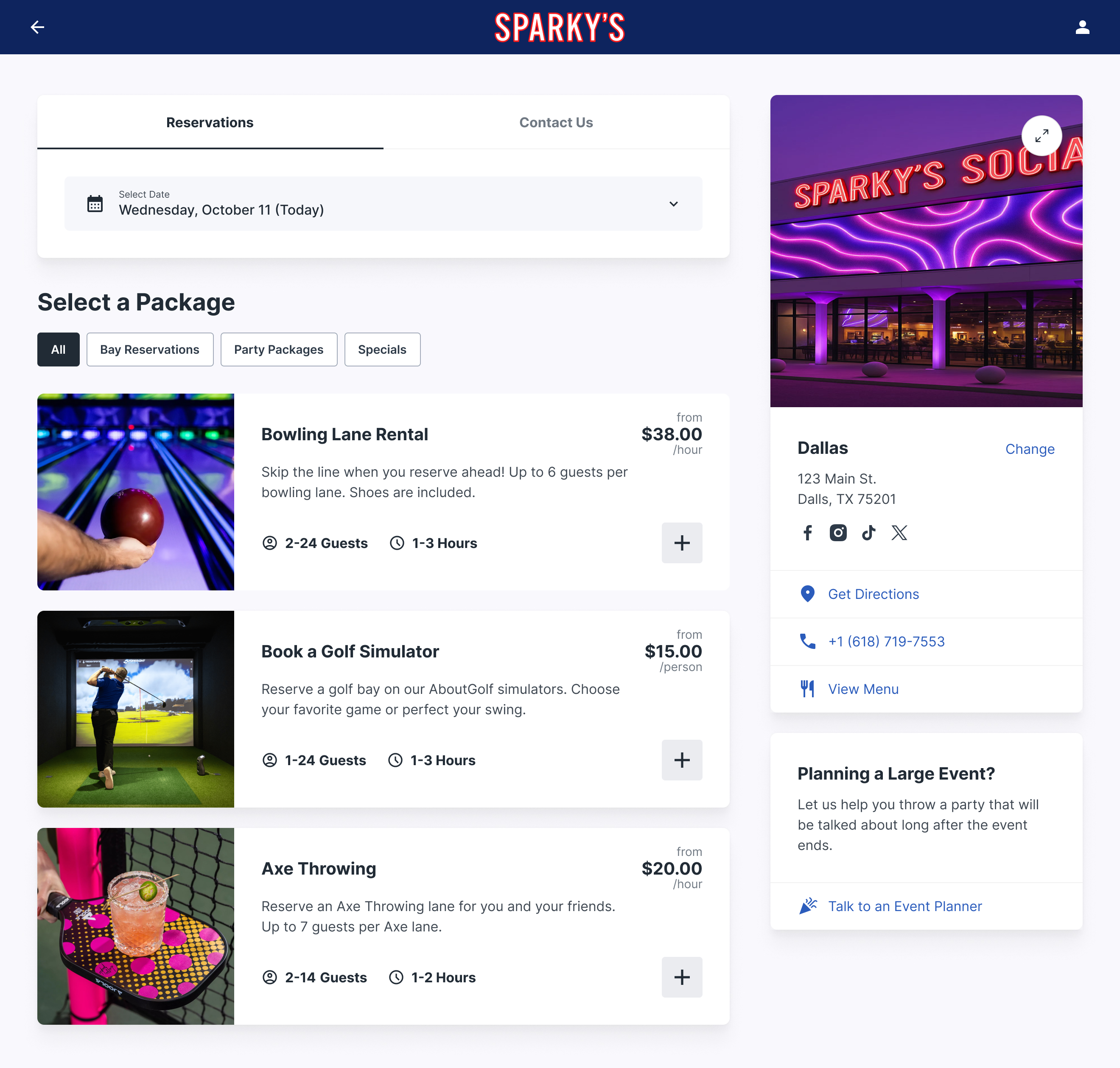
The gap between tech-forward venues and laggards is widening. Online booking, mobile ordering, automated lane/bay assignment, dynamic pricing, and integrated POS systems aren't optional anymore — they're baseline expectations. Venues using platforms like Rex for reservations and GoTab for mobile ordering are seeing measurably higher throughput and per-guest revenue.
Sustainability and Local Sourcing
Consumers — especially under-35 demographics — care about environmental impact. Forward-thinking eatertainment operators are sourcing locally, reducing single-use plastics, installing energy-efficient lighting and HVAC systems, and marketing their sustainability efforts. In a crowded market, it also works as differentiation.
Blurred Lines Between Categories
The old categories (bowling alley, arcade, restaurant) are dissolving. A modern venue might combine bowling, golf simulators, karaoke rooms, a full restaurant, and a cocktail bar under one roof. The operators winning in 2026 think in terms of "experiences per square foot" rather than fitting into a single category.
How Does Technology Power the Modern Eatertainment Venue?
Technology is no longer a nice-to-have in eatertainment — it's the backbone of efficient operations and great guest experiences. Here's where it matters most:
- Online booking and reservations — guests expect to book lanes, bays, courts, and tables online before arriving. The booking flow is the guest's first impression of your venue. Venues using dedicated reservation platforms see 30–50% higher advance booking rates than those relying on phone-only reservations.
- Mobile ordering and payment — lane-side and table-side mobile ordering reduces wait times, increases order frequency, and frees staff to focus on hospitality instead of running orders.
- Dynamic pricing engines — adjusting activity rates by day, time, and demand. Friday 8 PM bowling costs more than Tuesday 2 PM — and guests accept it when it's transparent.
- Integrated systems — when the booking platform talks to the POS, which talks to the scoring system, which talks to the kitchen display, everything runs faster. Disconnected systems create bottlenecks that cost revenue.
- Data and analytics — understanding which activities drive the most F&B spend, which time slots underperform, and which marketing channels convert. Operators who measure, iterate, and optimize outperform those running on gut feel.
For a full rundown of the systems a modern venue needs, see our new venue tech stack guide.
How Do You Start an Eatertainment Venue?
If you're considering entering the eatertainment space, the fundamentals matter more than the trend. Here's the high-level roadmap:
- Choose your anchor activity — bowling, golf sims, axe throwing, pickleball, karaoke, or multi-activity. Pick based on your market, budget, and expertise.
- Validate the market — is there demand in your target area? Who's the competition? What's the population density and average household income within a 15-minute drive?
- Secure the right space — ceiling height, parking, visibility, lease terms, and zoning all matter. Eatertainment venues need specific infrastructure that not every retail space provides.
- Design for flow — the relationship between activity areas, dining, bar, and check-in determines throughput and guest satisfaction. Bad layout kills revenue.
- Build your tech stack early — booking system, POS, kitchen display, scoring/timing systems, and payment processing should be chosen before you open, not bolted on after.
- Plan your F&B program — this is where many eatertainment ventures stumble. The food needs to be genuinely good, not an afterthought. But the menu also needs to work within the constraints of an entertainment venue kitchen (limited prep space, high-volume rushes, items that travel well to lanes/courts).
We've published detailed guides for specific verticals — bowling, golf simulators, axe throwing, padel clubs, FECs, karaoke, and pool halls. Start with the one closest to your concept.
Related Articles
• How Technology is Transforming Eatertainment Experiences
• Competitive Socializing: Where Good Times Get Competitive
• Is Your Eatertainment Website Actually Turning Visitors into Paying Guests?
• Dynamic Pricing for Entertainment Venues: How to Stop Leaving Money on the Table
• How Punch Bowl Social Manages Multi-Activity Reservations at Scale
Frequently Asked Questions
What does eatertainment mean?
Eatertainment is a combination of "eating" and "entertainment." It refers to venues that blend full-service dining with interactive activities like bowling, golf simulators, axe throwing, arcade games, or mini-golf. The goal is to create a complete social experience where food, drinks, and fun are equally important.
What is the difference between eatertainment and competitive socializing?
Eatertainment is the broader category — any venue combining dining with entertainment. Competitive socializing is a subcategory focused specifically on activities with a competitive element (darts, axe throwing, shuffleboard, mini-golf) paired with food and drink. All competitive socializing venues are eatertainment, but not all eatertainment is competitive socializing — a bowling center with a restaurant qualifies as eatertainment without the "competitive" framing.
How much does it cost to open an eatertainment venue?
Build-out costs vary widely by format and size. A 5,000 sq ft karaoke lounge might cost $300,000–$600,000 to build out, while a 30,000 sq ft multi-activity venue with bowling, simulators, and a full kitchen could run $2–$5 million. Key cost drivers include activity equipment, kitchen buildout, liquor licensing, interior design, and technology systems.
What are the most profitable eatertainment activities?
Golf simulators, bowling, and private karaoke rooms consistently rank among the highest-margin activities because of their strong hourly rates, low ongoing maintenance costs, and ability to drive high F&B attach rates. The most profitable activity for any specific venue depends on market demographics, competition, and execution quality.
Is eatertainment a good investment in 2026?
The fundamentals are strong: consumer demand for experiences is growing, large retail spaces are available at favorable lease terms, and the model generates higher revenue per square foot than traditional restaurants. However, success depends on location, concept, execution, and capitalization. Poorly run eatertainment venues fail like any other business. The operators thriving in 2026 are those with strong F&B programs, efficient tech stacks, and clear differentiation in their market.
What technology do eatertainment venues need?
At minimum: an online reservation and booking system, a point-of-sale (POS) system integrated with the kitchen, payment processing, and a website with real-time availability. Growing venues add dynamic pricing, mobile ordering, membership management, CRM, and analytics. The specific stack depends on the venue's size and activities — a bowling center needs lane management and scoring integration, while a golf sim venue needs simulator software and bay scheduling. The eatertainment wave is still building. Consumer demand for immersive, social, food-forward experiences is growing year over year, and the operators who combine great guest experiences with efficient technology are the ones capturing that growth. Rex is the booking and reservation platform built specifically for eatertainment and competitive socializing venues. From lane scheduling to party packages to dynamic pricing, Rex handles the operational complexity so you can focus on delivering great experiences. [Book a demo](https://www.reservewithrex.com/get-started) to see how Rex can power your venue.