
If you're comparing Rex vs FareHarbor for your entertainment venue, you're looking at two very different platforms built for two very different worlds. FareHarbor is one of the biggest names in online booking — powering tours, activities, and attractions for over 20,000 companies worldwide. Rex is a purpose-built venue management platform designed specifically for bowling alleys, golf simulators, FECs, axe throwing venues, and other activity-based entertainment businesses.
Both platforms handle online booking. But the similarities mostly end there. The right choice depends on what kind of business you run, how complex your operations are, and whether you need a booking widget or a full venue operating system.
This comparison breaks down features, pricing, integrations, and ideal use cases so you can make the right call for your venue.
Quick Overview: Two Platforms, Two Philosophies
FareHarbor is a booking and reservation platform owned by Booking Holdings (the parent company of Booking.com, Priceline, and Kayak). It was built for tour operators, activity providers, and attractions — think kayak rentals, zip line tours, museum tickets, and snorkeling excursions. It excels at converting website visitors into confirmed bookings through embeddable booking widgets and a massive distribution network.
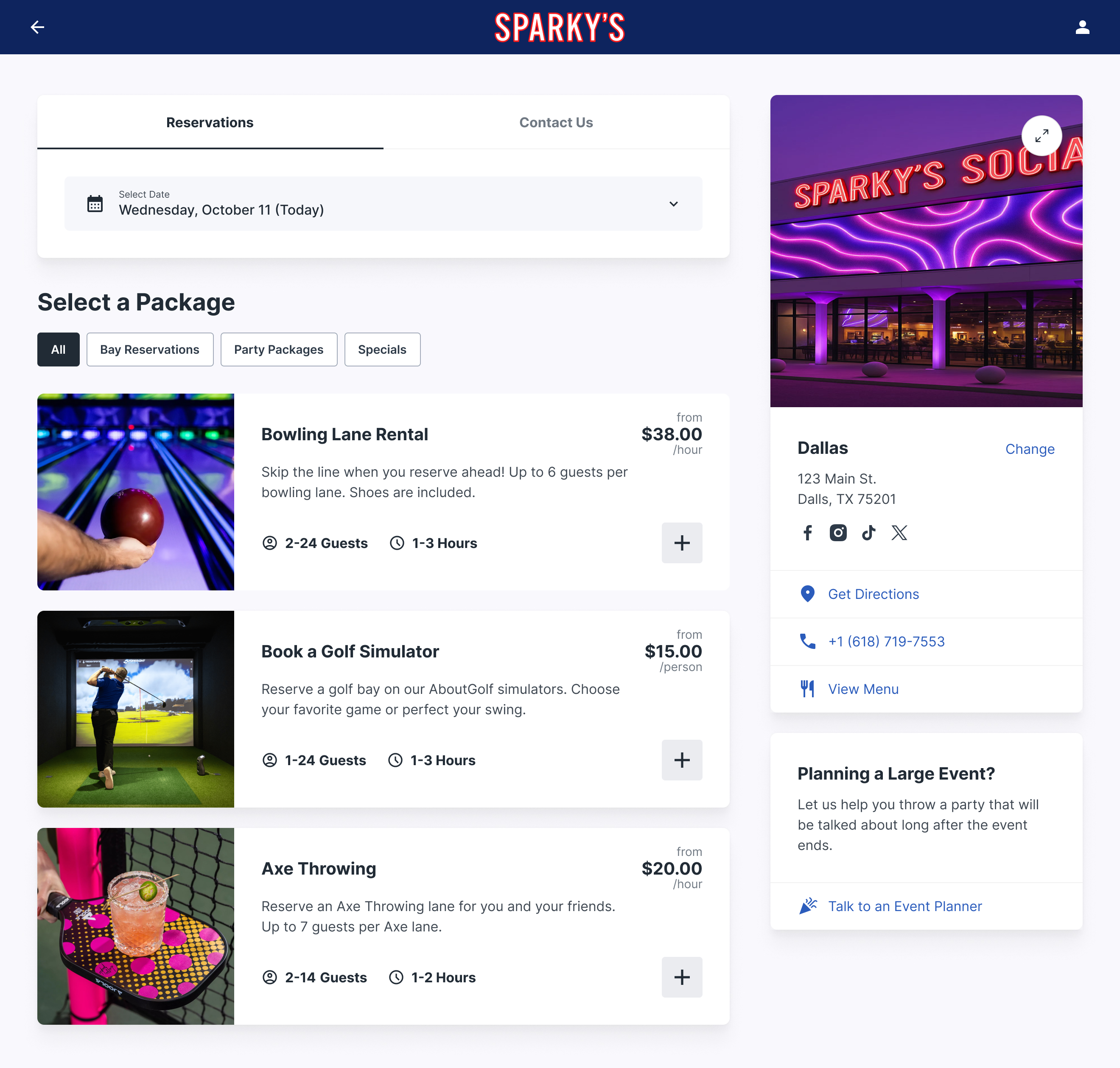
Rex is a venue management platform built from the ground up for activity-based entertainment venues. It handles online booking, but also lane and bay management, party packages with self-serve customization, memberships, waivers, and integrations with food and beverage POS systems like GoTab. Rex isn't trying to serve every business that takes a reservation — it's focused entirely on the operational complexity of multi-activity entertainment venues.
The core difference: FareHarbor is a booking engine. Rex is an operating system for venues.
Online Booking and Checkout
FareHarbor's booking experience is polished and proven. Their embeddable Lightframe widget lets customers book directly from your website without being redirected to a third-party page. It supports multiple activity types, date/time selection, add-ons, and secure payment processing. For a single-activity business — a kayak rental shop, a zip line park, a walking tour company — this works beautifully.
But entertainment venues aren't single-activity businesses. A typical FEC or bowling alley offers bowling, arcade games, laser tag, escape rooms, and food service — often in a single visit. Customers want to book a bowling lane, add laser tag for the kids, and reserve a party room, all in one transaction.
Rex's booking flow handles this natively. Its multi-activity single cart lets guests combine multiple activities, add-ons, and packages into one checkout. The system is built to understand venue-specific concepts like lane assignments, time slots, capacity limits per bay, and resource conflicts. FareHarbor can technically list multiple activities, but combining them into a unified cart experience with real-time resource availability isn't its core design.
Venue Operations and Resource Management
This is where the gap between the two platforms becomes clearest. FareHarbor is a booking engine — it gets people scheduled and paid. What happens after that is largely up to you and whatever other tools you're using to manage the floor.
Rex manages the entire venue operation. Lane and bay management shows your staff real-time availability, handles walk-ins alongside online bookings, and manages resource conflicts automatically. If a bowling league blocks 12 lanes every Tuesday night, Rex knows that and adjusts online availability. If a golf simulator needs 15 minutes between bookings for reset, Rex handles the buffer. If a party room needs to be turned over between events, Rex schedules the gap.
FareHarbor doesn't have lane management, bay assignment, or real-time floor views because it doesn't need them — tour boats and zip line courses don't work that way. But if you're running a 40-lane bowling center or a multi-bay golf simulator facility, you need that operational layer.
Party and Event Booking
Party bookings are a major revenue driver for entertainment venues — often 30–50% of total revenue. The booking experience for parties matters enormously because a complicated or slow process means lost bookings.
FareHarbor recently launched a Private Events feature designed for private charters and event bookings. It handles contracts, payments, and resource scheduling. This is a solid addition for tour and activity operators running private charters or venue rentals, but it's built around the charter and event rental model — not the birthday party and corporate event flow that entertainment venues depend on.
Rex's party booking system is purpose-built for entertainment venues. Customers can build their own party package online — choosing activities, headcount, food and beverage options, add-ons like decorations or VIP lanes, and time slots — all through a self-serve flow. The system calculates pricing in real time, collects deposits, and sends automated confirmations and reminders. It also integrates with Tripleseat for venues that use it for event management. For venues where party bookings are a core revenue line, this level of specialization matters.
Pricing Model
FareHarbor uses a commission-based pricing model that is free for operators. Instead of charging the business a monthly fee, FareHarbor adds a booking fee to the customer's transaction. This makes it attractive for smaller operators and seasonal businesses because there's no upfront cost. You pay nothing until you get bookings.
The downside of commission-based pricing shows up at scale. If your venue processes $50,000 or more in monthly online bookings, the per-transaction fees can add up quickly — potentially exceeding what you'd pay for a flat-rate subscription platform.
Rex uses subscription-based pricing. You pay a monthly fee based on your venue's size and needs. For entertainment venues doing consistent booking volume, the economics usually work out better with a flat subscription because the cost is predictable and doesn't scale with your revenue. Contact Rex directly for enterprise pricing tailored to your venue.
Distribution and Marketing
This is one area where FareHarbor has a genuine edge. Being owned by Booking Holdings gives FareHarbor access to a distribution network that includes Booking.com, Viator, GetYourGuide, Google Things to Do, and TripAdvisor. For tour and activity operators, this distribution is enormously valuable — it puts your experiences in front of millions of travelers actively searching for things to do.
For entertainment venues, though, the value of OTA distribution is more limited. Bowling alleys, FECs, and golf simulators serve primarily local and repeat customers, not tourists browsing Viator. Your marketing needs are more likely centered on local SEO, Google Business Profile, social media, and email marketing to your existing customer base.
Rex focuses on converting your own website traffic with an optimized booking flow, building repeat business through memberships, and growing revenue per visit through upsells and add-ons. It's a different growth model — retention and average order value rather than OTA distribution volume.
Integrations
FareHarbor integrates with a wide range of tools: Google Analytics, Mailchimp, Zapier, QuickBooks, and dozens of OTA platforms. It also has an open API for custom integrations. These integrations are geared toward the marketing and distribution stack that tour operators rely on.
Rex's integration stack is built for venue operations. Key integrations include GoTab for food and beverage POS, Tripleseat for event management, Steltronic for bowling scoring systems, aboutGOLF for simulator connectivity, Pixelcom for race timing, and gift cards natively and via integrations. These are the systems that entertainment venues actually use day-to-day — the ones that keep the floor running, not just the bookings flowing.
Memberships and Recurring Revenue
Memberships are a growing revenue stream for entertainment venues. Monthly membership plans that include perks like free shoe rental, discounted lane time, member-only pricing, and priority booking create predictable recurring revenue and increase visit frequency.
Rex has built-in membership management with recurring billing, tiered plans, member pricing rules, and automated renewals. Members get their own portal where they can manage their plan, view booking history, and access exclusive offers.
FareHarbor doesn't offer native membership management. If you want to run a membership program alongside FareHarbor, you'd need a separate tool for billing, member tracking, and pricing rules — adding complexity and potential sync issues.
Support and Onboarding
FareHarbor is known for strong customer support — 24/7 availability via phone and email, and an onboarding team that builds your dashboard and transfers existing reservations. With over 1,000 positive Capterra reviews, their support reputation is well-earned. For operators who need help getting set up quickly and want someone on the phone at 2 AM when a booking goes wrong, FareHarbor delivers.
Rex provides hands-on onboarding tailored to entertainment venues — including data migration from your existing platform, custom configuration for your specific activity types and pricing rules, and staff training. Because Rex is a more complex platform (it manages more of your operation), the onboarding process is more involved but ensures your team knows how to use every feature from day one.
Rex vs FareHarbor Feature Comparison

Where Rex Wins
Rex is the stronger choice when your venue has operational complexity that goes beyond simple booking. Specifically:
Multi-activity venues — If you offer bowling, golf sims, laser tag, escape rooms, or any combination of activities, Rex's multi-activity cart and resource management handle the complexity that FareHarbor wasn't designed for.
Party-heavy businesses — If birthday parties and corporate events are a significant revenue line, Rex's self-serve party builder with real-time pricing and Tripleseat integration is a major advantage.
Membership-driven venues — If you're building recurring revenue through membership plans, Rex handles this natively instead of requiring a separate subscription billing tool.
Venues with food and beverage — Rex's GoTab integration connects your booking system to your F&B operation, so tabs follow guests from the lanes to the bar without manual handoff.
High-volume venues — At scale, Rex's flat subscription pricing is more cost-effective than commission-based fees that grow with every booking.
Where FareHarbor Wins
FareHarbor is a genuinely good platform — just for a different type of business. It wins in these scenarios:
Tour and activity operators — If you run kayak tours, zip lines, walking tours, or any experience-based business, FareHarbor is built for exactly this. The booking flow, distribution network, and operator tools are all optimized for the tours and activities model.
Tourism-dependent businesses — If a large portion of your customers find you through OTAs like Viator or Booking.com, FareHarbor's distribution network is a massive advantage that Rex doesn't match.
Low-volume or seasonal businesses — FareHarbor's commission model means you pay nothing during slow months. For seasonal businesses that shut down in winter, this is a real financial advantage over a flat monthly subscription.
Single-activity attractions — If you operate one activity type (a trampoline park, a go-kart track, a museum) and just need clean online booking with strong distribution, FareHarbor is a proven, reliable choice.
The Hybrid Question: Can You Use Both?
Some entertainment venues in tourist-heavy markets consider running both platforms — Rex for venue operations and FareHarbor for OTA distribution. While technically possible, this creates real complexity: double-booking risk across two systems, split reporting, and staff needing to manage two dashboards. Unless OTA bookings represent a significant percentage of your revenue, the operational overhead usually isn't worth it.
For most entertainment venues, focusing on direct bookings through your own website — where Rex excels — is a more sustainable growth strategy than chasing OTA volume where you pay commissions on every transaction.
Making the Right Choice
The decision between Rex and FareHarbor isn't about which platform is better — it's about which platform fits your business. Ask yourself these questions:
Do you offer multiple activities that guests combine in a single visit? If yes, Rex's multi-activity cart and resource management are critical.
Do you need to manage lanes, bays, or rooms with real-time availability? If yes, you need Rex's operational layer. FareHarbor doesn't do this.
Do most of your customers come from OTAs and travel platforms? If yes, FareHarbor's distribution network is hard to beat.
Are party bookings a major revenue driver? If yes, Rex's self-serve party builder will save you hours of manual quoting and back-and-forth.
For the typical multi-activity entertainment venue — a bowling alley with an arcade and bar, an FEC with go-karts and laser tag, a golf simulator facility with a lounge — Rex is the platform built for your world. FareHarbor is an outstanding booking engine, but entertainment venues need more than a booking engine. They need a platform that understands lanes, bays, parties, memberships, and the operational chaos of a busy Saturday night.
Is FareHarbor free to use?
FareHarbor doesn't charge operators a monthly fee. Instead, it adds a booking fee to each customer transaction. This commission-based model means you pay nothing upfront, but the fees can add up significantly for high-volume venues processing thousands of bookings per month.
Can FareHarbor manage bowling lanes or golf simulator bays?
No. FareHarbor is a booking and reservation platform designed for tours and activities. It doesn't include lane management, bay assignment, real-time floor views, or resource conflict handling. For venue operations like these, you need a platform built for entertainment venues like Rex.
Does Rex connect to OTAs like Viator or Booking.com?
Rex is focused on direct bookings through your venue's own website rather than OTA distribution. Most entertainment venues generate the majority of their revenue from local and repeat customers, making direct booking optimization more valuable than OTA reach.
Can I switch from FareHarbor to Rex without losing my booking data?
Yes. Rex's onboarding team handles data migration, including customer records and booking history. Most venues run both systems in parallel for a short transition period to ensure nothing falls through the cracks.
Which platform is better for birthday party bookings?
Rex has a significant advantage here. Its self-serve party builder lets customers choose activities, headcount, food options, and add-ons online with real-time pricing. FareHarbor's Private Events feature is designed more for charter-style bookings and private rentals than the customizable party package flow that entertainment venues depend on.
Does FareHarbor offer membership management?
No. FareHarbor doesn't include native membership management. If you want to offer recurring membership plans with member pricing and automated billing, you'd need a separate tool alongside FareHarbor. Rex includes built-in membership management with tiered plans, member portals, and recurring billing.
See How Rex Works for Your Venue
Ready to see how Rex handles multi-activity booking, party packages, and venue operations? Book a demo and we'll walk you through the platform with your specific venue setup in mind.
Related Articles
Rex vs ROLLER: Which Venue Booking Platform Fits Your Business?
Rex vs CenterEdge: Which Venue Management Platform Fits Your Business?
Rex vs Clubspeed: Which Venue Management Platform Fits Your Business?
Rex vs Party Center Software: Which Platform Fits Your Venue?
Rex vs AlleyTrak: Which Bowling Reservation System Fits Your Business?
Rex vs SevenRooms: Which Reservation Platform Fits Your Venue?