If your entertainment venue charges the same price at 2 PM on a Tuesday as it does at 8 PM on a Saturday, you are leaving serious money on the table. Dynamic pricing — adjusting what you charge based on demand, time, and context — is how airlines, hotels, and ride-share companies have maximized revenue for years. Now it is the single biggest untapped lever for bowling centers, FECs, golf simulators, axe throwing venues, and every other activity-based entertainment business.
This is not about gouging customers. It is about aligning your prices with the value guests actually place on your experience at different times. A Friday night lane is worth more than a Tuesday afternoon lane — your pricing should reflect that. The venues that figure this out consistently generate 15–40% more revenue per available hour without adding a single new attraction.
What Is Dynamic Pricing (and What It Is Not)
Dynamic pricing means your rates shift based on measurable factors — time of day, day of week, season, demand levels, or booking lead time. It is not random price changes or surge pricing that punishes loyal customers. Think of it as a structured framework where every time slot has a price that reflects its true market value.
Most entertainment venues already practice a crude version of this. You probably charge more on weekends than weekdays, or run a happy hour special. Dynamic pricing takes that instinct and turns it into a system — one backed by data rather than gut feeling.
Here is what dynamic pricing is not:
- Not surge pricing — you are not Uber. Your guests should never feel penalized for showing up at a popular time. Prices are published in advance and guests choose the slot that fits their budget.
- Not discounting — dropping prices across the board is a race to the bottom. Dynamic pricing raises your ceiling on high-demand slots while making off-peak times more attractive.
- Not complicated — you do not need an algorithm. You need a pricing grid and the willingness to test it.
Why Dynamic Pricing Works for Entertainment Venues
Entertainment venues have a perishable inventory problem. An empty bowling lane at 3 PM on Wednesday cannot be sold later — that revenue is gone forever. Dynamic pricing solves this by maximizing revenue from high-demand periods and stimulating demand during slow ones.
The math is straightforward. A 20-lane bowling center running flat pricing at $35 per hour might average 60% utilization. With dynamic pricing:
- Peak hours (Friday–Saturday evening) — $50 per hour. These slots fill anyway — you are capturing the value guests already place on them.
- Standard hours (weekday evenings, Saturday afternoon) — $35 per hour. Your current rate, now positioned as the "regular" price.
- Off-peak hours (weekday daytime, Sunday morning) — $22 per hour. Low enough to attract price-sensitive segments — homeschool groups, retirees, remote workers looking for a midday break.
The result is not just higher revenue per peak hour. It is higher overall utilization because you have created a reason for price-sensitive guests to book during times they otherwise would not.
Consider Atomic Golf's transformation — they saw a 15x revenue jump partly by rethinking how they packaged and priced their time slots. When you pair smarter pricing with a frictionless booking experience, the results compound.
The Five Levers of Entertainment Venue Pricing
Dynamic pricing is not one strategy. It is a toolkit with five distinct levers you can pull independently or together.
1. Time-Based Pricing
The foundation. Divide your operating hours into three to four tiers based on historical demand:
- Premium — Friday and Saturday evenings, holiday weekends, special events. Highest price.
- Standard — weekday evenings and weekend afternoons. Your anchor price.
- Value — weekday daytime and early weekend mornings. Lowest price, designed to pull in new segments.
- Super value — dead zones you currently cannot fill. Price aggressively to test demand elasticity.
Start here. It is the easiest to implement and delivers the biggest immediate impact.
2. Day-of-Week Pricing
Not all weekdays are equal. Tuesday through Thursday often has different demand patterns than Monday or Wednesday. Look at your booking data from the last 90 days and identify which days consistently underperform. Those get lower rates. Days that run at 80%+ utilization get a premium tier.
3. Seasonal Adjustments
Summer, school breaks, and holiday seasons drive higher demand for most entertainment venues. Your pricing should reflect this. Many operators already do seasonal pricing informally — the key is making it systematic and publishing it in advance so guests can plan around it.
4. Lead-Time Pricing
Reward early bookers with lower rates. This gives you better demand visibility and locks in revenue. Guests who book 7+ days out get the best rate. Walk-ins or same-day bookings pay a premium. This is standard in hotels and airlines — entertainment venues are just catching up.
5. Package Bundling Psychology
Instead of discounting individual activities during slow times, bundle them into packages that feel like better value without reducing your effective hourly rate. A well-designed package pricing strategy that includes bowling plus food plus an arcade card for $65 per person feels like a deal — even if the components would total $55 if booked separately. Packages shift the conversation from "how much per hour" to "what experience am I getting."
How to Implement Dynamic Pricing Without Alienating Guests
The number one concern operators have about dynamic pricing is guest backlash. Fair enough. Here is how to do it without damaging your reputation.
Be Transparent
Publish your pricing grid. Show all time slots and their rates on your booking page. When guests can see that Tuesday at 2 PM is $22 and Saturday at 8 PM is $50, they do not feel tricked — they feel empowered to choose. Transparency turns dynamic pricing from a perceived penalty into a feature.
Frame It as Value, Not Penalty
Never say "peak surcharge." Say "off-peak savings" or "early bird rate." The psychology matters. Guests should feel they are getting a deal by choosing a less popular time, not being punished for wanting Saturday night.
Start Small and Expand
Do not launch five pricing tiers on day one. Start with two: regular and off-peak. Run it for 60 days, measure the impact, then add a premium tier for your busiest slots. Gradual changes let your staff and guests adjust without shock.
Use Your Booking System
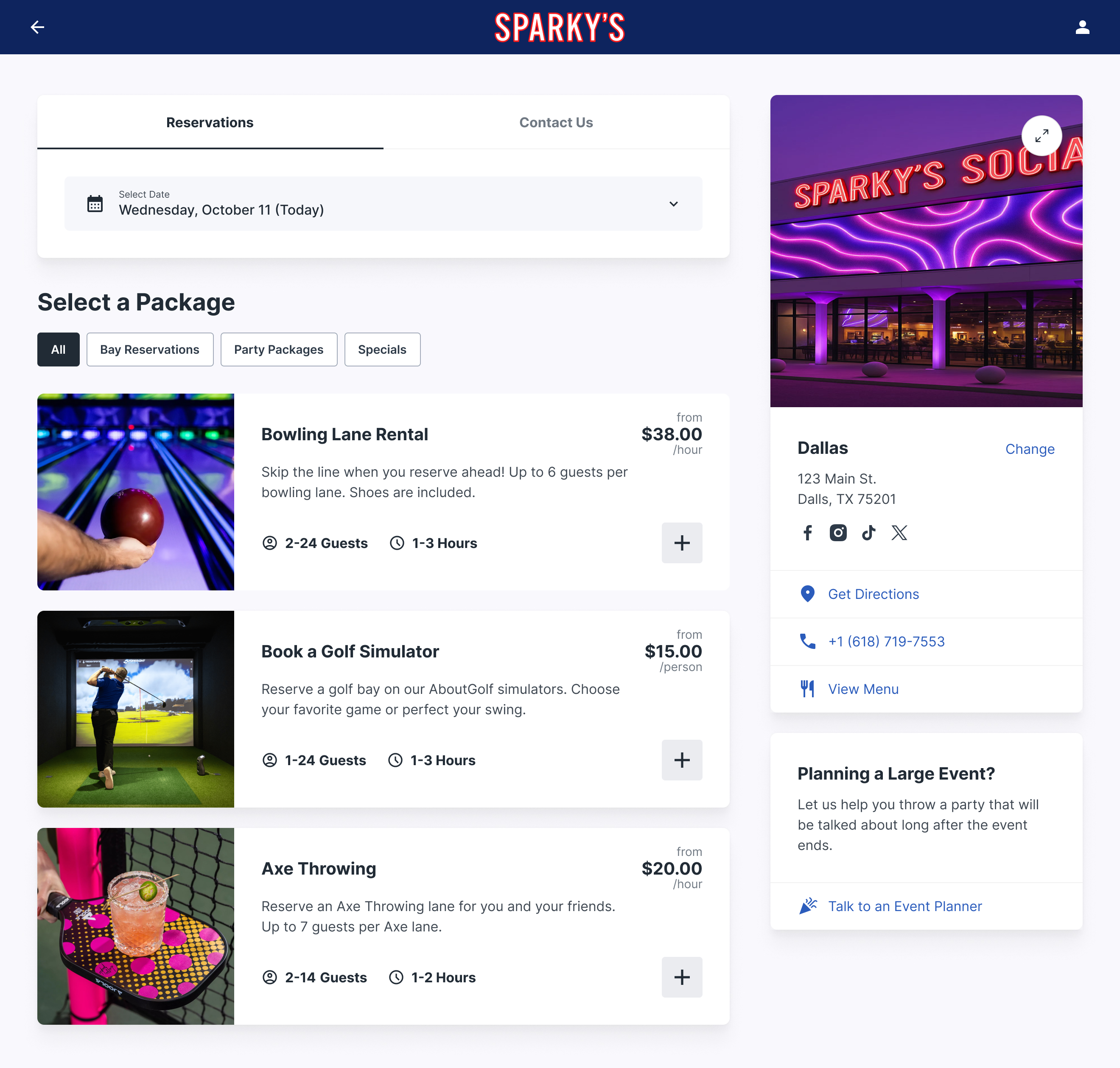
This is where your venue tech stack earns its keep. A modern booking platform lets you set time-based pricing rules once and have them apply automatically across your entire booking flow. Guests see the price for each slot in real time. No manual updates, no price list PDFs taped to the counter. Rex, for example, lets you configure different rates per time slot, day, and season — all visible to the guest during the booking process.
Real Numbers: What Dynamic Pricing Looks Like in Practice
Let us walk through a realistic example for a 16-lane bowling center.
Before dynamic pricing (flat $35 per hour):
- Average utilization — 55%
- Revenue per available lane hour — $19.25
- Weekly lane revenue (80 hours, 16 lanes) — $24,640
After dynamic pricing (three tiers):
- Peak ($50/hr) — 30% of hours, 90% utilization = $21,600
- Standard ($35/hr) — 40% of hours, 60% utilization = $10,752
- Off-peak ($22/hr) — 30% of hours, 45% utilization = $3,802
- Weekly total — $36,154
That is a 47% revenue increase from the same 16 lanes. And notice — overall utilization went up because the lower off-peak rate attracted guests who would not have come at $35. This is the compounding effect: higher revenue per peak hour plus more guests during off-peak.
Dynamic Pricing Beyond Lane Hours
Lane or court time is the obvious application, but smart operators apply dynamic pricing across their entire operation.
- Party and event packages — charge more for Saturday party slots than Wednesday ones. Corporate events during Q4 holiday season can command a 20–30% premium over summer bookings.
- Memberships — offer members access to off-peak rates as a perk. This drives utilization during slow times while making your membership more valuable.
- Food and beverage — happy hour pricing during off-peak activity times. If guests are already coming for $22 bowling, a $5 beer special makes the trip even more attractive and lifts your per-guest revenue.
- Arcade cards and add-ons — bundle arcade credits into off-peak packages at a slight discount. The marginal cost to you is near zero, and it increases perceived value.
Common Mistakes to Avoid
- Too many tiers — three to four is the sweet spot. More than that confuses guests and complicates your operations.
- Prices that change too frequently — set your pricing grid and let it run for at least 30 days before adjusting. Constant changes erode trust.
- Ignoring your data — dynamic pricing without booking analytics is just guessing. Track utilization by time slot weekly and adjust quarterly based on real patterns.
- Forgetting to communicate — your staff needs to explain the pricing when guests ask. Train your team on the why behind each tier so they can frame it positively.
- Discounting peak instead of raising it — if Saturday night is already selling out, your peak price is too low. The goal is to capture the value that already exists.
How to Get Started This Week
You do not need a consulting firm or a data science team. Here is a five-step plan you can execute in one week.
- Day 1 — Pull your booking data. Look at the last 90 days. Which time slots are above 80% utilization? Which are below 40%? This is your demand map.
- Day 2 — Design three tiers. Set a premium rate for your top 20% of time slots, keep your current rate as standard, and create a value rate 25–35% below standard for your bottom 30%.
- Day 3 — Configure your booking system. If your platform supports time-based pricing, set it up. If not, this is a strong signal it is time to upgrade.
- Day 4 — Update your booking page. Make the pricing visible. Add a simple grid or calendar view showing rates by time slot.
- Day 5 — Brief your team. Walk staff through the new pricing, the reasoning behind it, and how to handle guest questions.
Then run it for 60 days and measure. Compare revenue per available hour, overall utilization, and guest satisfaction. Nine times out of 10, you will see the same pattern: higher revenue with no increase in complaints. For more strategies to grow revenue without alienating guests, see our guide on increasing revenue per guest without raising prices.
Frequently Asked Questions
Will dynamic pricing drive away my regular customers?
No — if you implement it transparently. Regulars typically visit during off-peak times already, so they may actually see lower prices. The key is publishing your pricing grid so no one feels surprised. Most venues report zero increase in complaints after implementing time-based pricing.
How much of a price difference should there be between tiers?
A 25–40% spread between your lowest and highest tier is the sweet spot for most entertainment venues. Enough to influence behavior without feeling exploitative. For a $35 standard rate, that means $22–25 off-peak and $45–50 premium.
Do I need special software for dynamic pricing?
You need a booking system that supports time-based pricing rules. Any modern venue management platform — including Rex — lets you set different rates per time slot, day, and season. If your current system cannot do this, it is a strong signal to switch.
How long before I see results from dynamic pricing?
Most venues see measurable revenue lift within 30–60 days. The first month establishes the baseline. By month two, off-peak utilization typically increases as price-sensitive guests discover the value rates. Give it a full quarter before making major adjustments.
Should I apply dynamic pricing to party and event bookings too?
Absolutely. Party packages on Saturday afternoons should cost more than Wednesday evening slots. Corporate events during holiday season command a premium. Apply the same demand-based logic to every bookable product in your venue.
Stop Leaving Money on the Table
Dynamic pricing is not a theory — it is a proven revenue strategy that the best entertainment venues are already using. The question is whether you are going to keep charging flat rates while your competitors capture 30–40% more per available hour. Rex makes it easy to configure time-based pricing, publish it transparently to your guests, and track the results in real time. Book a demo to see how Rex can help your venue earn what every time slot is actually worth.