
Corporate events are the highest-revenue bookings most entertainment venues will ever handle. A single corporate outing can generate $5,000–$25,000 in a few hours — more than an entire weekend of walk-in traffic at some locations. Yet most venues treat corporate business as an afterthought, waiting for inbound inquiries instead of building a system that attracts them.
If you run a bowling center, FEC, golf simulator lounge, axe throwing venue, or any activity-based entertainment space, corporate events represent your biggest untapped revenue channel. This guide covers everything: how to price corporate packages, how to find and pitch local businesses, how to upsell food, beverage, and AV add-ons, and how to turn one-off events into repeat quarterly bookings.
Why Corporate Events Are Your Highest-Margin Revenue
Walk-in guests spend $25–$45 per person on a good day. Corporate groups routinely spend $75–$150 per person when you factor in activity fees, catering, private space rental, and bar tabs. The math is straightforward:
- Higher per-head spend — Corporate buyers aren't price-sensitive the way consumers are. They have event budgets to spend, and they want a memorable experience — not the cheapest option.
- Guaranteed minimums — Unlike walk-ins, corporate bookings come with confirmed headcounts and prepaid deposits. No empty lanes, no no-shows.
- Off-peak demand — Most corporate events happen on weekday afternoons and early evenings — exactly when your venue would otherwise sit half-empty.
- Repeat business — Companies don't do team building once. They do it quarterly, annually, for every new hire class. One great event becomes four bookings per year.
Venues like FatCats and Punch Bowl Social have built corporate events into a core revenue pillar — not a side hustle. The difference is having a system, not just a phone number on the website.
Building Your Corporate Event Package Menu
The biggest mistake venues make is offering a single "corporate event" option. Smart operators build a tiered package menu that lets corporate planners self-select based on group size, budget, and goals.
Starter Package (20–40 Guests)
- Activities — 2 hours of one primary activity (bowling, axe throwing, golf sim bays)
- Food — Buffet-style appetizers or pizza and wings
- Drinks — Soft drink package included, cash bar for alcohol
- Space — Semi-private area with reserved seating
- Price point — $40–$65 per person
Premium Package (40–100 Guests)
- Activities — 3 hours with access to multiple activities
- Food — Full catering menu with hot and cold options
- Drinks — Open bar for first 2 hours, then cash bar
- Space — Private event area with dedicated staff
- Add-ons — Branded welcome signage, team scoreboard, photo station
- Price point — $75–$110 per person
Executive Package (100+ Guests)
- Activities — Full venue buyout or dedicated wing, 4+ hours
- Food — Custom catering with dietary accommodations
- Drinks — Premium open bar throughout
- Space — Entire private area with AV setup for presentations
- Add-ons — Custom team-building competitions, awards, emcee support
- Price point — $110–$175 per person
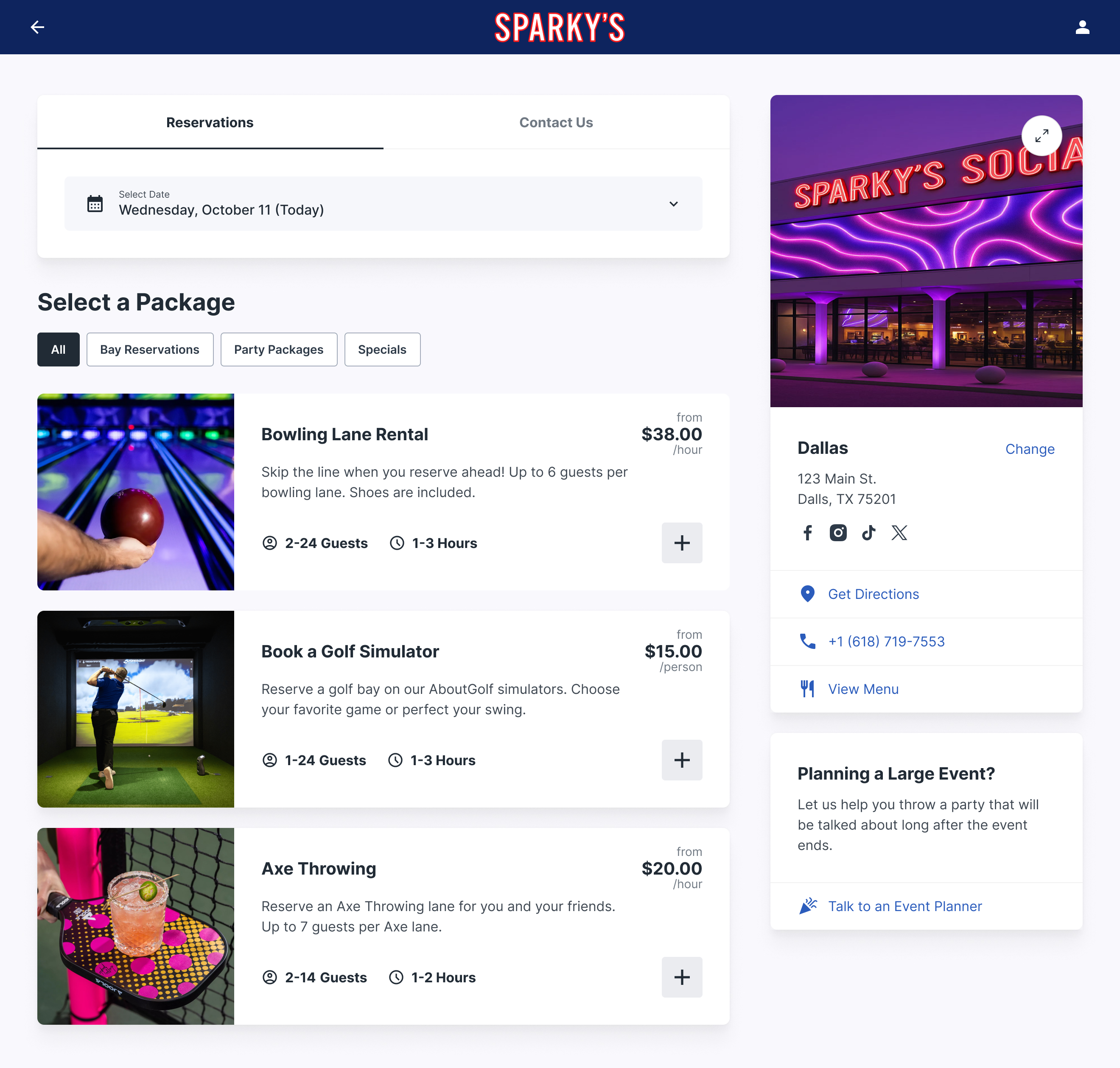
The key is making packages easy to understand and easy to book. If a corporate planner has to call you to figure out pricing, you've already lost half your prospects. Tools like Rex let you build custom party packages with granular add-ons that guests can browse and book online — no phone tag required.
Pricing Strategy That Maximizes Revenue
Corporate event pricing should follow three rules:
1. Always Price Per Person, Not Per Hour
Per-person pricing anchors the buyer to headcount, which is the number they actually care about. A company planning for 50 people immediately knows the budget. Per-hour pricing creates confusion and leaves money on the table when groups are large.
2. Build in Upsell Layers
Your base package should be attractive but leave room to add:
- Drink upgrades — Premium spirits, craft beer selections, wine pairings
- Food upgrades — From buffet to plated, add dessert stations, late-night snacks
- Activity add-ons — Extra time, additional activities, VIP lane access
- AV and branding — Projector use, custom welcome screens, branded photo booths
- Transportation — Partner with a local shuttle service for group pickups
3. Require Deposits and Minimums
Every corporate booking should require a 50% deposit at signing and have a minimum spend floor. This protects you from last-minute cancellations and ensures the booking is worth the reserved space. Typical minimums:
- Weekday afternoon — $1,500–$3,000
- Weekday evening — $2,500–$5,000
- Weekend — $5,000–$10,000
How to Find and Land Corporate Clients
Most venues sit back and wait for corporate inquiries. The venues making real money from corporate events actively pursue them. Here is a proven outreach system:
Identify Your Target Companies
Focus on companies within a 20-mile radius with 50–500 employees. These are large enough to have event budgets but small enough that an office manager or HR director makes the decision (not a procurement department). Look for:
- Tech companies — Remote-first teams that need in-person team building
- Professional services — Law firms, accounting firms, consulting companies
- Healthcare organizations — Hospital departments, dental groups, medical practices
- Financial services — Banks, insurance companies, wealth management firms
- Manufacturing and distribution — Warehouse teams, shift workers who rarely socialize together
Build Your Outreach List
Use LinkedIn Sales Navigator to find HR managers, office managers, and executive assistants at target companies. These are the people who plan team events. Google Maps can surface local businesses you might miss. Build a list of 100 companies to start.
The Outreach Sequence
A simple three-touch email sequence works well:
- Email 1 — Introduce your venue and corporate event capabilities. Lead with the experience, not the price. Include one photo of a past corporate event.
- Email 2 (3 days later) — Share a specific success story — "Last month we hosted [Company]'s team of 60 for their quarterly offsite. Here's what they said..."
- Email 3 (5 days later) — Offer a complimentary venue tour or a small team lunch on the house so they can experience the space firsthand.
The venue tour is your secret weapon. Once a corporate planner walks through your space during a live event and sees people having fun, the booking rate jumps dramatically.
Upselling Food, Beverage, and AV for Maximum Revenue
Food and beverage is where corporate events become truly profitable. The activity gets them in the door, but F&B is where the margin lives. If your venue has a food and beverage operation, make sure your corporate packages highlight it front and center.
Food and Beverage Best Practices
- Offer three catering tiers — Good, better, best. Most corporate buyers pick the middle option, so make sure that's your highest-margin package.
- Include at least one drink in the base price — It signals generosity and makes the package feel complete.
- Build bar packages by the hour — "$25 per person for 2 hours of open bar" is cleaner than running individual tabs.
- Partner with local caterers if you lack a kitchen — Take a 15–20% coordination fee for managing the catering logistics.
Venues using GoTab or similar POS integrations can streamline F&B ordering for large groups — guests order from their phones, kitchen gets organized tickets, and the corporate host gets a single consolidated bill.
AV and Presentation Capabilities
Many corporate events include a 15–30 minute presentation or awards ceremony. Having basic AV capabilities (projector, screen, microphone) can be the deciding factor for a corporate planner choosing between your venue and a hotel ballroom. If you already have screens for scoring or entertainment, repurposing them for corporate presentations is a low-cost add-on worth $200–$500 per event.
Technology That Makes Corporate Events Scalable
Running corporate events manually — email threads, spreadsheet tracking, phone calls for every change — caps out at about 3–4 events per month before your team drowns. The venues handling 10+ corporate events monthly use technology to automate the repetitive parts:
- Online package booking — Let corporate planners browse packages, customize options, and submit booking requests directly from your website. No phone call required for the first step.
- Event management integration — Connect your booking system with a platform like Tripleseat to manage proposals, contracts, BEOs, and invoicing in one place.
- Automated confirmations and reminders — Send booking confirmations, deposit reminders, and pre-event detail forms automatically. This alone saves 5–10 hours per month.
- Post-event follow-up — Automatically send a thank-you email with a rebooking offer 48 hours after every corporate event. This is how you turn one-off events into quarterly repeat business.
Rex's party booking system handles the online booking and customization piece — corporate planners can see available dates, select a package, add their options, and submit a request without ever picking up the phone. For venues that also use Tripleseat, the two systems work together to cover the full corporate event lifecycle from inquiry to invoice.
Turning One-Off Events Into Repeat Revenue
The real profit in corporate events is not the first booking — it is the second, third, and fourth. Companies that have a great experience come back. Your job is to make rebooking effortless.
The Repeat Booking System
- Assign a point of contact — Every corporate client gets a named contact at your venue. Not a generic email — a person they can text or call.
- Send quarterly outreach — In January, email your corporate clients: "Planning Q1 team building? Here are your preferred dates." Do this every quarter.
- Offer loyalty pricing — After the second booking, offer a 10% returning client discount or a complimentary add-on. The cost is trivial compared to the rebooking value.
- Create a corporate membership — For companies that book quarterly, offer an annual corporate membership with guaranteed priority scheduling and locked-in pricing. This is recurring revenue you can forecast.
Membership programs are growing across the entertainment venue industry. Read more about why memberships are the future of entertainment venues and how to structure them for both consumer and corporate clients.
Common Mistakes That Kill Corporate Event Revenue
- No dedicated corporate page on your website — If a corporate planner searches "team building venues near me" and lands on your site, they need to find corporate event info within 10 seconds. A buried contact form is not enough.
- Pricing requires a phone call — Modern corporate planners research 3–5 venues online before making a single call. If your pricing is hidden, you are invisible during the research phase.
- No follow-up system — Most venues close the file after the event ends. The venues making real money have automated follow-ups that trigger 48 hours, 30 days, and 90 days after every event.
- Treating corporate like consumer — Corporate buyers need different things: W-9s, invoicing (not just credit card), dietary accommodation forms, AV specs. Having these ready signals professionalism.
- Underpricing — Venues often price corporate events at consumer rates plus a room fee. Corporate buyers expect to pay more for a premium, private experience. Underpricing actually makes you look less professional.
Frequently Asked Questions
How much should I charge for a corporate event at my entertainment venue?
Most venues price corporate packages at $40–$175 per person depending on the tier. A starter package with 2 hours of activities and light food runs $40–$65 per person. Premium packages with open bar and multiple activities land at $75–$110. Executive or full venue buyout packages can reach $110–$175 per person. Always price per person, not per hour.
How do I find companies that want to book corporate events?
Focus on companies within 20 miles of your venue with 50–500 employees. Use LinkedIn to find HR managers, office managers, and executive assistants — these are the people who plan team events. Build a list of 100 target companies and run a simple three-email outreach sequence. Offer a complimentary venue tour to convert interest into bookings.
What is the best day and time for corporate events?
Weekday afternoons (2–6 PM) and early evenings (5–8 PM) are the sweet spot. These times work for corporate schedules and fill your venue during otherwise slow periods. Avoid competing with peak consumer hours on Friday and Saturday evenings unless the group is large enough to justify the premium pricing.
How do I handle food and beverage for large corporate groups?
Offer tiered catering packages (good, better, best) rather than à la carte. Include at least one drink option in the base price. Build bar packages by the hour — $25 per person for 2 hours of open bar is cleaner than individual tabs. If you do not have a full kitchen, partner with a local caterer and take a 15–20% coordination fee.
How can I turn one corporate event into repeat quarterly bookings?
Three things: assign a named point of contact for every corporate client, send quarterly outreach emails suggesting upcoming dates, and offer loyalty pricing after the second booking (10% discount or complimentary add-on). For companies that book consistently, create an annual corporate membership with priority scheduling and locked-in pricing.
Do I need special software to manage corporate events?
You do not strictly need it, but venues handling more than 3–4 corporate events per month benefit enormously from event management tools. Platforms like Tripleseat handle proposals, contracts, and invoicing. Booking systems like Rex let corporate planners browse packages and submit requests online. Together they automate the repetitive work and let you scale without adding staff.
Start Building Your Corporate Events Program
Corporate events are the fastest path to higher revenue per square foot at your venue. The opportunity is there — you just need the packages, the outreach, and the systems to capture it. See how Rex helps venues manage party and event bookings with online booking, custom packages, and integrations that handle the heavy lifting.