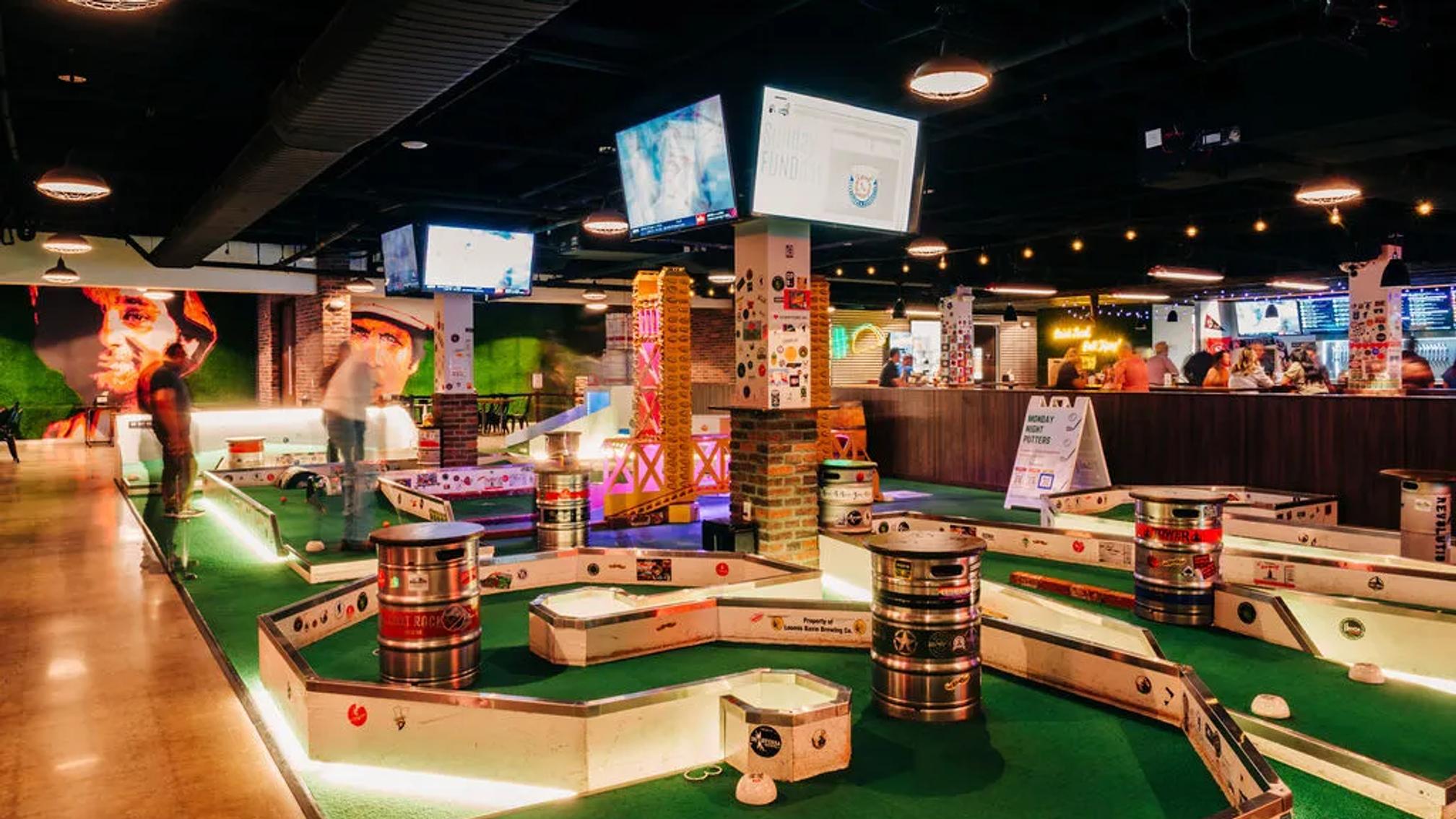
Mini golf is one of the most accessible entertainment businesses you can open — and one of the most profitable when you get the model right. If you're researching how to start a mini golf business in 2026, you're entering a market that's growing fast. The global miniature golf market surpassed $1.3 billion in 2025, driven by indoor entertainment concepts, eatertainment combos, and experience-hungry consumers who'd rather spend money on doing things than buying things.
The economics are compelling. A well-designed 18-hole mini golf course can generate $300,000–$800,000 in annual revenue with startup costs that are a fraction of most entertainment venues. Per-round fees have healthy margins, party packages drive group bookings, and the operational complexity is manageable even for first-time operators.
This guide covers everything you need to open a mini golf business — from concept selection and course design to startup costs, permits, technology, staffing, marketing, and revenue optimization. Whether you're planning a standalone outdoor course, an indoor glow-golf experience, or adding mini golf to an existing entertainment venue, this is the operator's playbook.
Understanding the Mini Golf Business Model
Before you start shopping for locations or hiring course designers, understand the revenue engine you're building. Mini golf businesses make money through multiple channels, and the best operators stack them deliberately.
- Per-round fees — Your core revenue driver. Expect $8–$16 per adult and $6–$12 per child for a standard 18-hole round. Indoor and themed courses command premium pricing — $14–$22 per person is common for high-concept venues
- Party packages — Birthday parties and group events typically generate $200–$600 per booking, bundling rounds with food, drinks, a reserved area, and add-ons. Parties can represent 25–40% of total revenue for venues that market them well
- Food and beverage — From a simple snack bar to a full restaurant, F&B adds 30–50% to per-visit revenue. Indoor venues and eatertainment concepts lean heavily on this channel
- Corporate events — Team-building outings, company parties, and private buyouts at $1,500–$5,000+ per event. Lower volume but high-margin and often booked during slower weekday periods
- Memberships and season passes — Recurring revenue from locals who visit frequently. A $99–$199 annual pass locks in customers and smooths out seasonal revenue swings
- Merchandise and extras — Branded balls, scorecards, photos, arcade games, and add-on activities. Small individually, but they compound
The strongest mini golf businesses don't rely on just one channel. They design the experience to drive party bookings, upsell F&B, and convert one-time visitors into members. If you're building a family entertainment center with mini golf as one activity, the revenue stacks even higher.
Choosing Your Mini Golf Concept
Not all mini golf is created equal. Your concept determines your startup costs, target market, revenue potential, and operational complexity. Here are the four main formats operators are building in 2026:
Traditional Outdoor Mini Golf
The classic: 18 holes, landscaped course, waterfall features, and a ticket booth. Startup costs are lower ($150,000–$400,000), and the concept is proven. The downside is weather dependency — outdoor courses in northern climates may only operate 6–8 months per year, which means you need to generate a full year's profit in half the calendar.
Best for: warm-climate markets, tourist destinations, operators who want a simpler business model with lower overhead.
Indoor Themed Mini Golf
Glow-in-the-dark, immersive theming, blacklight effects, and Instagram-worthy set pieces. Indoor courses eliminate weather risk and operate year-round. Startup costs are higher ($250,000–$600,000) because you're building out a full interior environment, but you also command premium pricing — $14–$22 per round versus $8–$12 for outdoor.
Best for: urban and suburban markets, cold-climate regions, operators targeting millennials and Gen Z who want experiences worth posting about.
Eatertainment Mini Golf
Mini golf paired with a full-service restaurant or bar. Think Puttshack, Swingers, or Puttery — upscale mini golf where the food and drinks are as important as the game. Startup costs are significant ($500,000–$1.5 million+) but so is the revenue potential. F&B can represent 50–60% of total revenue in these concepts.
Best for: high-traffic urban locations, operators with restaurant or hospitality experience, markets with strong nightlife and dining demand.
Mini Golf as an Add-On Activity
Adding mini golf to an existing entertainment venue — a bowling alley, FEC, driving range, or arcade. Lower incremental cost ($75,000–$200,000 for an indoor course addition) because you're leveraging existing infrastructure. Mini golf becomes a traffic driver and upsell opportunity rather than a standalone business.
Best for: existing venue operators looking to add activities, FECs building multi-attraction facilities, operators who want diversified revenue without a standalone buildout.
Location and Space Requirements
Location can make or break a mini golf business. The right spot puts you in front of your target audience with enough space to build a great course and room to grow.
How Much Space Do You Need?
- Outdoor 18-hole course — 8,000–15,000 square feet for the course itself, plus 2,000–4,000 sq ft for a clubhouse, parking, and common areas. Total footprint: 10,000–20,000 sq ft
- Indoor 18-hole course — 4,000–8,000 square feet for the course. Indoor courses can be more compact because holes are designed vertically and creatively. Add 1,000–3,000 sq ft for lobby, F&B, and back-of-house. Ceiling height: minimum 12 feet, ideally 14+
- Mini course (9 holes) — 2,000–4,000 sq ft indoor or 4,000–8,000 sq ft outdoor. Good for add-on installations or space-constrained locations
Location Criteria
- Visibility and foot traffic — High-traffic retail corridors, shopping centers, tourist districts, or near complementary businesses (movie theaters, bowling alleys, restaurants). Walk-by visibility matters more than you think — impulse visits can represent 15–25% of revenue
- Accessibility — Easy to find, easy to park. Ample parking is non-negotiable for suburban locations. Urban venues need proximity to public transit
- Demographics — Target areas with families (ages 25–45 with children), strong household incomes ($60K+), and population density. College towns and tourist areas also work well
- Competition — Some competition validates demand. Zero mini golf within 15 miles might mean no demand, not untapped opportunity. But avoid oversaturated markets
- Zoning — Verify entertainment or recreational use is permitted before signing anything. Outdoor courses may face noise or lighting restrictions. Indoor venues in retail spaces are usually easier to zone
Startup Costs: What to Budget
Mini golf startup costs vary dramatically based on concept and location. Here's a realistic breakdown for each format:
Outdoor Course (18 Holes)
- Course construction — $80,000–$250,000 depending on complexity, materials, and landscaping. Simple concrete courses with basic obstacles are cheapest; themed courses with water features, caves, and custom sculptures push toward the high end
- Clubhouse and facilities — $30,000–$100,000 for a ticket counter, restrooms, snack bar, and storage
- Land and site work — $20,000–$80,000 for grading, drainage, utilities, and parking lot
- Permits and fees — $5,000–$15,000 for building permits, environmental reviews, and business licensing
- Technology — $3,000–$8,000 for booking system, POS, payment processing, and website
- Initial marketing — $5,000–$15,000 for grand opening promotion, signage, and local advertising
- Working capital — $20,000–$50,000 for three to six months of operating expenses before you hit profitability
Total outdoor estimate: $163,000–$518,000
Indoor Course (18 Holes)
- Course construction and theming — $120,000–$350,000. Indoor courses require more creative design — blacklight paint, custom obstacles, sound systems, lighting rigs, and scenic elements
- Buildout and leasehold improvements — $50,000–$150,000 for HVAC, flooring, walls, restrooms, and ADA compliance
- F&B setup — $30,000–$100,000 if adding a bar or kitchen (equipment, health department requirements, initial inventory)
- Technology — $5,000–$12,000 for booking system, POS, digital scoring, and AV equipment
- Permits and licenses — $8,000–$25,000 including liquor license if applicable
- Marketing and branding — $8,000–$20,000 for brand development, signage, grand opening, and digital presence
- Working capital — $30,000–$75,000
Total indoor estimate: $251,000–$732,000
Eatertainment Concept
Budget $500,000–$1.5 million+ for a full eatertainment build. The course itself might be $150,000–$400,000, but the restaurant buildout, commercial kitchen, liquor license, interior design, and staffing infrastructure add up fast. These are serious ventures that require either significant capital or investor backing.
Course Design and Construction
Your course is your product. A boring course with straight-line holes and generic obstacles won't generate word-of-mouth or repeat visits. A memorable course that surprises players, creates photo opportunities, and offers genuine challenge keeps people coming back — and posting about it.
Design Principles
- 18 holes is the standard — Nine-hole courses work for add-on installations, but 18 holes is what customers expect for a standalone mini golf experience. It also justifies premium pricing
- Progressive difficulty — Start with easier holes to build confidence, increase challenge gradually, and end with a signature hole that creates a memorable finish
- Photo moments — Design 2–3 holes specifically for Instagram and TikTok moments. Unique sculptures, dramatic lighting, water features, or oversized props. These become free marketing when guests share them
- Flow and pacing — Avoid bottlenecks where groups stack up waiting. Design wider areas around harder holes. Keep the pace moving — a round should take 45–60 minutes for a group of four
- ADA compliance — All holes must be wheelchair accessible. This isn't optional — it's federal law. Pathways need to be minimum 36 inches wide with smooth surfaces and gentle slopes
- Theming consistency — Pick a theme and commit to it. Tropical, space, pirate, local landmarks, underwater — it doesn't matter what the theme is, but it needs to feel cohesive. Inconsistent theming makes a course feel cheap
Hiring a Designer vs. DIY
Professional mini golf designers charge $15,000–$50,000+ for a full course design, and it's money well spent for a standalone business. They handle hole layout, drainage, ADA compliance, construction specifications, and theming. Firms like Harris Miniature Golf Courses, Adventure Golf & Sports, and Cost of Wisconsin have decades of experience and portfolios you can evaluate.
DIY design works for simple add-on courses or if you have construction experience. But underestimating the engineering — drainage alone can ruin a course if done wrong — is one of the most common and expensive mistakes new operators make.
Permits, Licenses, and Insurance
The paperwork isn't glamorous, but skipping it can shut you down or expose you to massive liability. Start this process early — some permits take months.
- Business license — Required everywhere. Register your LLC or corporation, get an EIN, and file with your city and state. Cost: $50–$500
- Zoning and land use permits — Confirm your location is zoned for entertainment or recreational use. If not, you'll need a variance or conditional use permit — which can take 3–6 months and isn't guaranteed
- Building permits — Required for any construction or significant renovation. Your contractor typically handles the application, but budget $2,000–$10,000 in fees
- Food service license — Required if you're serving any food, even prepackaged snacks. A full kitchen requires health department inspections and food handler certifications
- Liquor license — If serving alcohol. Cost and availability vary wildly by state — $300 in some states, $100,000+ in others. Start researching this immediately if it's part of your concept
- Liability insurance — Non-negotiable. General liability insurance for a mini golf venue runs $2,000–$6,000/year. If you're adding food, alcohol, or adventure elements (climbing, water features), expect higher premiums. Get an umbrella policy
- Music licensing — If playing music in your venue (and you will), you need licenses from ASCAP, BMI, and SESAC. Budget $500–$2,000/year
Building Your Technology Stack
The right technology stack eliminates operational friction, maximizes revenue per tee time, and gives you data to make smarter decisions. Here's what you need:
Booking and Reservation System
This is the backbone of your operation. You need a system that handles tee time reservations, party bookings, walk-in management, and group events — ideally from a single platform. Platforms like Rex are purpose-built for activity-based entertainment venues, handling hourly bookings, party packages, memberships, and multi-resource scheduling out of the box. That's a fundamentally better fit than adapting a restaurant reservation tool or using a generic calendar.
Key features to look for: online booking (24/7 self-service), dynamic capacity management, party and event booking with customizable packages, membership and season pass support, and integrations with your POS and payment processor.
Point of Sale (POS)
Your POS handles walk-in transactions, F&B sales, merchandise, and add-ons. If your booking system integrates with your POS (or includes POS functionality), that's ideal — it reduces double-entry and gives you a unified view of revenue per customer.
Payment Processing
Stripe is the standard for modern entertainment venues — transparent pricing, easy integration with booking systems, and support for online payments, tap-to-pay, and recurring membership billing. Budget 2.9% + $0.30 per transaction.
Website
Your website is your 24/7 salesperson. It needs to do three things: show what you offer, let people book instantly, and convert browsers into visitors. Embed your booking widget prominently — above the fold on every page. For optimization tips, check out this guide to entertainment venue website optimization.
Staffing Your Mini Golf Business
Mini golf is one of the most labor-efficient entertainment businesses you can run. A well-designed course with good technology needs surprisingly few people.
Core Roles
- General Manager — One person to run daily operations, manage staff, handle vendor relationships, and own the P&L. Salary: $45,000–$65,000 in most markets
- Course attendants — Monitor the course, manage flow, assist guests, handle light maintenance. Two to four per shift depending on volume. Hourly: $12–$18
- Front desk and ticket sales — Handle walk-ins, check-ins, merchandise, and phone inquiries. One to two per shift. Can double as F&B staff in smaller operations
- F&B staff — If applicable. Bartenders, servers, kitchen staff. Scale based on your food and beverage concept
- Maintenance — Outdoor courses need regular landscaping, painting, and repair. Indoor courses need less but still require cleaning and upkeep. Can be part-time or contracted
Seasonal vs. Year-Round
Outdoor courses in seasonal climates will staff up in summer and scale down (or close) in winter. Plan your hiring accordingly — recruit and train 4–6 weeks before your peak season. Indoor venues operate year-round, which makes staffing more predictable but requires you to manage slower periods without overstaffing.
Marketing and Customer Acquisition
Mini golf markets itself better than most entertainment concepts — people already know what it is and already want to do it. Your job is making sure they choose your course when the urge hits.
Grand Opening
Your grand opening is your single biggest marketing opportunity. Plan it 4–6 weeks in advance. Invite local media, offer free rounds for the first 100 visitors, partner with nearby restaurants for cross-promotions, and create a social media event. Budget $3,000–$8,000 for a proper launch event. It's worth it — the press and social coverage from opening week can generate months of awareness.
Local SEO and Google Business Profile
Claim and optimize your Google Business Profile immediately. Add photos, accurate hours, your booking link, and respond to every review. For "mini golf near me" searches — which represent a huge chunk of discovery — Google Business Profile is more important than your website. Also build out your presence on Yelp, TripAdvisor (especially for tourist markets), and Apple Maps.
Social Media
Mini golf is inherently visual and shareable. Instagram and TikTok are your primary channels. Post course photos, behind-the-scenes construction content, user-generated content from guests, party highlights, and seasonal promotions. Encourage guests to tag your venue by creating Instagram-worthy holes and offering incentives (free round for the best post of the week).
Party Packages
Birthday parties and group events should be your highest-priority marketing channel after the first month. They generate $200–$600 per booking and bring groups of 10–25 people who might not have visited otherwise. Create clear, bookable packages on your website — don't make parents call to get pricing. For strategies on maximizing party bookings, read our guide to building the ultimate party package.
Corporate Events
Mini golf is perfect for corporate team building — it's fun, inclusive (no athletic ability needed), and short enough to fit into a half-day offsite. Market directly to HR departments and office managers within a 15-mile radius. Offer weekday-only corporate rates to fill slow periods. See our full breakdown on running a profitable corporate events program.
Revenue Optimization Strategies
Getting customers through the door is step one. Maximizing what each customer spends — and getting them to come back — is where the real money is made.
Dynamic Pricing
Charge more when demand is high and less when it's low. Weekend evenings and holidays should be priced 20–40% above weekday mornings. This isn't price gouging — it's standard practice in every entertainment and hospitality business. Done right, dynamic pricing can increase revenue 15–25% without adding a single new customer.
Memberships and Season Passes
A $99–$199 annual membership that includes unlimited rounds (or discounted rounds) creates recurring revenue and locks in repeat visits. Members visit 4–6x more often than non-members and spend more on F&B per visit. They're also your best word-of-mouth marketers. Memberships are the future of activity-based entertainment — build them into your model from day one.
Upselling and Add-Ons
Train your team to upsell naturally. Suggest the party package upgrade with the photo package. Offer the combo deal (mini golf + one drink + appetizer). Create a "championship round" add-on for competitive groups. Small per-visit increases compound fast — for deeper strategies on increasing revenue per guest, start with simple bundles and test what resonates.
Leagues and Tournaments
Weekly mini golf leagues drive consistent midweek traffic. Charge $15–$25 per person per week for an 8-week league. Monthly tournaments create events that generate social media buzz and attract new customers. Both build community around your venue — which is the single best defense against a competitor opening nearby.
Seasonal Promotions
Summer is your peak — lean into it with extended hours, twilight pricing, and partnerships with summer camps. Fall and winter (for indoor venues) are opportunities for holiday events: Halloween-themed courses, Christmas mini golf, and Valentine's date night packages. Every season should have a promotional hook.
Frequently Asked Questions
How much does it cost to start a mini golf business?
Startup costs range from $150,000–$500,000 for an outdoor course to $250,000–$750,000 for an indoor themed course. Eatertainment concepts with full restaurant buildouts can exceed $1 million. The biggest variables are course construction, location buildout, and whether you include food and beverage service.
How profitable is a mini golf business?
A well-run standalone mini golf business can generate $300,000–$800,000 in annual revenue with net margins of 15–30% after stabilization. Party packages, F&B, and memberships significantly boost profitability beyond per-round fees alone. Most operators reach profitability within 12–18 months.
Do I need experience in entertainment to open a mini golf course?
Not necessarily, but it helps. The mini golf-specific operations are learnable — hole maintenance, customer flow, scoring. What you do need is basic business acumen, comfort with hiring and managing staff, and ideally some hospitality or retail experience. Many successful mini golf operators come from outside the industry.
How many holes should a mini golf course have?
Eighteen holes is the standard and what customers expect from a standalone mini golf business. Nine-hole courses work as add-ons to existing entertainment venues or for space-constrained locations. Some venues offer both an 18-hole course and a shorter 9-hole option for families with young children.
Is mini golf seasonal or year-round?
It depends on your format. Outdoor courses in northern climates typically operate April through October, with peak revenue in June through August. Indoor courses operate year-round, with summer and holiday seasons being the busiest. If you're in a seasonal market, your business plan needs to account for generating a full year's profit in 6–8 months.
What technology do I need to run a mini golf business?
At minimum: a booking and reservation system for tee times and party packages, a POS for transactions, payment processing, and a website with online booking. Platforms built for activity-based entertainment venues handle all of these from a single system, which is far more efficient than stitching together separate tools. Add digital scoring and a CRM as you grow.
Build Your Mini Golf Business on the Right Foundation
The difference between a mini golf course that struggles and one that thrives often comes down to systems — the technology that handles bookings, manages capacity, processes payments, and gives you the data to make smart decisions.
Rex is built for exactly this. Purpose-designed for activity-based entertainment venues, Rex handles tee time reservations, party packages, memberships, dynamic pricing, and multi-activity scheduling from a single platform. No duct-taping restaurant tools together. No outgrowing your system in year two.
See how Rex works for mini golf venues →