Bowling centers that ran free-fall pinsetters for decades are pulling them out and installing string pinsetters. Shawn Lavender bought Interstate Bowl North in Harrisonburg, Virginia, and had converted six of its 32 lanes by November 2025, with the rest to follow. "I'm a bowler so I get it," he told the Harrisonburg Citizen. "I like the free falls, but this is business." Napa Bowl in California, a 32-lane house the same family has run since 1946, switched in 2023. The US Bowling Congress, which certifies centers for league play, now counts more than 100 string installations among the roughly 3,500 centers it certifies.
If you own a center with aging free-fall machines, you're probably weighing the same switch. Whether it pays comes down mostly to one line on your books: what you spend on your pinsetter mechanic. This guide covers:
- The short answer
- What three owners paid to convert
- What strings save, using one 24-lane center's numbers
- What they cost you in league bowlers
- Which centers should convert now, and which should wait
- How to convert a few lanes before the whole house
If you're still planning a center from scratch, start with our guide to starting a bowling alley.
Are string pinsetters worth it? The short answer
String pinsetters are worth it if you pay a full-time mechanic you'd rather not pay, or if you can't find one to hire. They aren't worth it yet if certified league bowlers are your core business and you can still get your free-fall machines fixed.
Here's the math, using the seller's own numbers for a 24-lane center. If the conversion lets you drop a full-time mechanic, it pays for itself in about three to six years. If you keep the mechanic and only save on parts and downtime, it takes 11 years or more. The cost is on the league side: averages run about 3.4 pins a game lower on strings, and some regulars refuse to bowl on them.
What owners paid to convert a bowling center to strings
Owners rarely quote a per-lane price, but three gave totals:
| Center | Lanes | What the owner reported | Per lane |
|---|---|---|---|
| Livingston Lanes, Geneseo, New York | 16 | "approaching $250,000" | about $15,600 |
| Napa Bowl, Napa, California | 32 | "nearly $1 million" | about $31,000 |
| Lehigh Lanes, Lehigh Acres, Florida | 12 | about $300,000, including new carpet and furnishings | left out |
That works out to roughly $15,600 to $31,000 a lane. Lehigh's total is left out because it included new carpet. Flying Bowling, a string machine maker, lists $15,000 to $22,000 a lane for the major American and European brands, plus $1,000 to $3,000 a lane for shipping and installation. Get quotes for your own lanes before you plan around any of these numbers.
What string pinsetters save: one 24-lane center, worked out
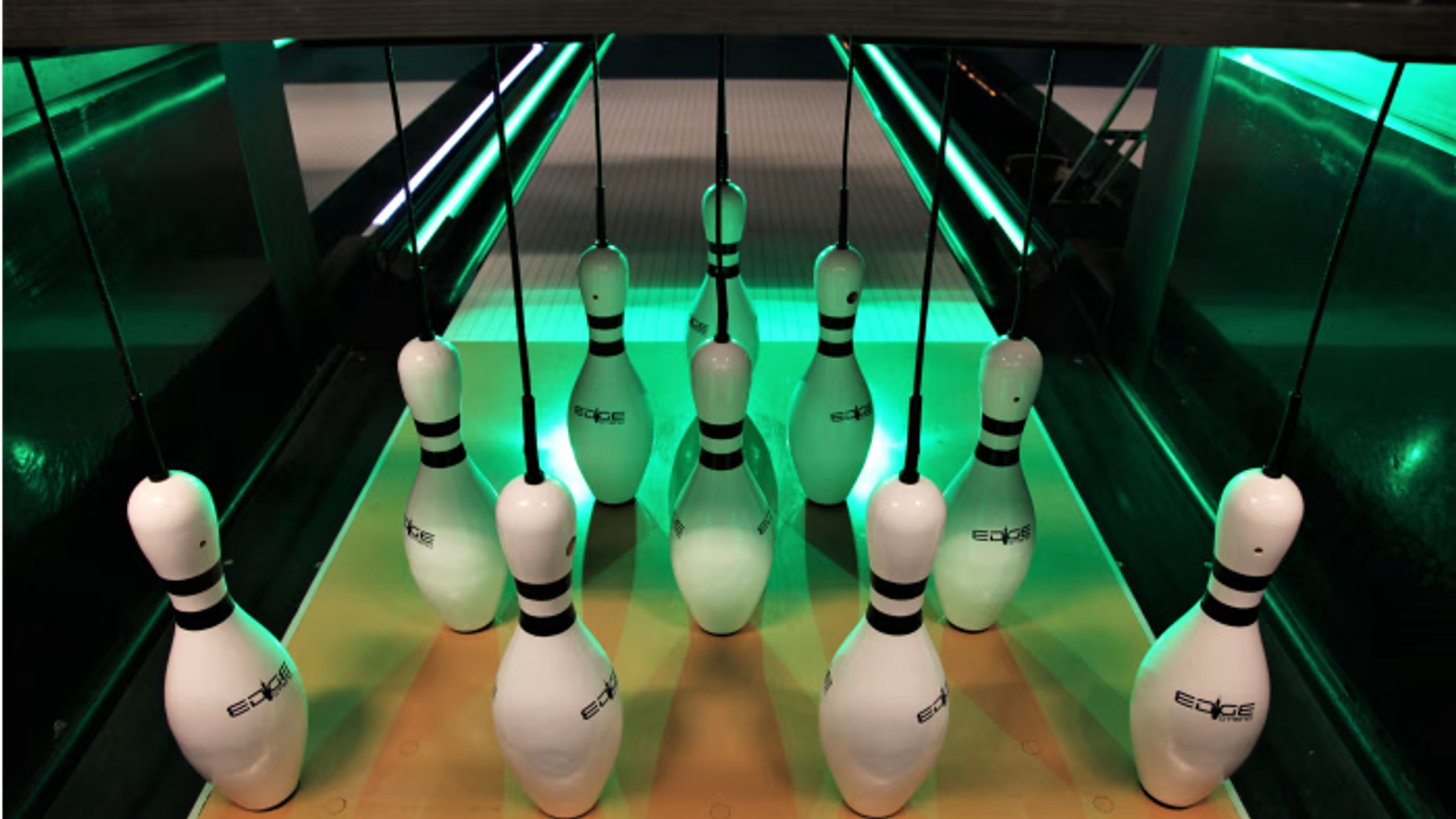
A free-fall machine sweeps the pins off the deck, sorts them and sets them back in place, using hundreds of moving parts. A string machine hangs each pin from a cord and pulls it back up, using about 75. Dan Sousa, whose father opened Napa Bowl, remembered the old machines this way: "It was like 32 automobiles running all day ... We had a full-time mechanic and were spending up to $3,000 a month on parts."
The fullest set of numbers comes from Hudsonville Lanes, a 24-lane center in Michigan. The figures come from Brunswick, the company that sold Hudsonville its string machines, so treat them as the seller's case. Here is what the free-fall machines were costing Hudsonville each year:
- Parts for the old machines: about $24,000 a year
- Mechanic labor: an average of 54 hours a week, which Brunswick puts at over $90,000 a year
- Extra revenue from lanes no longer down: over $10,000 a year, by owner Dana Sorensen's own estimate. Brunswick says service calls fell from about three an hour to about three a day.
- Total: about $124,000 a year
Converting 24 lanes costs about $384,000 to $600,000 at Flying Bowling's installed prices, or about $744,000 at what Napa paid. Here's how long each level of saving takes to cover that:
- All three lines, mechanic included: about three to six years
- Parts and recovered lane time only, with the mechanic still on payroll: about 11 to 22 years
The mechanic's wages are what make the payback. Two caveats. First, 54 hours a week is more than one full-time job, so a center paying one 40-hour mechanic saves less than Hudsonville did. Second, strings still need someone to clear a tangle or answer a service call. At the 300 Club in Green Lake, Wisconsin, which reopened on strings in 2021, manager Orly Rivera had untangled pins about 10 times by early 2023. Palasad South in London, Ontario, kept all three of its mechanics and moved them onto "long-neglected building repairs and revenue-generating game maintenance," owner Rob Szabo said. Every hour of mechanic time you keep comes off that $90,000.
If you can't fill the job at all, the math changes. Strings become the way you keep lanes open. Lavender worked on his own machines into his 40s: "You run out of people and I can't do it all nor do I want to." Rivera told Spectrum News that a mechanic coming from Milwaukee isn't going to reach Green Lake quickly.
The owner of Townline Luxury Lanes in Malden, Massachusetts, added up the same three lines before deciding. He looked at labor, parts and "how much down time I was having," he told a bowling trade magazine. His conclusion: "I know the strings can pay for themselves in a few years."
What strings cost you with league bowlers
Pins on strings don't fall quite the way free pins do, and serious bowlers notice. The USBC's 2025 scoring report, drawn from 66 centers and more than 10,000 bowlers, found averages running 3.4 pins a game lower on strings. Bowlers averaging over 210 drop about 7 pins a game, or "about 2 less strikes per 3-game set." Your open-play guests won't miss a few pins. Your best league bowlers will.
The USBC has certified string pinsetters as their own category since August 2023, so league scores bowled on strings count. Even so, some bowlers won't bowl on them. A Napa regular told the Los Angeles Times: "There were people who flat-out said no way ... I have one very good friend who refuses to bowl here anymore."
Livingston Lanes had to convert in the middle of the season, which disrupted several of its certified leagues. "We're looking for people to give us just one chance," co-owner Dana Carson said.
Some owners win their leagues over. Lehigh Lanes' co-owners admitted they were skeptical at first. After bowling on strings themselves, they said, their doubts "were quickly erased."
Which kind of center should convert, and which shouldn't yet
Pull last year's numbers: what you paid your mechanic, what you spent on parts, and how your bowling revenue splits between league fees and everything else (open play, parties, groups and corporate events). Then find your center below:
- You pay a full-time mechanic and open play carries the house. Convert. Open-play guests come to have fun, and as Sorensen put it, "When you're here just to have fun, it's really easy to just have fun." Our guide to increasing party bookings covers filling those lanes.
- You can't hire or keep a mechanic. Convert, whatever your league share. A center that loses lanes every weekend loses parties and leagues both.
- Certified leagues are your core business and you can still get your machines fixed. Don't convert the whole house yet. Strikers East in Raymond, New Hampshire, is a case in point. Leagues are about 40% of its business and bowl five days a week, and it put in used free-fall machines in 2026. Owner Toffy Beyloune says parts and mechanics are getting hard to find, and he flies a mechanic in every couple of months to tune the machines. That's the price of staying on free-fall. Compare it against a string quote.
How to convert a few lanes before the whole house
Interstate Bowl North is converting in steps. It started with six lanes and, as of November 2025, planned about eight more by spring 2026. A partial conversion lets you test strings with your own bowlers. One catch: you won't get the mechanic saving until the last free-fall lane goes, because those lanes still need someone to fix them.
- Convert the lanes your parties and open play use most.
- Put a league on the string lanes for a few weeks, with its members' agreement, so they've bowled on strings before you ask them to switch. Sorensen's line for anyone asking about playability was "Give it a try."
- Install between league seasons. The work itself is quick: Palasad South swapped 20 lanes in 10 days. What hurt Livingston was moving its leagues onto new machines mid-season.
- Track parts and service calls on both kinds of lane, so you know what the old machines are really costing you.
- Ask your leagues at season's end, then convert the rest and take the mechanic saving.
For more on where a bowling center's money comes from, see our guide to increasing bowling alley revenue.
Start with your mechanic's hours
This week, put what you paid your mechanic last year next to what you spent on parts, and ask two string machine makers to quote your lanes. If the mechanic line is the big one and open play carries the house, convert. If certified leagues pay the bills and your machines still get fixed, start with the party lanes and put a league on them before you decide on the rest.
If you follow the plan above, your string lanes take parties, open play and one trial league, while your other league nights stay on free-fall lanes. Rex runs online booking for bowling centers, with separate schedules for league nights, so parties and open play only book the lanes and hours you open to them. Book a Rex demo to see how it works.
Frequently Asked Questions
Are string pinsetters cheaper to run than free-fall pinsetters?
Owners who switched say yes. String machines have about 75 moving parts against hundreds on a free-fall machine, so parts bills and mechanic hours drop. Napa Bowl was spending up to $3,000 a month on parts before it converted.
Do league scores count on string pinsetters?
Yes. The USBC has certified string pinsetters as their own equipment category since August 2023. Its 2025 report found averages running about 3.4 pins a game lower on strings, and more for high-average bowlers.
How long does it take to install string pinsetters?
It can be quick. Palasad South in Ontario converted 20 lanes in 10 days.
Can you mix string and free-fall lanes in one center?
Yes. Interstate Bowl North in Virginia was running both as of November 2025, converting in stages from six of its 32 lanes.