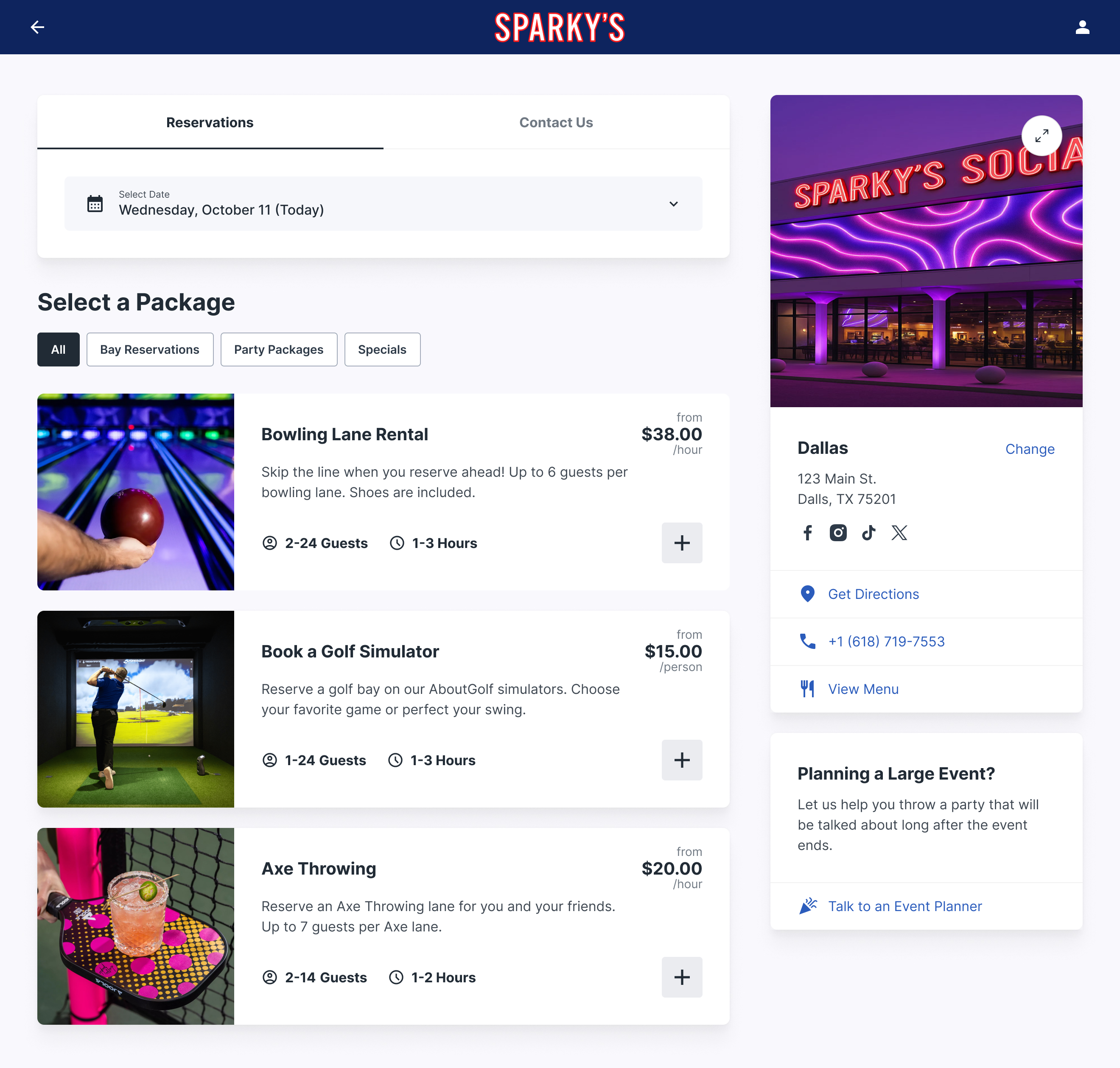
Most operators looking at ROLLER alternatives are not unhappy with ROLLER. They are running a venue it was not shaped for: a bowling center, a golf simulator lounge, a karaoke bar, a pickleball club. ROLLER is strongest at high-volume admission attractions like trampoline parks and water parks, and the closer your business gets to timed, resourced, multi-activity bookings, the more you end up bending it. This guide covers nine platforms, what each is actually good at, and which ones publish a price you can check before you take a call.
Why do operators look for a ROLLER alternative?
Three reasons come up over and over.
The booking model does not match the venue. Admission attractions sell entry. Competitive socializing venues sell a specific bay, lane, or room for a specific window, often with a second activity stacked after it and food attached to both. Those are different data models, and the difference shows up in every edge case: swapping a group to a bigger lane, running an hour of golf then a table for dinner, holding a resource while a deposit clears.
Pricing is not visible until you are in a sales cycle. ROLLER's pricing page lists four tiers, Lite, Pro, Premium and Enterprise, and describes what each includes, but shows no dollar amounts. That is normal in this category. It is also why a shortlist should include at least one vendor that publishes a number.
Scope you are not using. ROLLER covers 19 venue categories including zoos, museums, water parks and aqua parks. Breadth is a real strength when you run a mixed attraction. It is overhead when you run six lanes and a bar.
The industry data supports being deliberate here rather than defaulting. ROLLER's own 2026 Attractions Industry Benchmark Report found that "online bookings now account for 45% of total revenue, even though they make up just 33% of total bookings," and that "members visit an average of 4.9x per year compared to just 1.3x for non-members." Your booking platform and your membership engine are doing a disproportionate share of the work. Picking one that fits the way you actually sell is worth the two weeks of evaluation.
What is ROLLER genuinely good at?
Worth saying plainly, because a shortlist built on a competitor's weaknesses is a bad shortlist.
ROLLER is a complete operating system for admission-led attractions. Every tier includes online checkout, point of sale, party packages, memberships, integrated payments, cashless card integration and analytics. Higher tiers add guest flags and bans, wristband management, mobile food and beverage ordering and a custom checkout domain. If you run a trampoline park with a redemption counter, a cafe and wristband entry, that is a well-matched product and you should probably stay.
The alternatives below are for everyone else.
The best ROLLER alternatives in 2026
| Platform | Best for | Published pricing | Booking fee |
|---|---|---|---|
| Rex | Bowling, driving range, golf sims, karaoke, axe throwing, pickleball, go-karts, FECs | $195 to $395 per venue per month | None on bookings |
| CenterEdge Advantage | FECs running heavy on-site POS and redemption | $300 to $800 per month by workstation count | Not published |
| Clubspeed | Karting and multi-attraction FECs | $319 to $699 per month | Not published |
| Semnox Parafait | RFID cashless, arcade cards, access control | Not published | Not published |
| Party Center Software | Party-led venues: play centers, skating, trampoline | Not published | Not published |
| Checkfront | Simple activity booking with no on-site POS | GBP 99 per month | 3% on online bookings |
| Xola | Tour and activity operators | No subscription | 2.39% + $0.30 per transaction |
| Peek Pro | Tour and rental operators | Quote-based | Not published |
Rex
Built specifically for entertainment and competitive-socializing venues rather than adapted from restaurant or attraction software. It serves bowling, golf simulators, driving ranges, karaoke, axe throwing, family entertainment centers, mini golf and putting, pickleball, go-karts, escape rooms and eatertainment.
The distinguishing capability is multi-activity bookings: sequential or overlapping activities inside one reservation, which is the thing most admission-shaped systems cannot express. Add-ons cover food, rentals and merchandise, priced per guest or per booking. Dynamic and time-slot pricing, coupon codes that can be time-gated and activity-specific, custom taxes and fees, a waitlist with automated notification when slots open, memberships and recurring billing, leagues with participant limits, and digital waivers. The host app handles front-desk work: floor management, reservation timers, walk-ins.
Pricing is public and per venue: Core at $195 monthly or $175 on annual, Pro at $295 or $250, Growth at $395 or $350. There are no transaction fees on bookings, which is the number that matters most if your average order value is high. Integrations include Stripe, GoTab, Tripleseat, aboutGolf, ClassPass, OpenTable, Klaviyo, Square, and Google Reserve.
Where it is not the answer: if your business is admission plus redemption plus a wristband gate, the attraction-native platforms are closer to the shape of your day.
For the head-to-head detail, see Rex vs ROLLER.
CenterEdge Advantage
The most direct like-for-like swap for an FEC, and the only vendor on this list that publishes prices by workstation count rather than by feature tier. CenterEdge's pricing page lists $300 per month for 1 to 3 workstations, $550 for 4 to 9, $800 for 10 to 15, and contact pricing above 16. Add-ons are priced separately: redemption at $100 per month, integrations at $50, digital signage at $50. Every plan includes the full Advantage Suite, and the quoted prices assume you also use CenterEdge Payments.
Strong fit if your revenue is concentrated at the counter. Weaker if most of your bookings originate online and need resource-level scheduling.
Clubspeed
Purpose-built around karting and extended into other attractions. Clubspeed lists 15 or more venue categories including karting, trampoline, FEC, golf, arcade, axe throwing, batting cages, bowling, escape rooms and laser tag. Its pricing page publishes Core at $399 per month, or $319 billed annually, and Premium at $699, or $559 annually, with Enterprise on request.
If race management, heat scheduling and driver profiles are core to your operation, this is the specialist. If they are not, you are paying for a karting engine you will not run.
Semnox Parafait
The RFID and cashless specialist. Parafait is where you land when the hard problem is stored value, arcade cards, access control and lockers rather than reservations. Semnox does not publish pricing. Treat it as an infrastructure choice that often sits alongside a booking platform rather than replacing one.
Party Center Software
Party-led venues are its center of gravity, and it names adventure parks, amusement parks, bowling centers, cinemas, event centers, FECs, indoor playgrounds, skating rinks, trampoline parks, theme parks and water parks among the venue types it serves. It covers online party booking, digital waivers, POS, memberships, an online store, payment processing and gift cards. No pricing is published.
Good fit if birthday parties are the majority of your bookings. Thinner if open play and timed resources are.
Checkfront and Xola
Both are lightweight booking layers rather than venue operating systems, and both publish their numbers, which makes them useful as a price anchor even if you do not pick them.
Checkfront runs a single plan at GBP 99 per month plus a 3% online booking fee, with no setup fees, no limit on bookings, and no extra charge on OTA or API bookings. The 3% applies to online bookings only, and you choose whether to absorb it or pass it to the guest. Xola has no subscription at all and charges 2.39% plus $0.30 per transaction in the United States.
Run the math before the percentage looks cheap. A venue doing $80,000 a month online pays roughly $2,400 in Checkfront booking fees alone, which is several times what a flat per-venue subscription costs. Percentage pricing is genuinely cheaper for low-volume operators and genuinely expensive for everyone else. Neither platform gives you a front-desk POS.
Peek Pro
Built for tour and rental operators: boat and kayak rentals, ATV tours, ziplines, walking tours, axe throwing, VR experiences. It covers online booking, abandoned-booking recovery, dynamic pricing, staff scheduling, digital waivers and a point-of-sale for walk-ups. Its site states that "Peek Pro uses custom, quote-based pricing tailored to your business rather than a fixed monthly plan."
Relevant if your venue also sells guided experiences. Off-target if you sell lanes, bays and rooms.
How do you pick between them?
Four questions settle it faster than a feature matrix.
- Does one reservation ever contain two activities? An hour of simulator golf then a table, or laser tag then a party room. If yes, you need a platform that models that natively. Retrofitting it with two linked bookings breaks reporting, deposits and the front desk.
- Where does the money come in? If most revenue is booked online in advance, buy the booking engine and treat POS as secondary. If most is taken at the counter, buy the POS and treat online as secondary. Vendors are honest about which one they built first if you ask directly.
- Percentage or subscription? Multiply your monthly online revenue by the fee percentage and compare it to twelve months of subscription. Do this before the demo, not after.
- What has to keep working on day one? Existing memberships, stored value, gift card balances, your payment processor, your scoring system, your F and B POS. Every one of those is a migration line item, and each is easier to confirm now than to discover in week three.
If you are building the whole stack from scratch rather than replacing one piece, The New Venue Tech Stack Guide walks through every system you need before opening day. Bowling operators comparing specifically inside that vertical should start with Best Bowling Booking Systems in 2026.
What should you check before you switch?
Ask every vendor on your shortlist for these in writing, before the contract.
- The total first-year number, including implementation, per-device charges, waiver fees, SMS fees and payment processing. Compare totals, never headline prices.
- Whether you can keep your current payment processor, or whether the quoted price assumes their processing.
- What happens to active memberships and recurring billing during cutover, and who runs the migration.
- Whether gift card and stored-value balances transfer, or need to be honored manually.
- Which of your existing systems have a live integration today, named specifically, rather than "we can integrate with anything."
- What the front desk does when the internet drops.
Memberships deserve particular attention given how much repeat traffic they drive. How to Build a Membership Program for Your Entertainment Venue covers what to structure before you migrate one.
Which one should you shortlist?
If you run an admission attraction with a redemption counter, stay on ROLLER or look at CenterEdge. If karting is your core, look at Clubspeed. If your hard problem is cashless and access control, look at Semnox. If parties are the business, look at Party Center Software. If you sell timed, resourced, multi-activity experiences at a bowling center, golf simulator lounge, karaoke bar, axe throwing venue or pickleball club, that is exactly the shape Rex was built for, and the pricing is on the website so you can rule it in or out in a minute.
The fastest way to know is to put your own busiest Saturday in front of a system and see whether it can express it. Book a demo and bring your real schedule, not a simplified version of it.
Frequently Asked Questions
Does ROLLER publish its pricing?
No. ROLLER's pricing page lists four plans, Lite, Pro, Premium and Enterprise, along with what each includes and how many POS licenses come with it, but no dollar amounts. You need a sales conversation to get a number. Among the alternatives here, Rex, CenterEdge, Clubspeed, Checkfront and Xola all publish figures you can check without talking to anyone.
Is a percentage booking fee cheaper than a monthly subscription?
Only at low volume. A 3% fee on $10,000 of monthly online revenue is $300, which beats most subscriptions. The same 3% on $100,000 is $3,000 a month, which does not. The crossover point is usually somewhere between $10,000 and $20,000 in monthly online revenue depending on the subscription you are comparing against. Calculate it with your own numbers before a demo, because it is the single largest cost difference between these platforms and it does not appear on any feature comparison.
What happens to memberships and stored value when we migrate?
This is the part that goes wrong most often, and it is a question for the vendor rather than a thing you can assume. Recurring billing has to be re-established against the new processor, which sometimes means re-collecting card details from members. Gift card and arcade card balances may or may not transfer depending on whether the old system exports them. Get both answers in writing and schedule the cutover for your slowest week, not your busiest.
Do we need an all-in-one platform, or can we integrate?
Both work, and the deciding factor is how many locations you run and who maintains the stack. A single venue with one manager is usually better served by fewer systems, even if each is slightly less specialized. A multi-location operator with someone owning operations can often get a better result from a strong booking platform integrated with a specialist POS and a specialist cashless system. What does not work is buying an all-in-one and then running three of its modules alongside three competing products.