A family entertainment center business plan isn't just a document you write to get a bank loan. It's the operating manual for a business that will live or die based on how well you understand your market, price your experiences, and fill your venue on Tuesday afternoons — not just Saturday nights.
Most FEC business plans fail for the same reason most FECs struggle: they focus on the fun stuff (what attractions to buy, how to design the space) and skip the hard stuff (realistic revenue projections, operating cost breakdowns, and a booking strategy that actually converts walk-by traffic into repeat guests).
This guide walks through every section of a family entertainment center business plan — with real numbers, real decisions, and the operational details that banks and investors actually care about.
What makes FEC business plans different
Entertainment venues aren't like restaurants or retail stores. Your revenue model is fundamentally different:
- You sell time, not products. Every lane, bay, court, and arena has a capacity ceiling. Revenue optimization means maximizing utilization — not just traffic.
- You have wildly different demand curves. Weekday mornings vs. Saturday evenings might differ by 10x. Your plan needs to account for this, not just average it out.
- Your customer segments want different things. Birthday parties, corporate events, date nights, and family outings all have different willingness to pay, different booking patterns, and different operational requirements.
- Capital expenditure is front-loaded and lumpy. A bowling lane costs $80,000-$120,000 to install. An indoor go-kart track can run $500,000+. These aren't decisions you can easily undo.
Your business plan needs to wrestle with all of this. Generic templates won't cut it.
Section 1: Executive summary
Write this last. It should answer five questions in one page:
- What is this? A family entertainment center with [specific activities] in [location].
- Who is it for? Families, corporate groups, and young adults within a [X]-mile radius.
- Why will it work? [Market gap, location advantage, differentiated experience].
- How much does it cost? Total startup capital required and funding sources.
- What's the return? Projected timeline to profitability and key financial milestones.
Keep it under 500 words. If your executive summary needs more than one page, you haven't distilled your thinking enough.
Section 2: Market analysis
This is where most FEC business plans are weakest. "Families like fun" is not a market analysis. Here's what you actually need:
Define your trade area
Your primary market is the population within a 20-30 minute drive. For urban locations, that might be a 10-mile radius. For suburban or rural, it could be 30+.
What to measure:
- Population within your trade area (Census data, ESRI)
- Household income distribution — your sweet spot is $60K-$150K household income
- Age demographics — you want families with kids 4-16, but also 18-35 for evening entertainment
- Population growth trends — a growing suburb is a different bet than a declining city
Competitive landscape
Visit every entertainment venue within your trade area. Not just FECs — bowling alleys, trampoline parks, movie theaters, escape rooms, indoor go-karts, mini golf. They're all competing for the same leisure dollar.
For each competitor, document:
- What activities they offer
- Their pricing (screenshot their booking pages)
- Their online booking experience (or lack of one)
- Google review score and common complaints
- Estimated capacity and busy/dead times
The gap you're looking for: what do families in your area have to drive 45+ minutes to experience? That's your opportunity.
Industry context
The FEC industry was valued at roughly $34 billion in 2025 and is growing at 10-12% annually. The trend is moving toward:
- Multi-activity concepts — single-attraction venues are losing to places that offer 3+ activities under one roof
- Eatertainment integration — food and beverage aren't a side note; they're 30-40% of revenue at the best venues
- Technology-enabled experiences — from online booking to digital scoring to mobile food ordering, guests expect a seamless tech layer
- Premium pricing acceptance — guests will pay more for better experiences, but they expect the booking and service quality to match
Section 3: Concept and experience design
This is where you get specific about what your FEC actually is.
Activity mix
Choose activities that:
- Serve multiple age groups (bowling works for 5-year-olds and 50-year-olds)
- Have different session lengths (quick turns like arcade games + longer experiences like laser tag)
- Generate repeat visits (leagues, memberships, seasonal events)
- Don't all peak at the same time (add activities with different demand patterns)
Common FEC activity combinations:
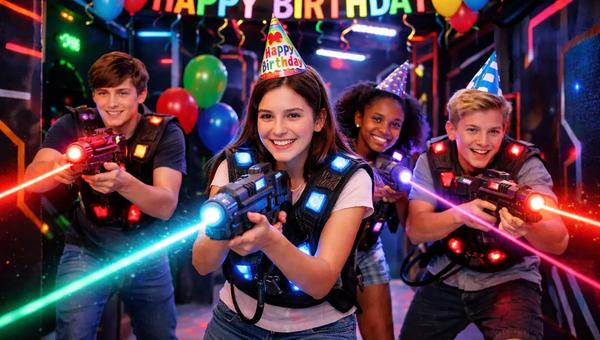
- Bowling + arcade + laser tag + party rooms (classic model)
- Mini golf + go-karts + bumper cars + arcade (outdoor/indoor hybrid)
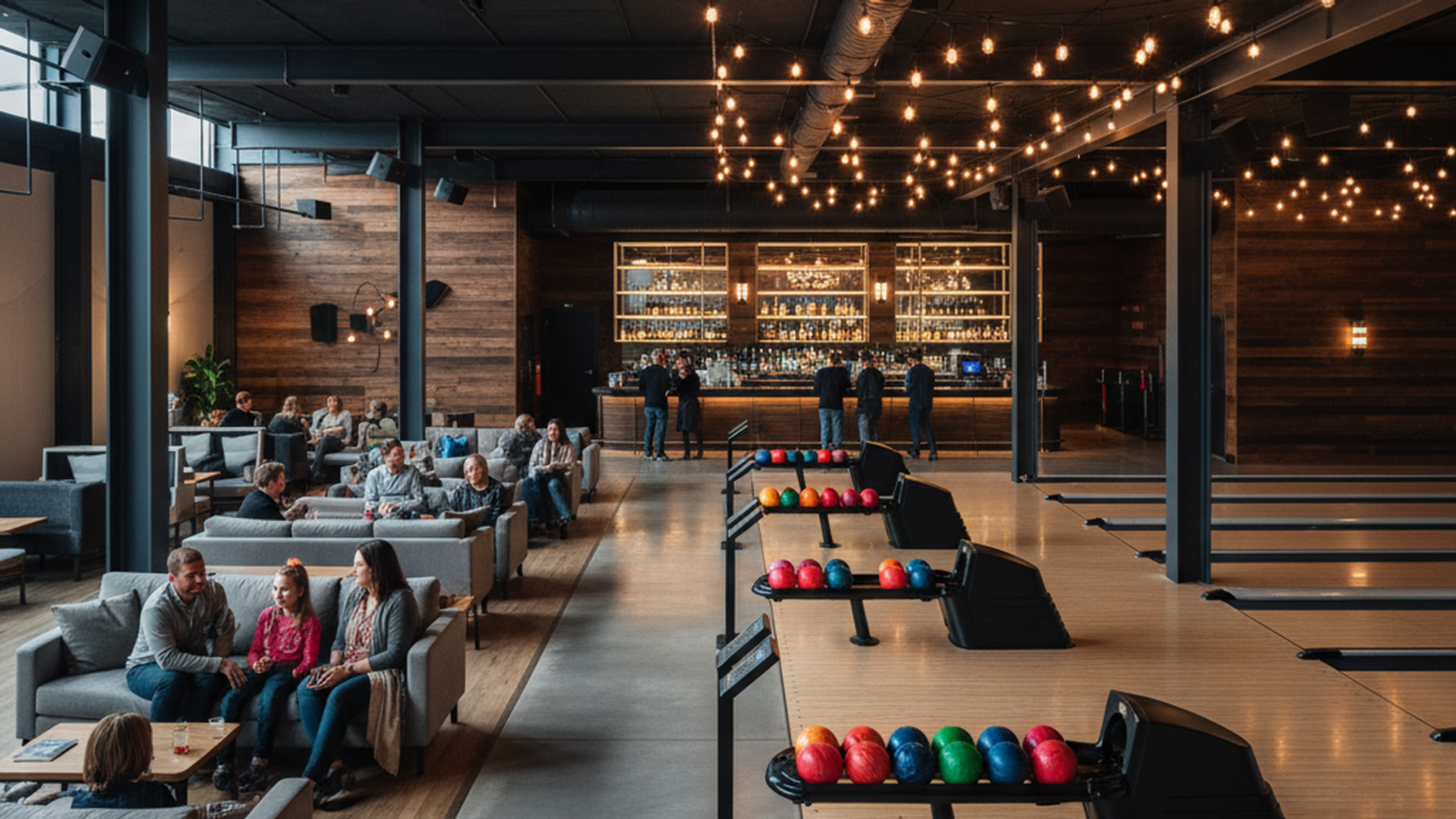
- Bowling + golf simulators + bar/restaurant + events (eatertainment model)
- Trampolines + climbing + ninja course + party rooms (active play model)
Space planning
A typical FEC needs 15,000-50,000 square feet depending on concept (for layout optimization tips, see optimizing your activity center layout for maximum engagement). Budget roughly:
- 40-50% for attractions
- 20-25% for food and beverage (kitchen, dining, bar)
- 15-20% for common areas (lobby, party rooms, restrooms)
- 10-15% for back-of-house (office, storage, mechanical)
Capacity and throughput
This is the number your investors care about most: how many guests can your venue serve per hour, and what's the realistic utilization rate?
Example for a 16-lane bowling center:
- Max capacity: 96 bowlers at once (6 per lane)
- Average session: 1.5 hours
- Realistic utilization: 40% weekdays, 85% weekend evenings
- Weekly throughput: ~2,500-3,000 guests (bowling only)
Every activity needs this analysis. It's the foundation of your revenue projections.
Section 4: Revenue model
FEC revenue comes from four main buckets. Your business plan should project each separately.
Activity revenue (40-60% of total)
This is bowling, laser tag, go-karts — whatever guests are paying to do. Price by:
- Time-based — per hour, per game, per session
- Dynamic — higher on weekends and evenings, lower during off-peak (see how bowling centers are using this to boost revenue)
- Package — bundle activities together at a slight discount to increase per-guest spend
Key metric: Revenue per available activity-hour. If a bowling lane generates $40/hour when occupied and you have 16 lanes operating 14 hours/day, your maximum daily lane revenue is $8,960. At 55% average utilization, that's $4,928/day.
Food and beverage (25-40% of total)
The best FECs generate $8-15 in F&B spend per guest. At the high end, venues with full bar programs and quality food menus (not just pizza and nachos) can hit $18-20 per guest. For strategies on boosting this number, see our guide on how to increase revenue per guest without raising prices.
What drives F&B revenue:
- Menu quality and variety — guests who planned to stay 1 hour stay 2 when the food is good
- Mobile ordering — let guests order from their lane/bay without flagging down a server
- Alcohol program — a well-run bar can transform weeknight economics
- Package deals — include food credits in activity bundles
Events and group bookings (15-25% of total)
Birthday parties and corporate events are the highest-margin revenue stream in most FECs (see our guide on crafting corporate event packages and increasing party bookings):
- Birthday packages typically run $25-45 per child, with F&B margin of 70%+
- Corporate events can command $50-100+ per person
- Group bookings tend to be pre-paid, improving cash flow
This stream is also the most operationally demanding. Your plan should detail: how many party rooms, max concurrent events, staffing requirements, and booking lead time.
Memberships and passes (5-15% of total)
Recurring revenue through memberships is growing across the FEC industry. Models include:
- Monthly unlimited play (like a gym membership)
- Discount memberships (pay $20/month, get 20% off all activities)
- Punch cards and visit packages
Memberships transform your revenue from "hope they show up this weekend" to predictable monthly income. We wrote a full breakdown of how to build a membership program for your entertainment venue if you want to go deeper on this.
Section 5: Operations plan
Staffing
Entertainment venues are labor-intensive. Budget for:
- Management: General manager, assistant manager, F&B manager (~$50-80K each)
- Front-line: Hosts, activity attendants, F&B staff, party hosts ($14-18/hour)
- Maintenance/tech: Keeping attractions running (this is non-negotiable — broken equipment kills reputation)
Rule of thumb: Labor should be 25-35% of revenue. If it's higher, you're either overstaffed or underpricing.
Technology stack
Modern FECs need three core systems:
- Reservation and booking system — online booking, dynamic pricing, package management, event coordination
- Point of sale (POS) — for F&B and retail transactions
- Scoring/attraction management — lane management for bowling, timing for go-karts, etc.
The best venue operators integrate these systems so data flows between them. When a guest books online, their lane assignment, food order, and party package details should all be in one place — not three separate systems that don't talk to each other.
Hours and scheduling
Most FECs operate 70-80 hours per week:
- Weekdays: 11am-9pm or noon-10pm
- Weekends: 10am-11pm or midnight
- Extended hours for holidays and summer
Staff scheduling is one of the biggest operational challenges. You need enough coverage for peak times without burning payroll during dead periods.
Section 6: Marketing and customer acquisition
Pre-launch (3-6 months before opening)
- Build anticipation with social media, local press, and community events
- Collect email addresses with a "notify me" page
- Partner with local schools, sports leagues, and community organizations
- Host a soft-opening for local influencers and families
Ongoing acquisition
- SEO and content — blog posts targeting "things to do in [city]," "[activity] near me," party planning guides
- Google Business Profile — critical for local discovery. Keep photos updated, respond to reviews, post events
- Social media — Instagram and TikTok for the experience, Facebook for events and parents
- Email/SMS — birthday club reminders, membership promotions, event announcements
- Paid ads — Google Ads for "birthday party venues near me" and similar high-intent searches
Retention
Getting guests through the door once is marketing. Getting them back monthly is operations. Focus on:
- Post-visit follow-up (email with photos, rebooking offer)
- Loyalty programs and memberships
- League nights and recurring events
- Consistent experience quality — one bad visit costs you a family for years
Section 7: Financial projections
Startup costs
A realistic FEC buildout ranges from $500,000 (small, existing space, limited attractions) to $5M+ (ground-up build, full concept). Typical breakdown:
Category | % of Budget | Example ($2M build)
Leasehold improvements | 30-35% | $600-700K
Attractions/equipment | 25-30% | $500-600K
F&B buildout | 10-15% | $200-300K
Technology/POS/booking | 3-5% | $60-100K
Pre-opening costs | 5-8% | $100-160K
Working capital | 10-15% | $200-300K
Revenue projections
Be conservative. Most new FECs take 6-12 months to hit their stride. Project month by month for Year 1, then quarterly for Years 2-3.
Key assumptions to document:
- Average guests per week (ramp from 30% to 70% of capacity over Year 1)
- Average revenue per guest ($20-35 for most FECs, including F&B)
- Seasonal variation (summer and holidays up 30-50%, January-February down 20-30%)
Break-even analysis
Most FECs break even on operations within 12-18 months. Full capital payback is typically 3-5 years.
Document your monthly fixed costs (rent, insurance, base staff, loan payments) vs. variable costs (hourly staff, COGS on F&B, utilities). The point where revenue covers both is your break-even.
Section 8: Funding and use of proceeds
If you're seeking investment or a loan, be explicit about:
- Total capital needed and how you arrived at that number
- Sources: SBA loan, personal investment, investor equity, equipment financing
- Use of proceeds: exactly where every dollar goes
- Collateral: for debt financing, what secures the loan
SBA 7(a) loans are common for FEC buildouts. Equipment financing can cover attraction purchases. Some franchise models offer financing assistance.
Common mistakes in FEC business plans
Overestimating utilization. Your lanes won't be 80% full on Tuesdays. Build your model on realistic utilization (40-50% weekdays, 75-85% weekends) and let upside surprise you.
Underestimating operating costs. Maintenance, insurance, and utilities for entertainment venues are higher than you think. Budget 5-8% of revenue for attraction maintenance alone.
Ignoring the booking experience. If your plan doesn't include online reservation technology, your revenue projections are based on a world that doesn't exist anymore. Guests expect to book from their phone at 10pm on a Wednesday. If they can't, they book somewhere else.
Treating F&B as an afterthought. The venues winning in 2026 are building restaurant-quality food programs, not warming up frozen pizzas. F&B is often the difference between a venue that's "fine" and one that's a destination.
No plan for off-peak hours. Every FEC is packed on Saturday at 7pm. The question is: what's your strategy for Monday at 2pm? Homeschool groups, corporate events, senior leagues, preschool programs — the best operators fill every hour.
Your FEC business plan is a living document
The plan you write before opening will be wrong. That's fine — its purpose is to force rigorous thinking about every aspect of the business. Once you're operating, the real data takes over.
The venues that thrive are the ones that obsess over their numbers: revenue per guest, utilization by hour, F&B attachment rates, rebooking rates. Build your business plan with these metrics front and center, and you'll have a framework for making decisions long after the plan is "done."
Related Articles
• How to start a family entertainment center
• Supercharge Your Family Fun Center with These 10 Awesome Activities
• The Heart of Fun: Optimizing Your Activity Center Layout for Maximum Engagement
• Benefits of Building a Membership Program for Family Fun Centers
• How to Start a Bowling Alley: A Complete Business Guide for 2026