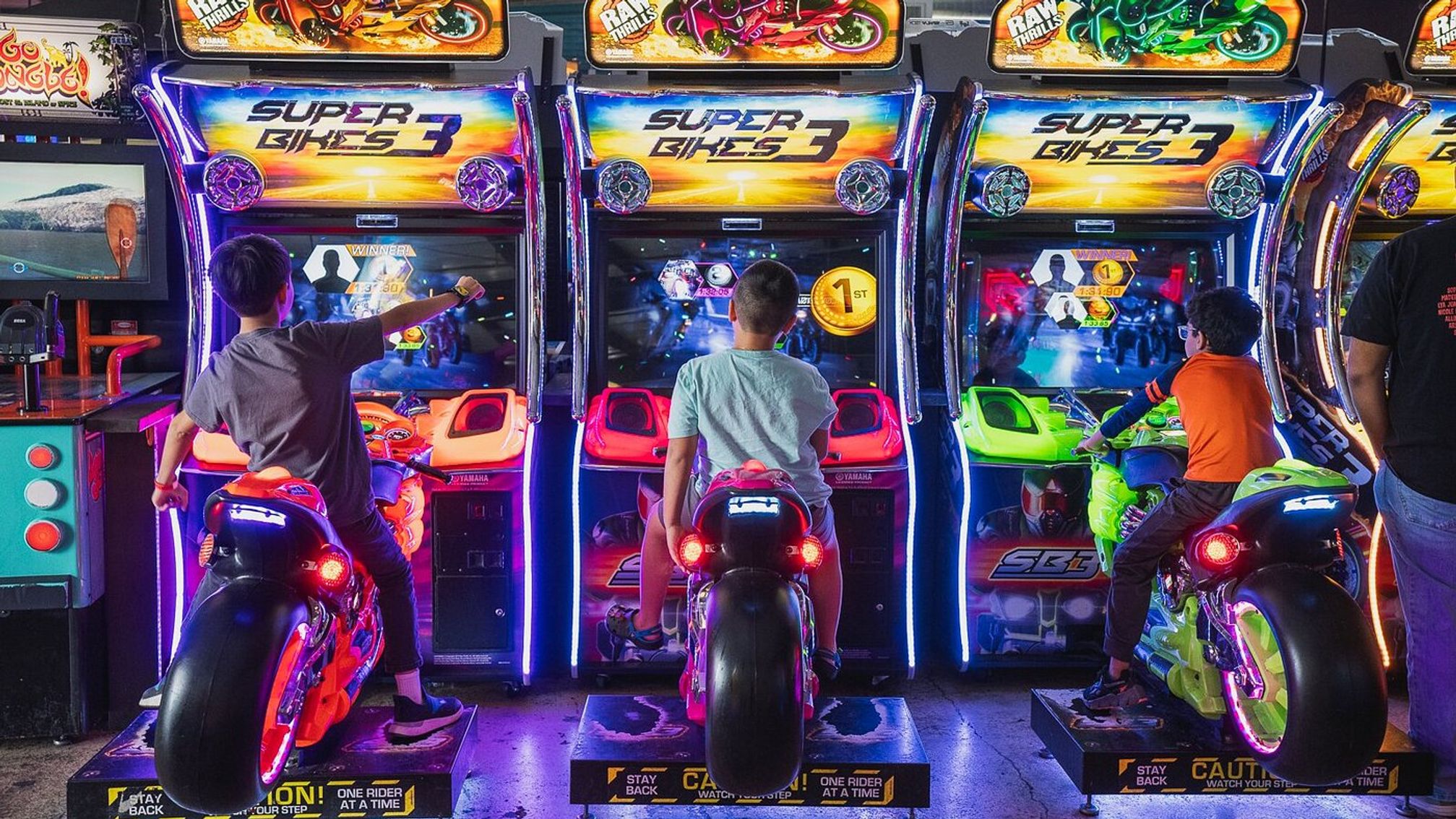
Walk into a bowling center or family entertainment center and you'll often find an arcade on the floor. Driving games by the shoe counter, a claw machine by the front desk, a wall of ticket games next to the party rooms. Kids drift over between frames, a parent loads a game card, and the arcade keeps earning on a Tuesday when half the lanes are dark.
The games get there one of two ways. You buy them, or an outside company places them for free and takes a cut of every play. That second way is an arcade game revenue share. The company is a route operator, usually called a vendor. It owns the machines, fixes them and splits the cash box with you.
This guide walks through:
- which of the two pays more, and when
- the splits vendors ask for
- what a revenue share costs you over time
- what owning costs you past the price tag
- what to get in writing if you sign with a vendor
Which pays more: a revenue share or owning?
Owning pays more once two things are true: your traffic is steady, and someone can fix a jammed machine. Until then, a revenue share is the better deal, because the vendor pays for the games that flop and the games that sit broken.
For one game, using the averages from game distributor, Betson Enterprises, *Bowling Center Management* in June 2024: the average cost to buy is roughly $11,000, and earns about $200 a week.
- On a 50/50 share: about $100 a week to you, with nothing spent.
- Owned: all $200 a week to you, after spending $11,000.
So owning brings in $100 a week more than the share. That extra $100 a week has to cover the $11,000 you spent, which takes about two years. After that, owning stays $100 a week ahead for as long as the game is popular. If the vendor's deal is 60/40 or 70/30 their way, the gap is bigger and owning gets ahead sooner.
On ticket games you also buy the prizes. Betson aims for about 30% of each ticket-game dollar to go back out as tickets, and still ranks ticket games ahead of video games for how fast they pay back. Keep in mind that Betson sells games, and these are its numbers for a typical location.
Is your traffic steady yet?
In a new arcade, you don't know which games your guests will play, and every game you buy is a bet on that. Earnings vary a lot. Adam Pratt, who has run arcades near Salt Lake City since 2008, published a year of weekly averages for his top 10 games in RePlay, the coin-op trade magazine. Cruis'n Blast did $403 a week. Number 10, Big Buck Wild, did $68. An $11,000 game that does $68 a week takes about six years to pull ahead of a 50/50 share.
On a share, that's the vendor's money tied up, and the vendor can pull the game and bring in another. Once you've run games for a year and can see which ones the kids line up for during a Saturday party, that bet is mostly settled.
Can someone fix a jammed game this week?
If nobody on staff can, and there's no game tech nearby you can call, stay on a share whatever the split. A game you own earns nothing while it sits broken.
What splits do vendors ask for?
Expect the vendor to ask for half, and more on new games, ticket games and big-city floors. Pratt, who also writes the Arcade Heroes blog, lists the splits he usually sees as "50/50, 60/40, 65/35 or 80/20."
What moves it:
- How new the game is. On KLOV, an online forum where arcade collectors and vendors trade notes, one poster summed it up as "50/50 on old equipment. 60/40 on newer, maybe 2010 and up."
- Ticket and claw games. San Diego vendor Earl Rizzo told MEL Magazine these run closer to 70/30 his way, because he pays for the prizes.
- Where you are. Another KLOV poster put big-city deals in places like San Francisco or Chicago at 70/30 to the vendor, and 50/50 in places like Montana.
The split is a negotiation. A busy center with steady traffic has room to push for the bigger side.
What a revenue share costs you over time
You hand the vendor half the take or more, every week, until you buy the game or the vendor takes it away. In return you pay nothing up front, and you find out whether your guests play before you've spent $11,000 a cabinet. The vendor handles repairs and can swap a dead game for a new one. Betson lists that as a plus in International Bowling Industry, saying vendors "can often rotate games between locations to give your customers new games/variety."
Pratt tried splitting on some classic games and then bought them, because "it ended up being better for me to buy them outright." At one point four different vendors wanted space in his arcade, and "it felt like too many hands in the cookie jar." He wrote that if he split every game, he doubted he'd cover his bills.
Three more things show up in vendor deals:
- Minimums. On new games, many vendors take a set amount before any split. The KLOV poster who described splits by game age added that most vendors he knows have minimums before the split is made.
- Exclusivity. A former bar owner on the same forum said his deal meant "the only other machines I was allowed were mine and none from another company."
- Slow repairs. Pratt has heard from bar and arcade owners "who have a bad operator that never comes in when they need them," and who moved to owning because of it.
What owning costs you past the price tag
- Repairs are yours. Owning means "100% of the repairs on the games I own are my responsibility to figure out," as Pratt puts it. Someone on staff learns, or you pay a game tech.
- Prizes are yours to buy. On ticket games, that's the "around 30%" Betson aims to pay back out in tickets.
- Local fees. Some cities and states charge a fee for each machine. A KLOV poster said they were $45 a game in Omaha.
- The wrong game. A game that does $68 a week ties up the same $11,000 as one doing $403.
Plenty of venues run a mix. Pratt owns most of his floor and has let vendors bring in ticket games and new releases, which "has allowed me to offer a few more new items in my place that I otherwise would not have had the capital to grab." If you're still planning where the arcade goes, our guide to laying out an activity center covers how it fits beside lanes and party rooms.
What to get in writing from a vendor
- A repair window: how many days a broken game can sit before it's fixed or swapped.
- Earnings for each game: you need each game's weekly number to know which ones to buy later.
- A buyout clause: JVL, a game maker, says many agreements let you "purchase the machine outright after a set period." Ask before you sign.
- No exclusivity, or at least the right to put in games of your own.
- Any minimums, with the games they apply to named.
- Who pays local machine fees.
Buy once your traffic is steady and someone can fix the games
Take a revenue share while you're still finding out whether the arcade earns its floor space. Once a year of weekly numbers shows which games earn, and someone can fix a jammed machine, buy those games and keep the vendor on the rest, held to a repair window.
Our guide to increasing bowling alley revenue covers the bigger revenue lines: lanes, parties and food. If you'd like your lanes, party rooms and add-ons booked and paid for online, book a demo of Rex.
Frequently Asked Questions
What is a typical arcade game revenue share split?
Half and half is the split you'll hear most. Vendors ask for more on newer games and on ticket and claw games, where they pay for the prizes.
Who fixes arcade games on a revenue share?
The vendor owns the machine, so the vendor fixes it. Put a repair window in the contract, because a broken game earns nothing for either of you.
How long does an arcade game take to pay off if you buy it?
JVL, a game maker, puts it at 12 to 18 months in a busy bar or restaurant and 24 to 36 months in a quieter one, counting everything the game takes in. Measured against what a 50/50 share would have paid you, it takes about twice as long.
Can I buy a game from the vendor later?
Often, yes. Many revenue share agreements include a buyout clause after a set period. Ask about it before you sign.